A capable cloud ad tracker for affiliates, media buyers and iGaming teams. Minute-by-minute AI traffic distribution, cookieless server-side tracking, native CAPI to Meta, Google and TikTok, and an anti-fraud kit on the higher plans. The gaps are outside proof and support that reads as a coin flip, plus a strict no-refund billing policy you should know before you attach a card.
It is at its best for affiliate and igaming media buyers who want automation-heavy click tracking. That is the lens the rest of this review uses: not whether it is the biggest tool on the market, but whether it is the right one for that operator.
What PeerClick is
PeerClick is a cloud-based ad tracker for affiliates, media buyers, iGaming teams and agencies. It sits in your click path, the way Voluum and RedTrack do, and its job is to tie every visit, click and conversion back to the offer, landing page and traffic source that produced it, then optimize toward the combination that makes money. It tracks native, display, pop, email, search, push, social and video traffic from one panel, paid and organic alike.
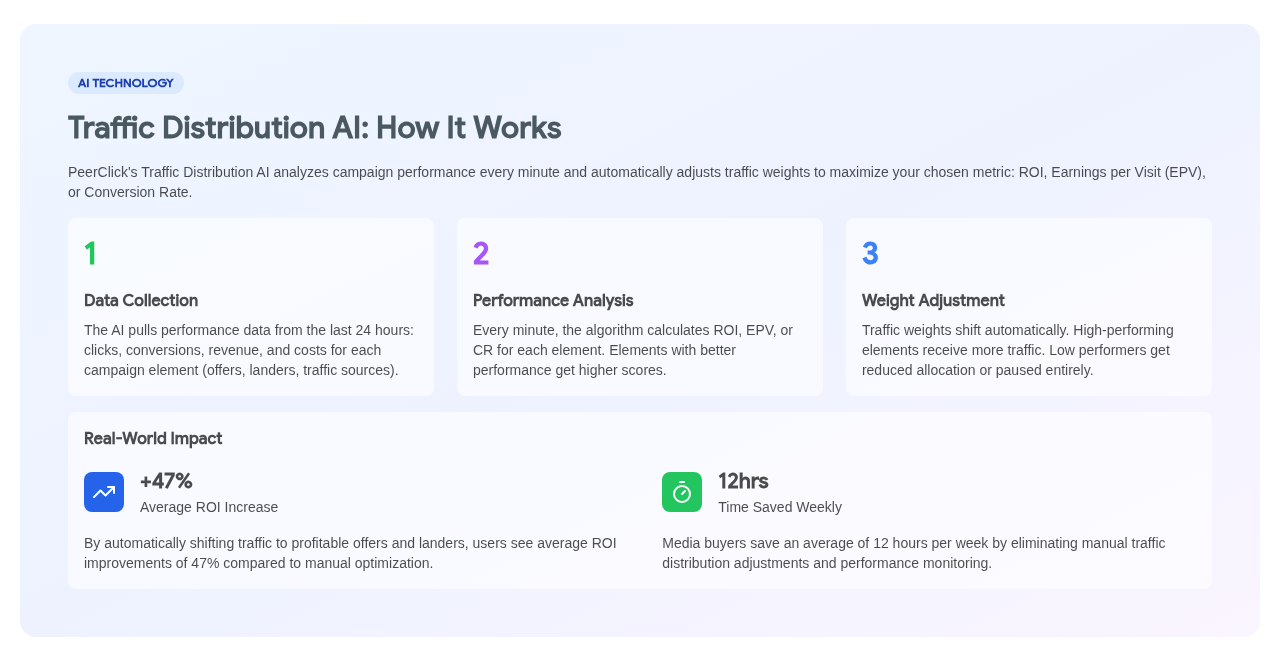
What sets its pitch apart from the rest of the lane is automation. The Traffic Distribution AI reads the last 24 hours of performance and, every minute, shifts traffic weight toward the offers, landers and paths with the best ROI, earnings per visit or conversion rate, and starves or pauses the losers. On top of that sit rule-based routing, alerts and an Autopilot layer that can pass conversions, pause and activate campaigns, change bids and update costs without you leaving the tracker. For a media buyer whose edge is speed of iteration, that is the reason to look.
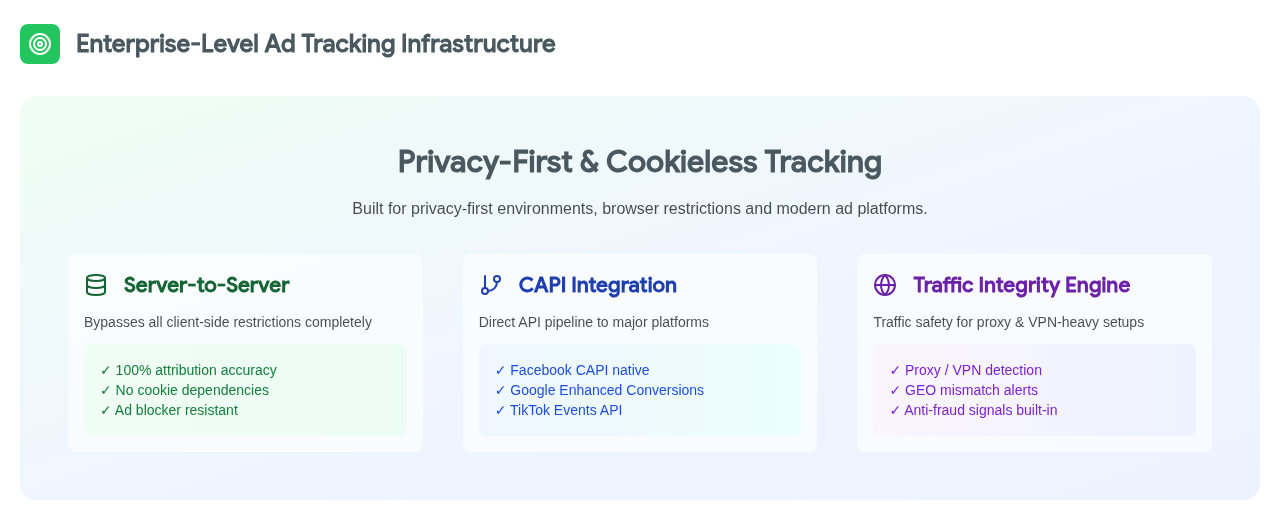
The tracking underneath is built for a post-cookie world. It runs server-to-server, so it does not depend on browser cookies that iOS and ad blockers strip, and it pushes conversions back to the platforms through native Facebook CAPI, Google Enhanced Conversions and TikTok Events API. That feedback loop is what a naive last-click setup cannot give you, and it is what lets the ad platforms optimize on real outcomes rather than a partial pixel read.
Is it real, or will you regret buying it?
If you are here because you have heard the name and want to know whether PeerClick is a real product or a fly-by-night, the answer is that it is real. It is an established cloud tracker with a working platform, 100-plus integrations, a documented help center and a live product roadmap. There is no scam story. The company publishes hard usage figures (it claims 170 billion-plus events tracked and 500 million clicks a day), and affiliate communities have discussed it for years. As a piece of software, it does what it says.
The honest caution is not legitimacy, it is thin outside proof and a strict commercial policy. The candid, operator-to-operator record you would normally cross-check against is scarce: PeerClick holds a single Trustpilot review at a 3.2 score, has no real G2 presence, and most of the glowing write-ups are on affiliate-network blogs with a referral interest. That does not make it bad, but it means you are buying with less independent signal than you would get on Voluum or RedTrack, so the trial matters more here, not less. And the billing terms are unforgiving, which is the part most likely to produce regret if you skip the fine print. More on both below.
Who it is for, and who it is not
PeerClick fits the operator it was built for: an affiliate or iGaming media buyer routing paid traffic to offers across native, pop, push and search, who wants a tracker that automates the optimization rather than just reporting on it. The FTD and RevShare tracking, the postback plumbing and the proxy and VPN detection are aimed squarely at that buyer, and the per-minute traffic distribution is genuinely useful when you are testing dozens of offer-and-lander combinations at once. Agencies running many client campaigns get workspaces and multi-user seats on the higher plans.
It is the wrong tool for several readers of this site. If you run one Shopify store on Meta and Google, a clean pixel plus each platform's Conversion API covers most of the value for far less money, and a store-first analytics tool fits better than an affiliate tracker. If you need very high click volume at the lowest cost per event, a self-hosted tracker such as Binom or Keitaro is cheaper to run once you can manage the server, and PeerClick offers self-hosting only on its custom Enterprise turnkey. And if you want a large, well-documented community and a deep bench of public setups to learn from, Voluum still leads the lane. If PeerClick is not the fit, the PeerClick alternatives worth weighing are ranked by who each one suits.
What buyers actually report
Read the outside record as signal and weigh where it comes from. The praise is consistent on two points: speed and ease. One affiliate wrote that the reports are fast and creating a campaign is very intuitive, and a round-up of tracking tools called PeerClick reliable and fairly priced. Buyers who lean on the automation tend to be the happiest, which lines up with where the product invests.
The criticism is worth knowing before you commit, and it clusters on support and the learning curve. Support experiences split hard. One member singled out a rep by name as super helpful and friendly, while another wrote that PeerClick has terrible support and that questions went unanswered, in the same breath as noting the tool just stopped working and that they make no refunds. A Trustpilot reviewer found it very technical and hard to use. Taken together, that is a tracker with real capability and uneven service, so budget setup time and test the support channel during your trial rather than after you have paid.
What it costs
PeerClick is self-serve and priced in four monthly tiers, billed on events, where every visit, click and conversion counts as one event. Starter is $99 a month for 20 campaigns, 1 million events and three months of data, but with no API integrations and only basic automation. Basic+ at $199 is the plan the vendor pushes as most popular: 100 campaigns, 3 million events, the AI traffic distribution and API access, though notably not the anti-fraud kit. The anti-fraud kit arrives on Advanced at $399 (400 campaigns, 10 million events, two extra users), and Exclusive at $849 adds VIP servers and 30 million events. Enterprise is quoted, and it is the only tier with on-premise deployment and source-code access. Annual billing takes 20% off.
Two cost details decide whether the sticker price is the real price. Events over your plan cap do not stop your traffic; they bill as overage at the end of the cycle, from $0.10 per 1,000 on Starter down to $0.03 on Exclusive, so a spike can push the bill past the tier. And the billing terms are strict: a card must be attached to use the panel, there are no refunds, and cancelling is a request processed within three business days rather than an instant toggle. A 10,000-event trial lets you kick the tires first, though the homepage and the help center disagree on whether a card is needed to start it, so check before you sign up. The full plan-by-plan breakdown is on the PeerClick pricing page, and for where it lands against the wider field, see the best ad tracking and attribution software roundup.
Changelog
- 27 September 2026: First published. Product facts and pricing read from PeerClick's own site and help center on 27 September 2026, and user sentiment weighed from affLIFT and Trustpilot.