Skip to content
Menu

Binom review (2026)

By Marcus Flynn, tracking and attribution editor. Updated 23 September 2026.

Quick answer

RedTrack is our top pick for most people. The default first tracker for most direct-response buyers: CAPI on every plan, ad-level spend sync, and an entry price a solo operator can carry.

  • RedTrack. Best for Multi-channel paid-social buyers. From $69/mo.
  • Voluum. Best for Affiliate and native/pop/push buyers. From $119/mo.
  • Hyros. Best for High-ticket info, webinar and call funnels.
  • Binom. Best for High-volume affiliate and media buyers comfortable running a server. From $149/mo.
  • FunnelFlux. Best for Media buyers tracking complex, multi-step funnels. From $99/mo.
  • Northbeam. Best for Scaled DTC ecommerce brands. From $1,500/mo.
  • Polar Analytics. Best for Shopify brands centralizing profit and marketing reporting.
  • Triple Whale. Best for Shopify DTC brands wanting attribution and AI insights in one app. Has a free tier.
  • AnyTrack. Best for marketers who want server-side tracking without a developer. Has a free tier.
  • ClickFlare. Best for buyers who want flat, predictable pricing at scale. From $69/mo.
  • ClickMagick. Best for solo advertisers and small teams buying paid traffic to offers they own. From $79/mo.
  • Cometly. Best for B2B SaaS teams tying ad spend to Stripe revenue and CRM pipeline.
  • CPV Lab Pro. Best for Paid-traffic affiliates and media buyers who want a tracker they own and host themselves. From $57/mo.
  • Keitaro. Best for High-volume affiliate and media buyers who want a proven self-hosted tracker with hands-on support. From €40/mo.
  • Rockerbox. Best for Mid-market and enterprise brands running cross-channel media, including offline, that need unified measurement.

Where Binom fits

The self-hosted tracker to pick if you run high click volume: one fixed license fee that does not climb with traffic, no matter how many clicks you push. The catch is that you, not a SaaS vendor, run the server it lives on.

It is at its best for high-volume affiliate and media buyers comfortable running a server. That is the lens the rest of this review uses: not whether it is the biggest tool on the market, but whether it is the right one for that operator.

What Binom is

It is a self-hosted performance-marketing tracker built for affiliates and paid-traffic buyers. You install it on your own server, route ad clicks through it, and read conversions back from affiliate networks through server-to-server postbacks. On top of that sit the things a buyer lives in: click routing with paths and rules, offer and lander rotation, reports up to five grouping levels deep, sub-ID tracking, and built-in cloaking. It is the same category as Voluum and RedTrack, but the delivery is the opposite: a licence you host, not a cloud account someone else runs.

The whole reason to choose Binom is its pricing model. You pay one license fee, and it does not rise with clicks. The vendor rates the v2 tracker at up to 260 million clicks a day and charges the same whether you push a thousand clicks or a billion. On event-priced SaaS trackers, a high-volume pop, push or native campaign can run a four-figure monthly bill; on Binom that same volume costs the license and your server. This is why affiliate buyers doing serious volume reach for it, and it is the one place it clearly beats the cloud trackers.

Self-hosting is the draw and the catch. Your click and conversion data stays on your own box with lifetime retention and no volume caps, which operators value for control and cost. The same design makes the server your job. Binom's own install docs require a bare VPS or dedicated server (Ubuntu, 4 GB RAM, two cores, 50 GB of disk, KVM), warn that stability is not guaranteed if you alter it, and expect you to handle domains, backups, monitoring and uptime. Support will install the tracker on a fresh server for free, but from there the infrastructure is yours to keep running. The real cost is total ownership, not the $149.

Who it is not for

It is a click and affiliate tracker, not a paid-social attribution suite. Its server-side conversion API depth is limited (the first version carries Facebook and Google integrations, the second is catching up), so a buyer whose spend is mostly Meta, TikTok and Google is better served by RedTrack's bundled CAPI or a platform-native stack. It is also overkill below meaningful volume: under a cheap or free cloud tracker's event cap, the fixed license and server upkeep rarely pay off. Binom earns its keep once event-based pricing starts to hurt and you have the server skills, or the budget to rent them.
Pros and cons

What works

  • One flat license that does not climb with clicks: the vendor rates v2 at up to 260 million clicks a day for the same price, which undercuts event-priced SaaS trackers at high volume.
  • Self-hosted, so your click and conversion data stays on your own server with lifetime retention and no volume or storage caps.
  • Fast redirects plus a full media-buying toolkit: paths, rules, rotations, five-level reports, sub-ID tracking and built-in cloaking, with support that installs it on a clean server for free.
  • A full-feature 14-day trial, extendable to 30 days on request, and a stated policy of refunding unused license time.

What to watch

  • You run the server. Binom's own docs require a clean dedicated or VPS box (Ubuntu, 4 GB RAM, 2 cores, 50 GB, KVM) and warn stability is not guaranteed if you alter it, so the real cost is server, domains, backups, monitoring and uptime on top of the license.
  • Server-side CAPI is limited: Facebook and Google integrations live in v1 and v2 is still catching up, so Meta and TikTok-heavy DTC buyers get more from RedTrack or a platform-native stack.
  • Bot, VPN and proxy filtering is a separate paid module, so the fraud protection some cloud rivals bundle is an add-on here.
  • Below meaningful volume it is overkill: under a cheap or free cloud tracker's event cap, the flat license plus server upkeep rarely beats a managed tool.
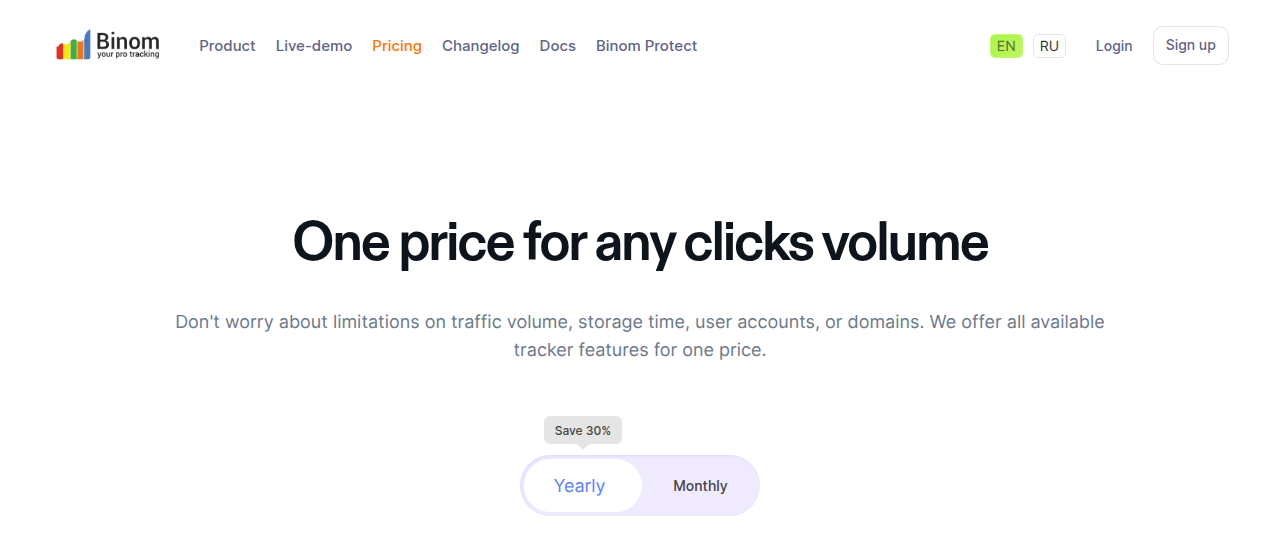
Binom's pricing page headline "One price for any clicks volume" over copy promising no limits on traffic, storage, accounts or domains, with a Yearly/Monthly billing toggle and a 30% yearly saving.
Flat pricing for any click volume. Binom's pricing page headline "One price for any clicks volume" over copy promising no limits on traffic, storage, accounts or domains, with a Yearly/Monthly billing toggle and a 30% yearly saving. Screenshot: binom.org,
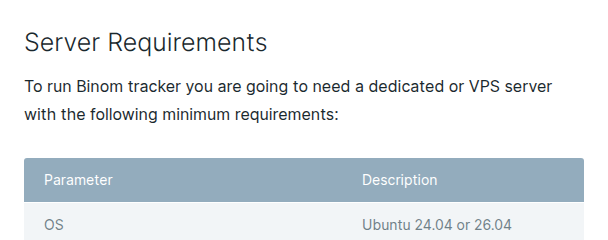
Binom's install documentation showing the minimum server requirements table, with the first row listing the required OS as Ubuntu 24.04 or 26.04 on a dedicated or VPS server.
Self-hosted server requirements. Binom's install documentation showing the minimum server requirements table, with the first row listing the required OS as Ubuntu 24.04 or 26.04 on a dedicated or VPS server. Screenshot: docs.binom.org,
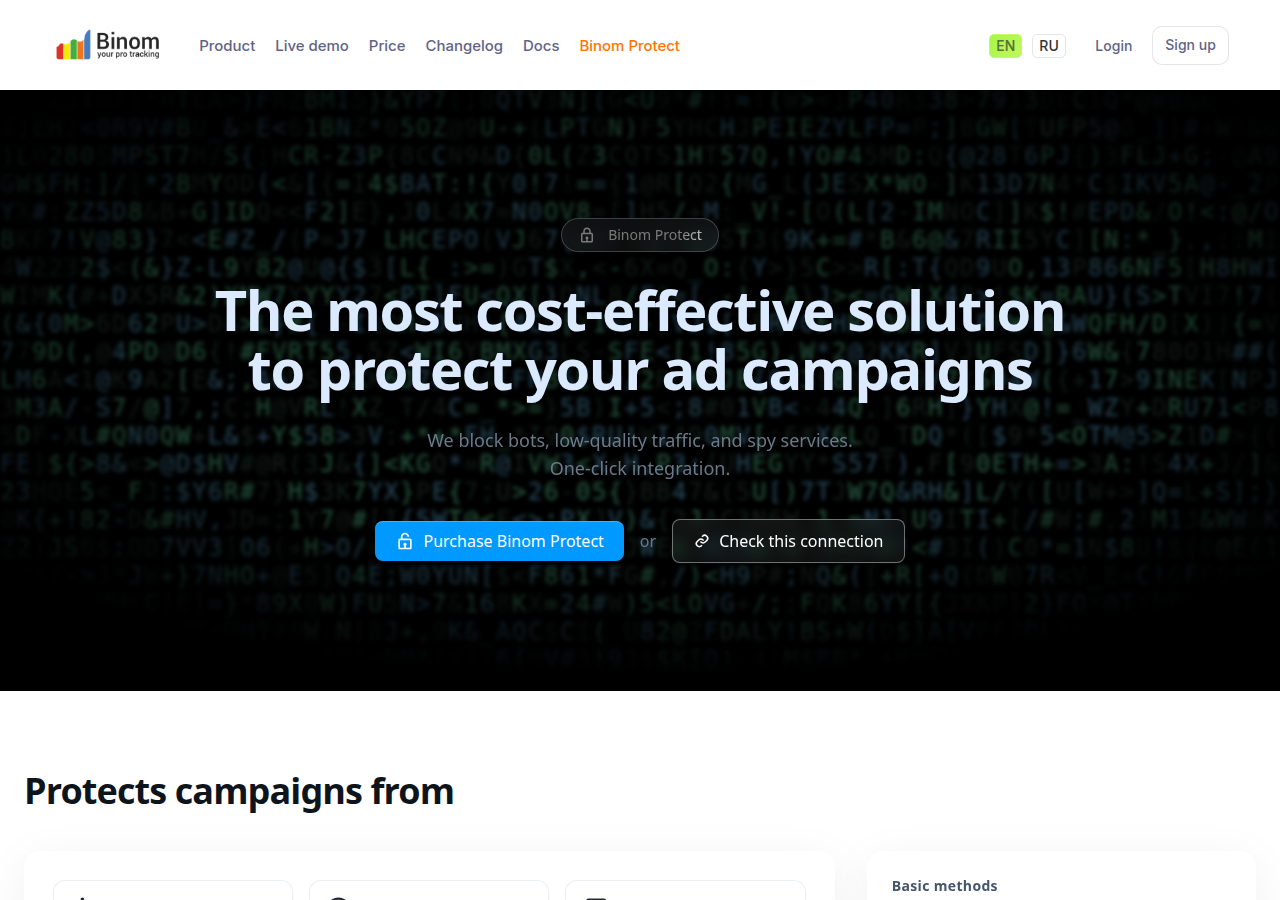
The Binom Protect landing page headed "The most cost-effective solution to protect your ad campaigns", stating it blocks bots, low-quality traffic and spy services with one-click integration.
Binom Protect bot and cloaking protection. The Binom Protect landing page headed "The most cost-effective solution to protect your ad campaigns", stating it blocks bots, low-quality traffic and spy services with one-click integration. Screenshot: protect.binom.org,

What users actually say about Binom

Research: unverified

Flat pricing is the whole pitch ↑ frequently praised

Binom charges one license fee no matter how much traffic runs through it, which is the reason high-volume pop, push, native and CPA buyers pick it over event-priced SaaS trackers. The vendor frames it as one price for any click volume, and long-term reports from affiliate forums (afflift.com, blackhatworld.com) repeat the same point: at real scale, a fixed tracker bill beats one that climbs with events.

“A universal tracking platform capable of solving almost any task for affiliates or media buyers”

Binom Blog: Binom - Performance marketing tracker for professionals

“No, you can buy a billion clicks and only pay the licensing fee for their processing. This fact, along with Binom's architecture capable of handling it, makes our tool ideal for professionals because tracking costs relatively to traffic costs tend to zero rather than increase with it.”

Binom Blog: Binom - Price

You own the data, and the server

Self-hosting is the draw and the catch. Your click and conversion data lives on your own box with lifetime retention, which operators value for control and cost. The same design makes the server your job: Binom's own docs require a clean dedicated or VPS server (Ubuntu, 4 GB RAM, 2 cores, 50 GB, KVM) and warn stability is not guaranteed if you alter it. Forum reviewers describe the real cost as total ownership: server, tracking domains, backups, monitoring and uptime, not just the license.

“Unlike сloud solutions, you alone own your data. There are no restrictions on volume or storage time.”

Binom Blog: Binom - Autonomy and Full Control

“To avoid conflicts with third-party software and to achieve optimal performance the installation must be done on a clean server that doesn't have any of your other working projects running.”

Binom Blog: Binom Documentation - Tracker installation

“We cannot guarantee stable tracker work in case you temper with the server. All the changes that are made on your server by someone other than Binom team are made at your own risk.”

Binom Blog: Binom Documentation - Server Requirements

Not a beginner or low volume tool

Binom assumes you already understand postbacks, tokens, tracking domains and basic server operations. Below meaningful volume the flat license plus server upkeep rarely beats a managed cloud tracker or a free-tier one, and operators on affiliate forums say the same: it earns its keep once event-based pricing on a SaaS tracker starts to hurt.

“A universal tracking platform capable of solving almost any task for affiliates or media buyers”

Binom Blog: Binom - Performance marketing tracker for professionals

“We cannot guarantee stable tracker work in case you temper with the server. All the changes that are made on your server by someone other than Binom team are made at your own risk.”

Binom Blog: Binom Documentation - Server Requirements

Generous trial and refunds ↑ frequently praised

A full-feature 14-day trial, extendable to 30 days on request, with no traffic or feature limits, plus a stated policy of refunding unused license time. That lowers the risk of testing it on a real VPS before committing.

“No, you can buy a billion clicks and only pay the licensing fee for their processing. This fact, along with Binom's architecture capable of handling it, makes our tool ideal for professionals because tracking costs relatively to traffic costs tend to zero rather than increase with it.”

Binom Blog: Binom - Price

“Yes, after registration, you'll have access to a 14-day trial with no limitations on traffic or functionality. You can also extend it to 30 days upon request to support or by using a coupon.”

Binom Blog: Binom - Frequently asked questions

What it costs

From $149 per month.

Binom v2 (self-hosted) is $149/mo, or $104/mo billed yearly. Binom Cloud (managed hosting) is $299/mo. Each additional license is $75 ($52 yearly). A 14-day trial with no traffic or feature limits, extendable to 30 days on request. Binom Protect (bot and cloaking protection) is a separate $69/mo yearly add-on.

Prices read from the vendor's own pricing page and current as of 23 September 2026. Check the vendor before you buy; plans change.

See the full Binom pricing breakdown

Frequently asked questions

How much does Binom cost?
From $149 per month. Binom v2 (self-hosted) is $149/mo, or $104/mo billed yearly. Binom Cloud (managed hosting) is $299/mo. Each additional license is $75 ($52 yearly). A 14-day trial with no traffic or feature limits, extendable to 30 days on request. Binom Protect (bot and cloaking protection) is a separate $69/mo yearly add-on.
Does Binom offer a free trial?
Yes, a 14-day free trial.

How we reviewed this

We do not run paid campaigns through Binom. We read its own documentation and pricing, verify every number against the vendor, and weigh the long-term reports of operators who run it at real spend. The full rubric is on the methodology page.

Related reading

Marcus Flynn

Written by

Marcus Flynn

Tracking and attribution editor

Marcus Flynn runs OfferStack's tracking and attribution desk. He has spent years close to direct-response paid media, and he reads the operator threads, vendor changelogs and pricing pages so you do not have to, then writes down what holds up once real budget runs through it. He owns the methodology and signs the site's money pages.

marcus@offerroas.com

Last checked 2026-09-23