Stack picker: the tracker, checkout and VSL player for your offer
Five questions about your spend, offer, traffic, processor and team, and the three tools that fit them, each linked to its review.
You already know your numbers: what you spend a month, what you sell, where the clicks come from, which processor holds your money and how many people touch the account. What the search results hand you is three separate lists, one of trackers, one of funnel builders, one of video hosts, each written as if the other two did not exist.
A direct-response stack has three layers that have to agree. The ad tracker measures the click. The checkout takes the card and holds the order. The VSL player matters only when a video does the selling. Answer the five questions below and you get one tool per layer, why it fits your mix, and the review, pricing page and head-to-head to read next.
This is a routing guide built from vendor pricing pages and long-term user reports, so treat the answer as a shortlist to test. To estimate the monthly bill, enter your clicks in the tracker cost table. For merchant-account risk, the chargeback ratio calculator shows where your MID sits.
Which stack fits your offer?
Pick an answer for each question and press the button. For a solo operator spending $5,000 to $25,000 a month on Meta to sell a VSL funnel through two NMI merchant accounts, the picker returns an event-metered cloud tracker, a funnel checkout with NMI routing and a sales-video player. The worked example below walks through that answer.
How the picker maps your answers
The tracker is the layer with the most ways to go wrong, because trackers work in three different ways. A route-through tracker owns the link in your ad and redirects the click to the offer, which is the only option when the landing page belongs to someone else. A tag-on-top tracker is a script on pages you own. Revenue attribution waits days or weeks for a sale and assigns it back to the ad, which is what webinar and call funnels need.
-
Third-party affiliate offer on paid social
Route-through: the ad points at the tracker's link, which redirects to the offer
-
Native, pop or push traffic
Route-through across many placements, self-hosted once spend passes $100k a month
-
Your own funnel, under $5k a month
Tag-on-top: a script on pages you own
-
Your own funnel on Meta, TikTok or Google, $5k and up
Event-metered cloud tracker
-
Webinar or call funnel
Revenue attribution over a long click-to-sale window
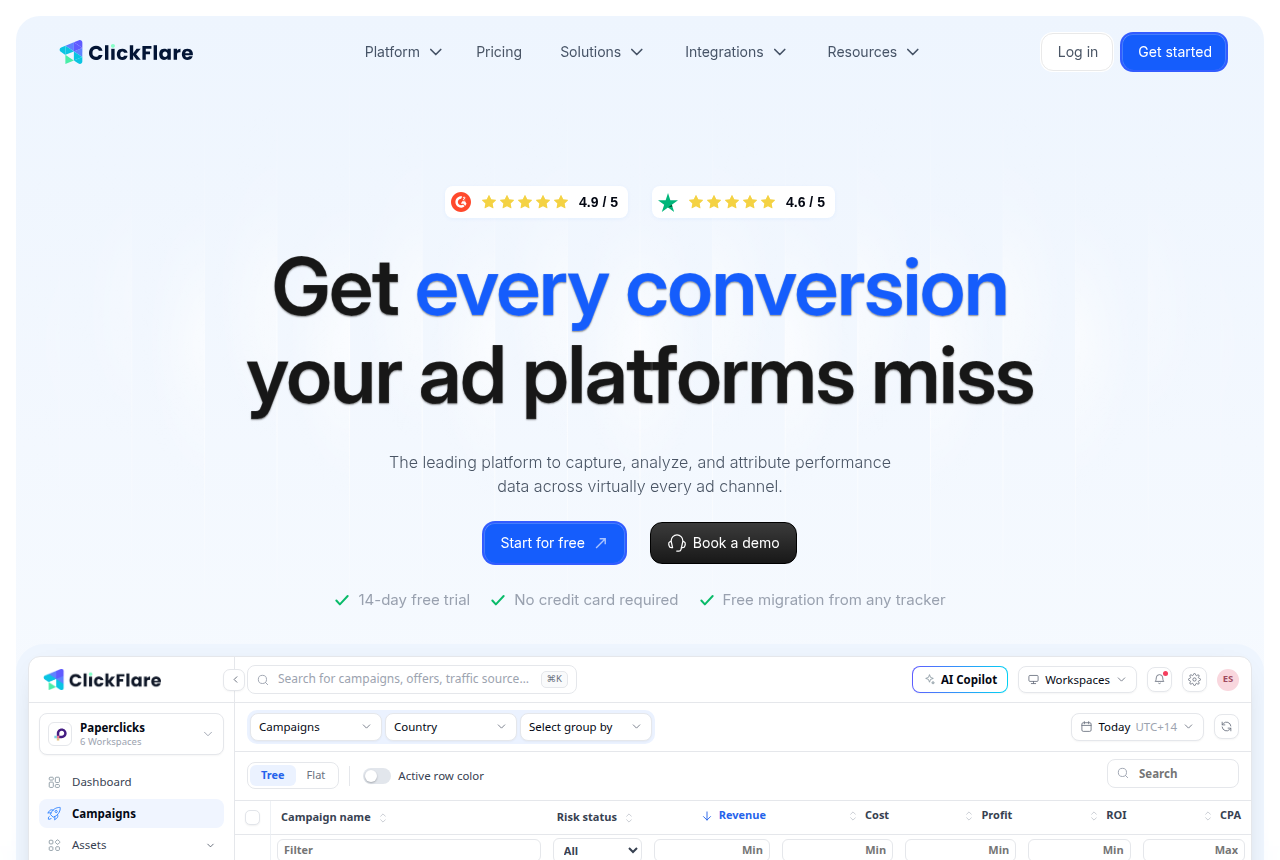
Spend and team size move you within a type. Trackers meter different units: RedTrack and ClickFlare count events (a visit, a click, a conversion and a postback each count), AnyTrack counts sessions, ClickMagick counts tracked visitors, and Binom is a flat licence on a server you run. ClickFlare's Cloud plan costs $69 a month, billed annually, for 1 million events. RedTrack's Solo plan costs $141 a month, billed annually, for 5 million. So a solo buyer or a small team under $25k a month gets ClickFlare first, and a larger team gets RedTrack.
Traffic source decides between social and native trackers. Voluum tracks native, display, pop, email, search, push, social and video in one platform, which is why every native or mixed answer leads there.
Webinar and call funnels go to Hyros, whose pricing is quoted after a demo. In one r/PPC thread on attribution tools, buyers name Wicked Reports and Rockerbox as the closest swaps for Hyros, server-side tools built for the same long window.
The processor answer picks the checkout. With one Stripe or PayPal account, any funnel checkout works, and the picker names ElasticFunnels with ClickFunnels beside it. Several MIDs split the answer by gateway. ElasticFunnels routes across MIDs only when every MID is on NMI: a weighted split of each first sale with rules by card brand, product and amount, and a daily cap per MID. Its Stripe, PayPal, Klarna and Authorize.net connections are one account each. When the MIDs sit on different gateways, the picker moves to Checkout Champ or Konnektive, whose billing engines connect to hundreds of processors. Checkout Champ lists over 270 gateways and charges $300 a month plus 1% of gross on its Growth plan. A network seller needs no checkout at all, a WooCommerce store gets CartFlows, and a Shopify store keeps Shopify's own checkout.
The offer answer decides the player. Only a VSL funnel gets one, and the picker names TrackPlay, which posts the cart-verified sale back to the ad platform from the play that earned it. A sales page, an affiliate offer or a call funnel gets an explanation of why a page-load event in the tracker is enough.
Each pairing comes from what the vendors publish and what long-term users report. Our method page explains how we evaluate tools.
Worked example: a $15,000 Meta VSL funnel
Say you run a single-product VSL funnel alone, spend $15,000 a month on Meta, and hold two merchant accounts on NMI. The picker returns ClickFlare, ElasticFunnels and TrackPlay.
Tracker: ClickFlare. The Cloud plan, $69 a month on yearly billing, includes 1 million events. Every page hop, conversion and postback counts as an event, so a funnel with a lander, a checkout and two upsells uses several per buyer. When a second offer or a media buyer joins, step up to RedTrack, whose entry plan holds 5 million events. Read RedTrack vs ClickFlare before you switch.
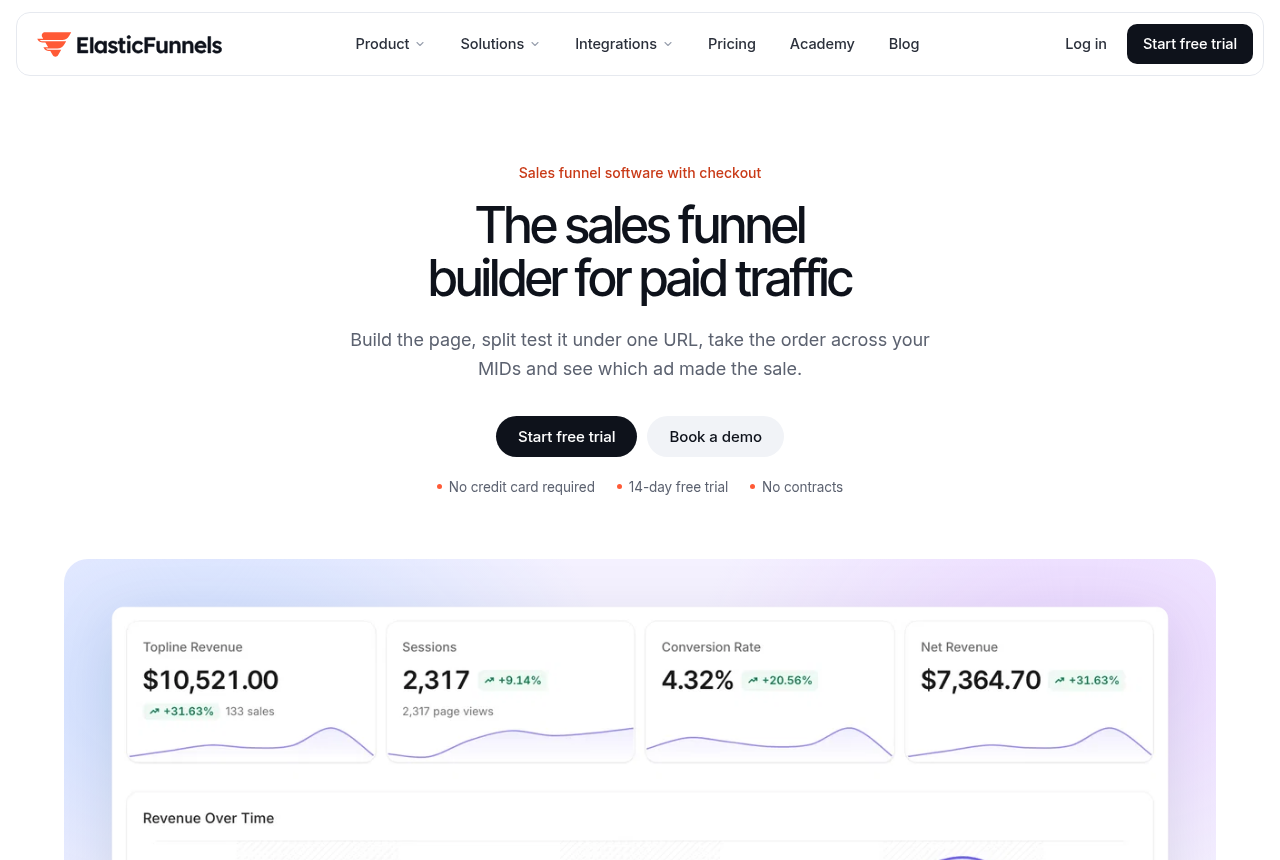
Checkout: ElasticFunnels. It builds the pages, split-tests them under one URL, and splits each first sale across the two NMI MIDs by the weights you set, with upsells and rebills kept on the MID that took the sale. The Starter plan is $97 a month for 50,000 page views. Past that limit you pay $1.20 per extra 1,000 page views, and you are never forced onto the Growth plan. It also takes 0.5% of revenue that runs through its own gateways, NMI included. Its weak spot is age. It has been in development since 2023, it is younger than the platforms it competes with, and few independent reviews have tested its claims. Its 14-day trial needs no card, which is enough time to route test orders through both MIDs before real spend moves. Our ElasticFunnels review covers the rest.
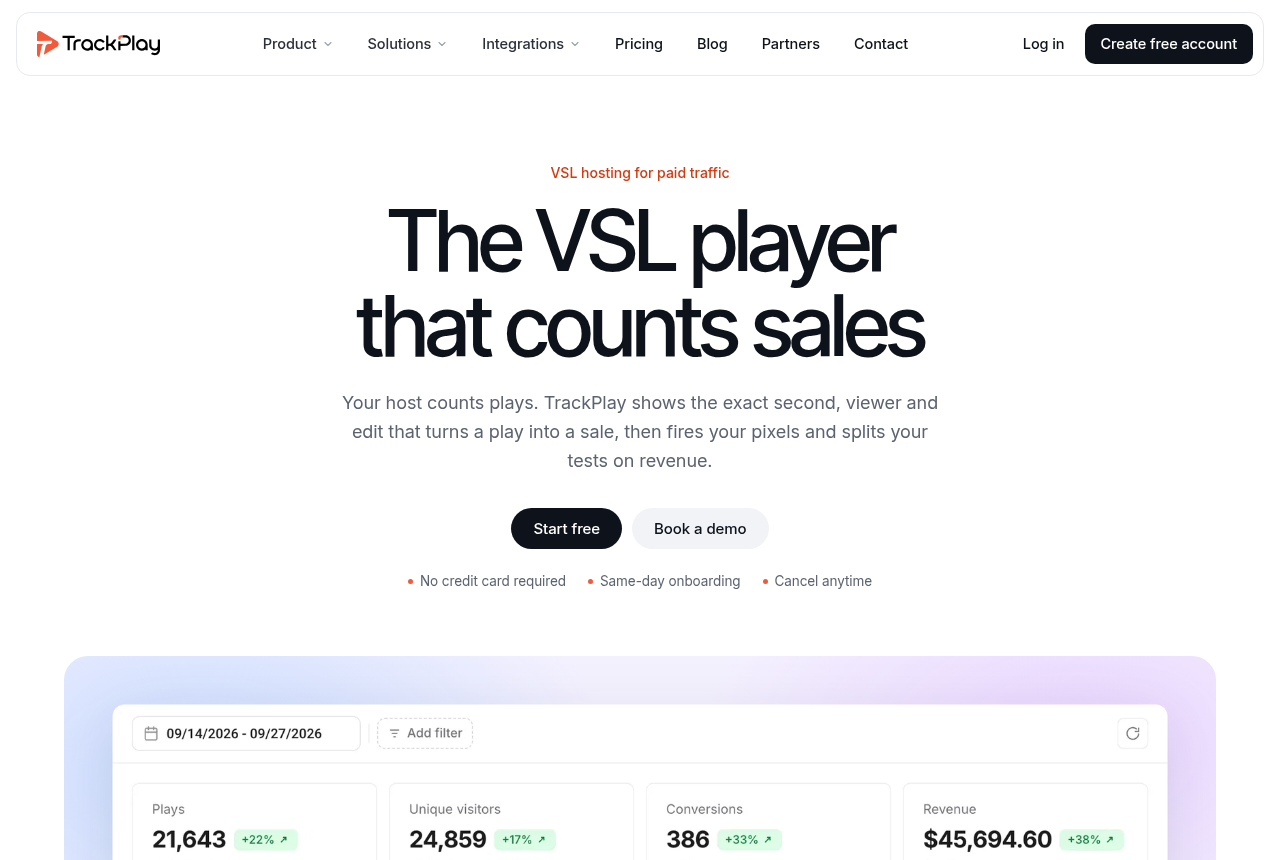
Player: TrackPlay. Basic starts at $29 for 5,000 plays, and a play counts once per viewer session only when someone actually played the video, so muted autoplay nobody unmutes is free. Retention is split into buyers and non-buyers, and the sale goes back to Meta server-side on the play that earned it. It is narrow by design: a player for sales video with none of the channels or webinar tools of a Wistia, which matters only if your video also has a content job. Signup currently asks for an invitation code. The TrackPlay review has the detail.
Why the picker skips Hyros here. Hyros is built for the long gap between a click and a sale on calls and webinars, and its price comes after a demo. A VSL that sells on the first visit closes inside the window any cloud tracker already watches. The Hyros review covers who it pays off for.
Why it skips Checkout Champ for now. Suppose the funnel grosses $30,000 a month, a 2.0 ROAS on the $15,000. Checkout Champ Growth would cost $300 plus 1% of that, so $600. ElasticFunnels Starter plus its 0.5% fee comes to $247 before any page-view overage. What Checkout Champ adds is gateway reach, and two NMI accounts do not need it. The Checkout Champ review and the Konnektive review show where that reach starts to pay.
Our take: choose the checkout first. We would pick it before the other two, because once rebills sit on a MID it is the hardest layer to move. Changing trackers means relinking your ads, and changing players means swapping one embed. Judge a checkout by what it does with your second merchant account, and a tracker by whether the unit it bills on matches the way you buy traffic.
If you also start buying native, the tracker answer changes. Read RedTrack vs Voluum first, and Voluum vs Hyros if a call funnel joins the mix.
What the picker leaves to you
Three layers are where paid-traffic stacks most often break, and they are all this page covers. Your email platform, your call center, a chargeback-alert vendor and the merchant account itself are separate decisions with their own trade-offs.
- The exact bill. Each tracker meters its own unit, so the roundup's cost table asks for your monthly volume and prices every tool on the same input.
- Your MID's health. Routing spreads sales across accounts, and each account is still judged on its own dispute ratio by its acquirer.
- A ranking. Every answer names the fit for one combination of inputs. The ordered list of trackers lives on the roundup.
For the ranked list and the bill at your volume, see the best ad tracking software roundup. For dispute ratios, use the chargeback calculator linked above.
Frequently asked questions
Do I need a separate tracker if my funnel runs on ElasticFunnels?
When is a dedicated VSL player worth paying for?
What changes if I only sell through ClickBank?
Can one tool cover all three layers?
Why does my monthly spend change the tracker?
Changelog
- 14 October 2026: First published, with the five-question picker, the tracker-type table and a worked example for a VSL funnel on Meta.
What we read
Other sources
5 discussions and reviews read for this page. Quotes are excerpts; open a link to read the original in context.
- [ef-routing] ElasticFunnels pricing
- [tp-plans] TrackPlay pricing
- [cc-gateways] Checkout Champ pricing
- [voluum-role] Voluum home page
- [reddit-attr] r/PPC thread on attribution tools
Related reading
Written by
OfferROAS Editorial
Editorial desk
OfferROAS Editorial is the desk behind the site's reviews and rankings. We read long-term operator reports, vendor documentation and pricing pages, verify every price against the source, and update the money pages on a fixed schedule. Where a call needs first-hand testing we say so plainly.
Last checked 2026-10-14