A first-party ad tracker built for the solo advertiser and small team who buy paid traffic to offers they own. You get accurate click-level attribution, server-side conversions fed back to Meta, Google and TikTok, and a flat price that is not tied to your revenue. It has tracked traffic since 2014 and its support is the thing buyers praise most. It is real and it works. You will regret it only if you expected a magic fix, needed a route-through campaign tracker for rotating offers, or only wanted a cheap link counter.
It is at its best for solo advertisers and small teams buying paid traffic to offers they own. That is the lens the rest of this review uses: not whether it is the biggest tool on the market, but whether it is the right one for that operator.
What ClickMagick is
ClickMagick is a first-party ad tracking and attribution platform. You put a small script on your pages and route your links through it, and it stamps every click, follows the visitor across devices, records the conversion, and shows you which ad, keyword, placement or email produced the sale. The part that earns its keep in 2026 is where it captures that data: on your own first-party domain, so the conversions an iOS restriction or an ad blocker would drop still get recorded, deduplicated, and posted back to the ad platform's Conversions API. Cleaner signal in means the platform's own optimization stops guessing.
It started life in 2014 as a link tracker and has grown into what the vendor now calls TrueTracking. The company says over 122,000 accounts have been created since then. That history is the honest answer to the first question a nervous buyer asks: yes, it is a real, established product, not a vibe-coded app that appeared last quarter.
Who it is for, and who should skip it
ClickMagick fits the operator sending paid traffic to offers they own or promote: Meta, Google, TikTok, native, YouTube, solo ads or email, into a funnel, a bridge page or an affiliate offer. If your ad platform and GA4 disagree about how many sales you got, this is the layer that reconciles them. One media buyer on r/PPC keeps it specifically to "see where conversions really come from" and to filter junk traffic out of the numbers.
Skip it if you are a media buyer who routes many offers through a redirect and needs the tracker itself to rotate offers, split traffic across landers by rule, and distribute clicks. That is Voluum, RedTrack and Binom territory, and ClickMagick does not do it. Skip it too if all you want is to cloak and count links on a blog, because the entry price is steep for that alone.
The "too good to be true" question
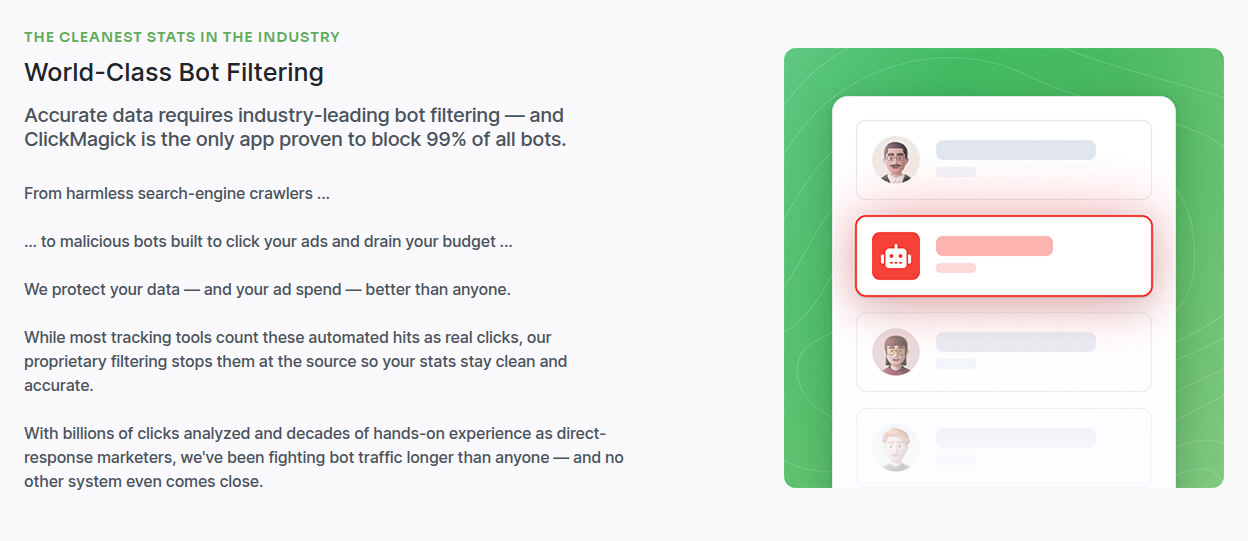
Experienced PPC people are right to be skeptical of the homepage's guarantees, and one thread on r/PPC said exactly that. Here is the honest version. ClickMagick is a tracking layer, not a patch over a broken setup. It only reports numbers you can trust once you pass click IDs cleanly and configure your postbacks properly, and the vendor's own knowledge base says pixel-and-link tracking is fading and its Campaigns plus server-to-server postbacks are the accurate path. Set it up carelessly and its numbers will not match your backend either. Set it up correctly and it does the job it claims. Use the 14-day trial to fire real conversions and check that ClickMagick, your network and the ad platform agree before you move a whole operation across.