Head-to-head
Voluum vs PeerClick
Both are cloud ad trackers that route your paid traffic, rebuild conversions server-side and feed them back to the ad platforms. One is the decade-old default with the deepest routing and the largest community; the other is cheaper and automates the optimization for you minute by minute. Which one comes down to what you are really buying.
By Marcus Flynn, tracking and attribution editor. Updated 3 October 2026.
Pick Voluum if you route paid traffic to offers and want the proven tracker with the deepest routing and the largest community to troubleshoot it, with automation available as a paid add-on; pick PeerClick if you want minute-by-minute AI traffic distribution and native CAPI built in at a lower starting price, and you are willing to run the trial hard against thin outside proof.
Quick answer
Voluum is our top pick for most people. Our pick for the operator choosing between these two. Voluum is the veteran cloud tracker built for the media buyer: it routes every click by zone, publisher, GEO, device and sub-ID, rebuilds the conversion signal server-side where a browser pixel fails, and flags junk traffic with its Anti-Fraud Kit. The published plan starts at around $119 a month billed annually, you start it yourself, and the user community is the largest in the category when a campaign breaks. The honest costs: fuller server-side CAPI depth sits on the pricier upper tiers, and hands-off automation means adding the Automizer layer, billed at $375 a month on top, so price the stack you would actually run.
- Voluum. Best for Media buyers who want the proven tracker with the deepest routing and the biggest community. From $119/mo.
- PeerClick. Best for Affiliate and iGaming buyers who want automation-heavy tracking at a lower price. Has a free tier.
Side by side
| Tool | Automation | Native CAPI | Outside proof | Entry price | From |
|---|---|---|---|---|---|
| 1. Voluum | Paid add-on | Upper tiers | Largest community | From $119/mo | $119/mo |
| 2. PeerClick | Built in | Standard | Thin so far | $99/mo + free | Free tier |
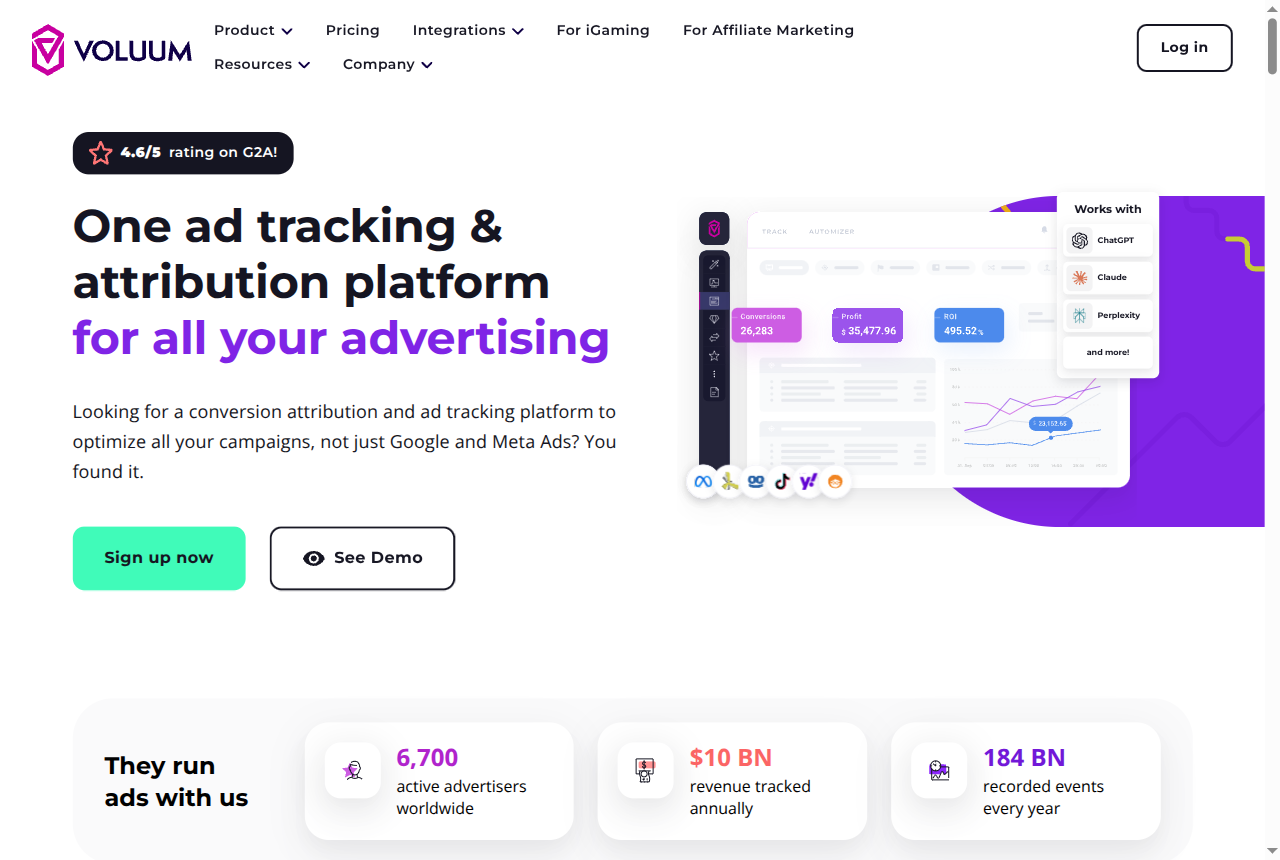
Voluum: pros and cons
What works
- Deep click-routing and traffic-distribution rules built for zone, publisher, GEO, device and sub-ID optimization.
- Cookieless tracking and S2S postbacks that hold up on redirect-style affiliate flows where browser pixels fail.
- The Anti-Fraud Kit flags suspicious traffic automatically, which matters most on native and pop inventory.
- Cloud-hosted with automatic migration from an old tracker, so there is no server to run, and the largest, most active user community in the category when a campaign breaks.
What to watch
- The automation layer, Automizer, is billed separately at $375/mo on top of the plan, so real automation costs stack fast.
- Fuller server-side CAPI depth and higher event ceilings sit on the pricier upper tiers ($539 to $1,599/mo).
- No free plan to prove it out first, so you commit to a paid tier from the start.
- It is built around click routing and offer/lander optimization more than ecommerce customer-journey attribution.
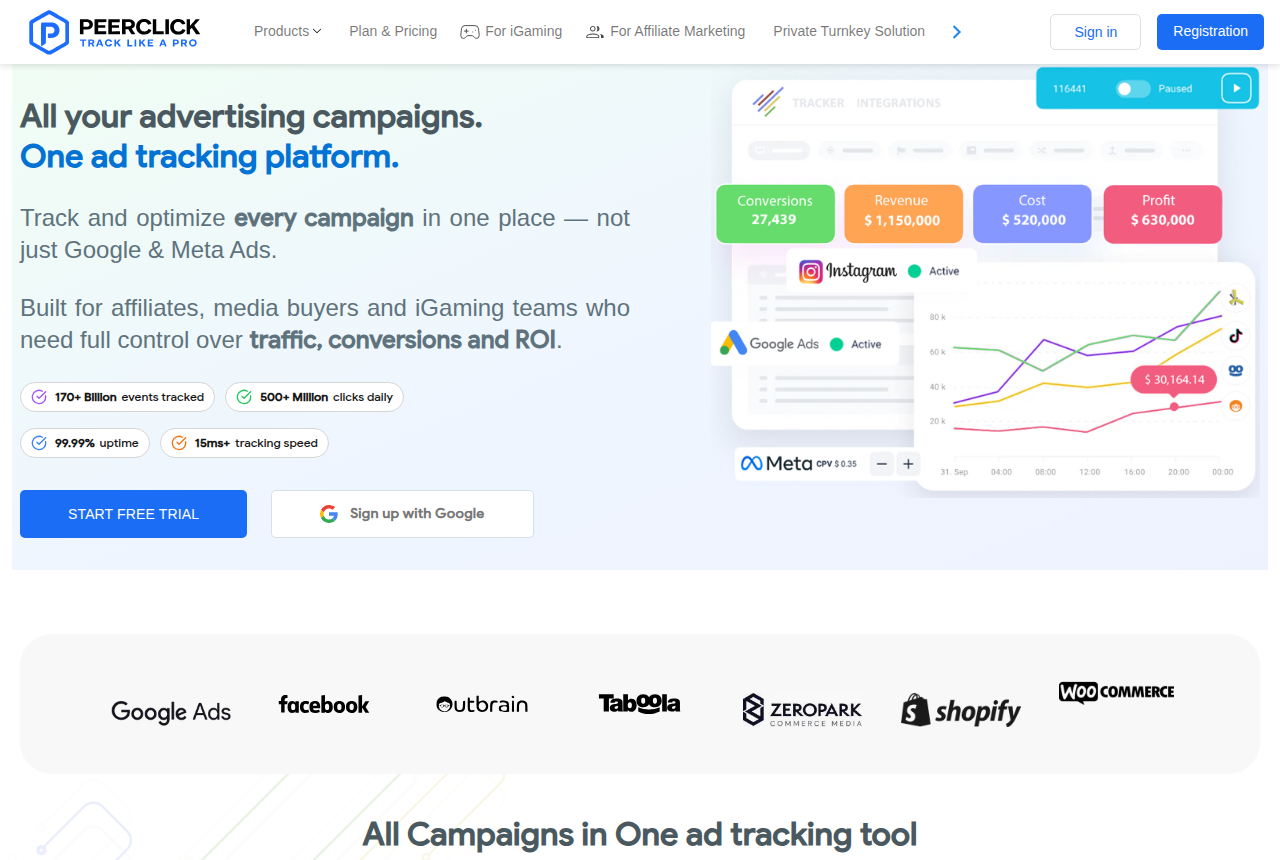
PeerClick: pros and cons
What works
- Traffic Distribution AI re-weights offers, landers and paths every minute toward your chosen metric (ROI, earnings per visit, or conversion rate). That is real automation, not another dashboard.
- Cookieless server-to-server tracking with native CAPI to Facebook, Google Enhanced Conversions and TikTok, so attribution holds up under iOS restrictions and ad blockers.
- Built for redirect-style affiliate and iGaming flows: incoming and outgoing postbacks, FTD and RevShare tracking, offer routing, A/B testing and 100-plus integrations.
- Operators call the reports fast and campaign setup intuitive, and rate the tracker reliable and fairly priced for what it does.
What to watch
- Outside proof is thin. One Trustpilot review at 3.2, no G2 footprint, and most write-ups are affiliate-network blog posts rather than candid operator threads. That is a reason to run the trial hard, not proof it is bad.
- Support reads as a coin flip. One buyer praised a named rep as helpful and friendly; another called support terrible and said the tracker just stopped working. There is no consistent middle to plan around.
- Billing is strict. No refunds, a card required to access the panel, and cancellation is a request a technician processes within three business days, not a button you press.
- The anti-fraud kit is gated to the $399 Advanced plan and above. The $199 most-popular tier does not include it, and events over the plan cap bill as per-1,000 overage on top.
The real differences
Two trackers, one job, two different bets
If you are down to exactly these two, start with how much they share, because it is most of the pitch. Both are cloud ad trackers you route paid traffic through. Both stamp every click, send the visitor to the right offer and lander, record the conversion your network or pixel posts back, and report profit by campaign, source, country and sub-ID. Both rebuild the conversion signal server-side with cookieless tracking and postbacks for the redirect-style flows a browser pixel cannot follow. Both carry native conversion APIs to Meta, Google and TikTok and an anti-fraud layer, and both are built for the same operator: an affiliate, media buyer or iGaming team buying native, pop, push or search. The difference is not what they do. It is what you are really buying.
Voluum is the veteran. It has been one of the defaults in affiliate and native buying for over a decade, and the thing you buy with it is depth and a community large enough that a broken campaign at 2am has a thread already written about it. PeerClick is the newer, cheaper challenger, and the thing you buy with it is automation: a distribution engine that re-weights your traffic every minute, with native CAPI included as standard rather than reserved for an upper tier. That maps onto a plain question about how you want to spend money and where you want to place your trust.
What Voluum is built to do
Voluum sits in the click path and routes every visit to the offer and lander that fit, by zone, publisher, GEO, device and sub-ID. On redirect-style affiliate traffic the parts that matter are the ones a browser pixel cannot do: cookieless tracking and server-to-server postbacks that still fire when a visitor never accepts a cookie, and an Anti-Fraud Kit that flags suspicious clicks automatically on the native and pop inventory where junk traffic hides. Its documentation keeps the two conversion paths separate and spelled out, postbacks for third-party network offers and pixels for your own, and records a conversion for a visit up to 180 days after the click. On its upper tiers it carries fuller server-side CAPI to push conversions back to Meta, Google and TikTok. It is cloud-hosted with automatic migration from an old tracker, so there is no server to run, and when something breaks the user community is the largest and most active in the category.
What PeerClick is built to do
PeerClick does the same in-path job, then tries to make the optimization decisions for you. Its Traffic Distribution AI re-weights offers, landers and paths every minute toward the metric you choose, whether that is ROI, earnings per visit or conversion rate, so budget moves to the winners without you watching a dashboard. Under it sits the plumbing a 2026 media buyer needs: cookieless server-to-server tracking with native CAPI to Facebook, Google Enhanced Conversions and TikTok as standard, incoming and outgoing postbacks, FTD and RevShare tracking for iGaming, offer routing, A/B testing and more than 100 integrations. Operators who use it tend to praise the speed: one afflift member wrote that "the reports are fast and creating a campaign is very intuitive." It starts at $99 a month events-based and keeps a free plan, so you can prove it out before you attach a card.
The line that separates them
Strip away the shared feature list and two real differences are left. The first is automation. PeerClick includes per-minute AI distribution in the product; the equivalent on the other side is Automizer, a layer that shifts budget and pauses campaigns by rules, billed as a separate add-on at $375 a month on top of the plan. If hands-off optimization is the reason you are shopping, PeerClick gives it to you cheaper. The second is proof. Voluum has a decade of operators, walkthroughs and threads behind it, so when you get stuck you are rarely the first. PeerClick's independent footprint is thin: one Trustpilot review at 3.2, no G2 presence, and most write-ups are affiliate-network blog posts rather than candid operator threads. Its support reads as a coin flip too, praised by one buyer and called "terrible" by another who said questions went unanswered. That is a reason to run the free plan and the trial hard, not proof the tracker is bad, but it is a real difference from what you get with Voluum.
There is a cost on the native-CAPI side worth naming precisely. PeerClick advertises native CAPI as standard across the product; Voluum keeps its fuller server-side CAPI depth on the pricier upper tiers. So a buyer who wants deep, native conversion APIs without a $539-plus plan reaches them sooner on PeerClick. What Voluum gives back for that price is depth of routing and the community to operate it.
Where the price actually bites
Both price on volume, and both have a trap in the sticker. PeerClick counts events, with per-1,000-event overage over your plan cap, and it gates two things you may assume are included: the Traffic Distribution AI needs the $199 tier, and the anti-fraud kit needs the $399 Advanced tier. Its billing is strict as well, a card required to see the panel, no refunds, and cancellation handled as a request a technician processes within three business days. Voluum's published Profit plan lands around $119 a month billed annually and climbs to Enterprise at $1,599, with the Automizer add-on costing $375 on top. So the honest comparison is not $99 against $119. It is the specific stack you would run: with AI distribution and anti-fraud, PeerClick is its $399 tier; with real automation, Voluum is its plan plus the add-on. Model both on your actual event volume before you commit.
Where your situation settles it
For most operators reading OfferROAS, Voluum is the pick, and it sits nine places above PeerClick on our roundup for the same reason. It does the job a paid-traffic operator has every day, routing clicks by every dimension that matters and holding attribution together server-side, and it does it as a proven system with the largest community in the category to lean on when a campaign breaks. You are not trusting one vendor's pages; you are joining a decade of operators who already found the edges. PeerClick is the better buy for a narrower, specific case: you want minute-by-minute AI distribution and native CAPI built in rather than bolted on, you are starting cheaper or on the free plan, and you are willing to run the trial hard because the outside proof is not there yet to do it for you. Rank and fit agree. Voluum for the operator who wants the proven system, PeerClick for the one who wants the automation baked in at a lower entry price.
When neither is the shape of your problem
Both of these tools track and route clicks. Neither builds the funnel the clicks land on: the pages, the checkout, the order bumps, the upsells, the rebills. And if the offer runs on a video sales letter, neither can see what happens inside the video. If that is the gap, two tools are worth knowing.
ElasticFunnels is a funnel platform for teams running paid traffic, and it collapses the stack these trackers sit beside: it builds the pages, hosts the checkout with order bumps, one-click upsells, subscriptions and multi-MID routing, and keeps the click, the order, the rebill and the refund on one data layer with a CRM and attribution. The feature most relevant here is same-URL split testing, because both Voluum and PeerClick split-test traffic in their own way: ElasticFunnels rotates variants server-side under one campaign link, so Meta, Google and TikTok keep their learning and a test never resets the ad by sending it to a new address. It starts at $97 a month with a 14-day trial that takes no card, every feature is on every plan, and plans differ by traffic. The honest caveat is that it is newer than the trackers here and there is very little independent third-party review coverage yet, which is what you would expect of a platform this recent, so until you run real volume through it you are weighing the vendor's own account more than a stack of outside reports. What it does not replace is an in-path click router for pure offer traffic; where it earns its place is building and hosting the funnel these two only measure.
TrackPlay matters when the offer runs on a video sales letter, which a click tracker cannot see inside. It is a VSL player and analytics platform that ties every second watched to who actually bought, draws retention per second split into buyers and non-buyers, and posts the cart-verified sale back to Meta, TikTok and GA4 on the play that earned it. It has a no-card free tier of 1,000 plays a month and paid plans from $29 a month. It is narrow by design, though: built for paid-traffic VSL conversion, it is not a general video host or a B2B content library, and it has none of the channels or webinar tooling of a Wistia, so it is the wrong tool if the video's job is content marketing rather than a direct-response sale.
What each one costs
Voluum is a cloud subscription priced on events and tiers, where an event is a tracked visit or conversion. The published Profit plan lands around $119 a month billed annually, and the ladder runs up through Scale and Agency to Enterprise at $1,599 a month, adding event ceilings, seats and the fuller server-side CAPI depth as you climb. The Automizer automation layer, which shifts budget and pauses campaigns by rules, is a separate add-on billed at $375 a month, so a buyer who wants hands-off optimization pays well above the plan line. There is no free plan, but everything is published, so you forecast the cost by your event volume and start it yourself.
PeerClick starts lower, from $99 a month events-based, and keeps a free plan so you can prove it out first. Two things buyers often assume are included are gated: the Traffic Distribution AI needs the $199 tier and the anti-fraud kit the $399 Advanced tier, and events over your plan cap bill as per-1,000 overage on top. Billing is strict, a card is required to access the panel, there are no refunds, and cancellation is a request a technician processes within three business days rather than a button you press.
So the entry prices, $99 against $119, are not the comparison that matters. Price the stack you would actually run. With AI distribution and anti-fraud, PeerClick is its $399 tier; with real automation, Voluum is its plan plus the Automizer add-on. Both meter on volume, so model each on your real event numbers before you attach a card.
Prices and buying terms checked on each vendor's own pages, current as of 27 September 2026.
Our pick
Voluum
Our pick for the operator choosing between these two. Voluum is the veteran cloud tracker built for the media buyer: it routes every click by zone, publisher, GEO, device and sub-ID, rebuilds the conversion signal server-side where a browser pixel fails, and flags junk traffic with its Anti-Fraud Kit. The published plan starts at around $119 a month billed annually, you start it yourself, and the user community is the largest in the category when a campaign breaks. The honest costs: fuller server-side CAPI depth sits on the pricier upper tiers, and hands-off automation means adding the Automizer layer, billed at $375 a month on top, so price the stack you would actually run.
Frequently asked questions
Is Voluum or PeerClick cheaper?
Do both send conversions back to the ad platforms?
Which one automates optimization for me?
Which should a paid-traffic operator pick?
Sources
From Voluum and PeerClick
- https://voluum.com
- https://voluum.com/pricing/
- https://doc.voluum.com/article/track-conversions
- https://peerclick.com/
- https://help-center.peerclick.com/en/articles/5973039-subscription-payments
Other sources
3 discussions and reviews read for this page. Quotes are excerpts; open a link to read the original in context.
- [pc-afflift-speed] PeerClick ratings on afflift
- [pc-afflift-support] PeerClick support experience on afflift
- [pc-trustpilot] PeerClick review on Trustpilot
How we compared these
We do not run paid campaigns through either tool. We read each vendor's own documentation and pricing, verify every number against the source, and weigh the long-term reports of operators who run them at real spend. The full rubric is on the methodology page.