Head-to-head
PeerClick vs AdsBridge
PeerClick and AdsBridge are both cloud ad trackers you route paid traffic through, and both cost less than the big names, so on paper they look like the same buy. They are not. PeerClick puts its effort into automation and signal: a distribution engine that re-weights your traffic every minute and native conversion APIs that hold up under iOS. AdsBridge puts its effort into the page: a built-in landing page builder that runs alongside the tracker at the lowest starting price of any real tracker. Pick PeerClick if you route real paid-traffic volume and want per-minute AI traffic distribution with native CAPI that holds attribution together under iOS; pick AdsBridge if you want the cheapest way to run a tracker and hosted landing pages in one tool, from $29 a month.
By Marcus Flynn, tracking and attribution editor. Updated 1 October 2026.
Quick answer
PeerClick is our top pick for most people. A capable cloud ad tracker for affiliates, media buyers and iGaming teams. Minute-by-minute AI traffic distribution, cookieless server-side tracking, native CAPI to Meta, Google and TikTok, and an anti-fraud kit on the higher plans. The gaps are outside proof and support that reads as a coin flip, plus a strict no-refund billing policy you should know before you attach a card.
- PeerClick. Best for Affiliate and iGaming media buyers who want automation-heavy click tracking. Has a free tier.
- AdsBridge. Best for Budget affiliates who want tracking and landing pages in one tool. From $29/mo.
Side by side
| Tool | Core job | Built for | Optimizes | Entry price | From |
|---|---|---|---|---|---|
| 1. PeerClick | AI click tracking | Volume buyers | AI, per minute | $99/mo, free plan | Free tier |
| 2. AdsBridge | Tracker + landers | Budget affiliates | Rules and tests | $29/mo, 14-day trial | $29/mo |
PeerClick: pros and cons
What works
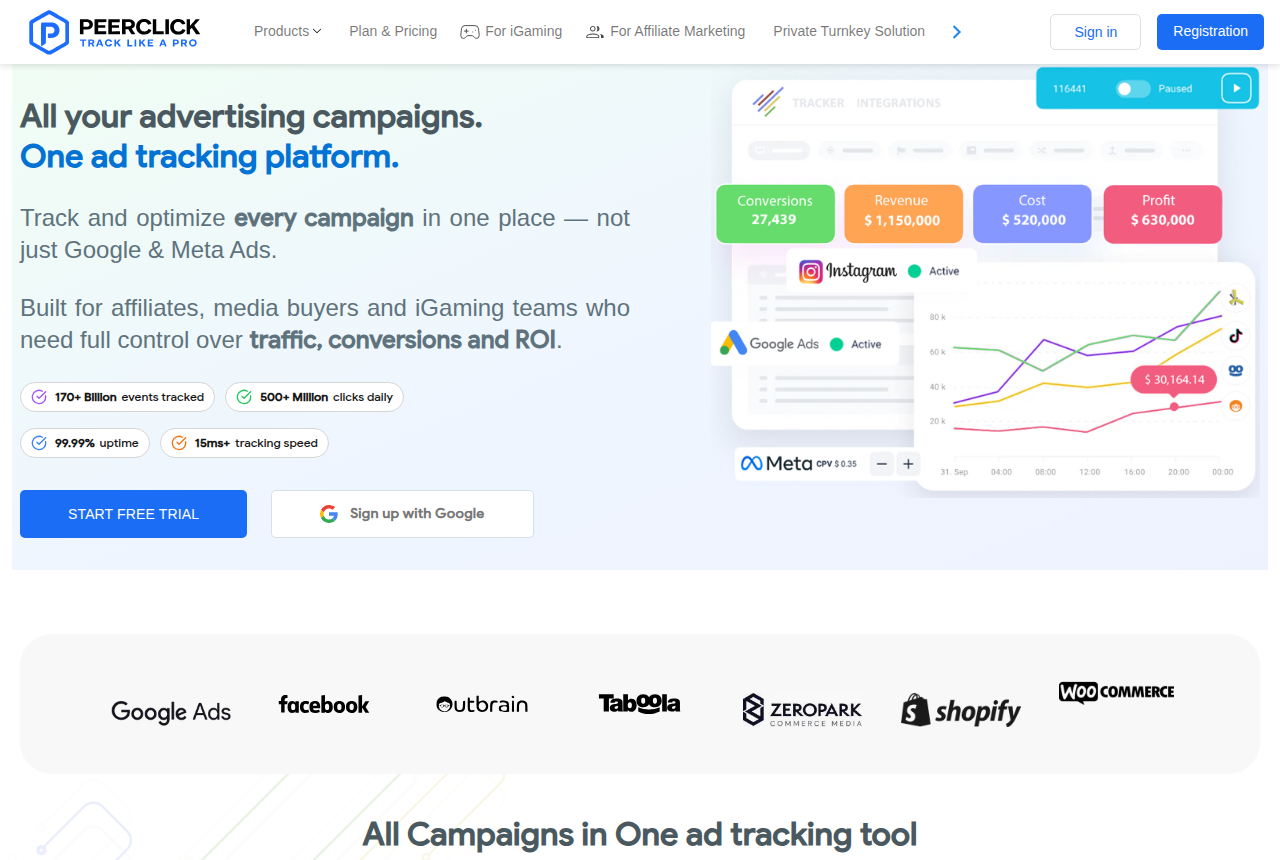
- Traffic Distribution AI re-weights offers, landers and paths every minute toward your chosen metric (ROI, earnings per visit, or conversion rate). That is real automation, not another dashboard.
- Cookieless server-to-server tracking with native CAPI to Facebook, Google Enhanced Conversions and TikTok, so attribution holds up under iOS restrictions and ad blockers.
- Built for redirect-style affiliate and iGaming flows: incoming and outgoing postbacks, FTD and RevShare tracking, offer routing, A/B testing and 100-plus integrations.
- Operators call the reports fast and campaign setup intuitive, and rate the tracker reliable and fairly priced for what it does.
What to watch
- Outside proof is thin. One Trustpilot review at 3.2, no G2 footprint, and most write-ups are affiliate-network blog posts rather than candid operator threads. That is a reason to run the trial hard, not proof it is bad.
- Support reads as a coin flip. One buyer praised a named rep as helpful and friendly; another called support terrible and said the tracker just stopped working. There is no consistent middle to plan around.
- Billing is strict. No refunds, a card required to access the panel, and cancellation is a request a technician processes within three business days, not a button you press.
- The anti-fraud kit is gated to the $399 Advanced plan and above. The $199 most-popular tier does not include it, and events over the plan cap bill as per-1,000 overage on top.
AdsBridge: pros and cons
What works
- Cheap to start: $29/mo for 100,000 visits with a 14-day trial that needs no card, well below what Voluum or RedTrack charge to get going.
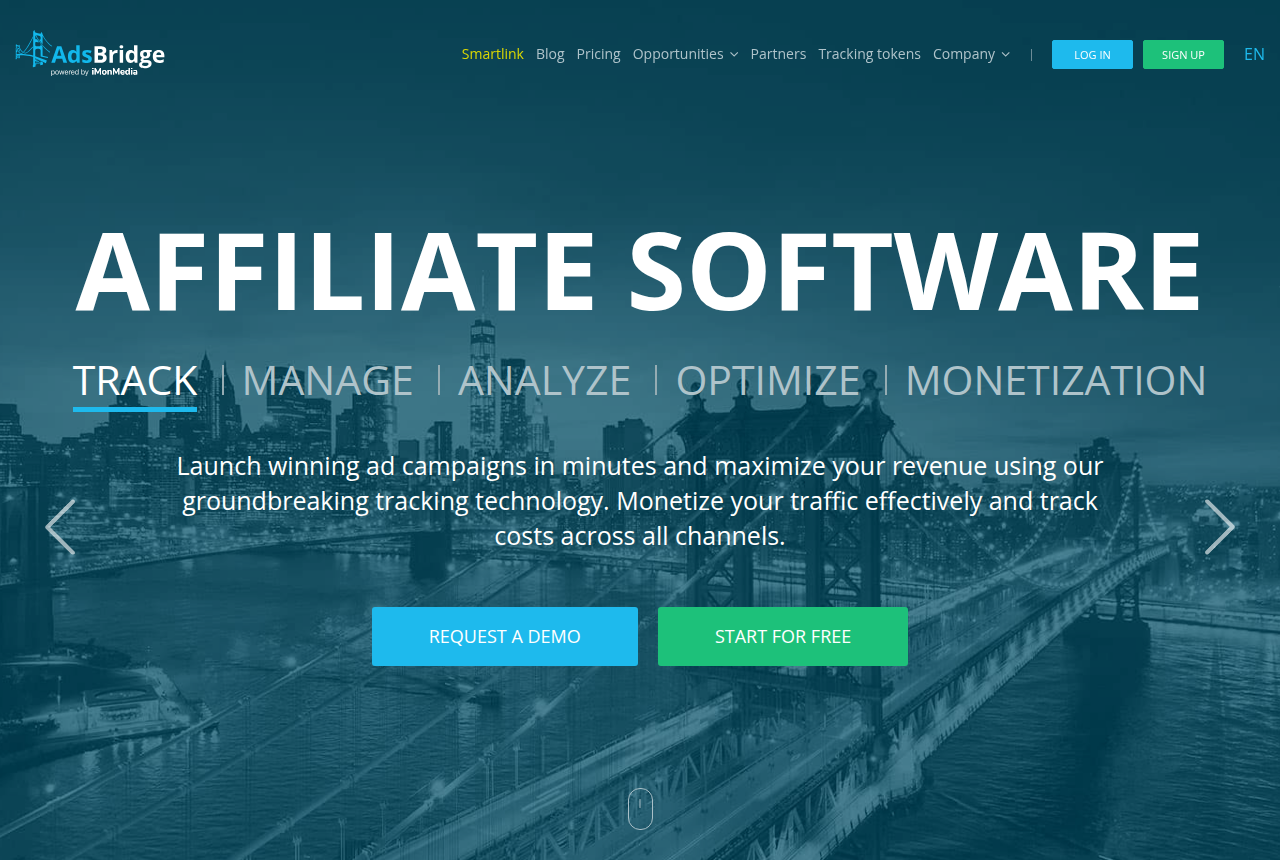
- A built-in landing page builder with visual and HTML editors, templates and CDN hosting, so your tracker and your landers live in one tool instead of two subscriptions.
- Cloud-hosted across seven AWS data centers in 160-plus countries, so there is no server to provision, patch or scale like Keitaro or Binom.
- The media-buyer basics are all present: a traffic distribution system with rules, split testing, S2S postbacks, tracking without redirects, and Fraud-Guard bot and proxy filtering.
- It has run under the same company since 2013, so it is an established tracker rather than a new arrival with no history.
What to watch
- Independent proof is thin and dated. G2 lists no reviews, Capterra has a handful, and most affiliate-forum praise is from 2014 to 2019, so you are largely trusting the vendor's own pages.
- Landing pages built in its editor are hosted on AdsBridge and cannot be downloaded, so switching trackers later means rebuilding those pages from scratch.
- Pricing is by monthly visits with per-1,000-visit overage, so a high-traffic pop or native campaign with a low conversion rate can push the real bill well past its tier.
- Cancellations get no refund under its own billing policy, so a mid-cycle change of mind costs you the rest of the month.
- Serious media buyers mostly shortlist Voluum, RedTrack or Keitaro, so there are fewer public setups and recent walkthroughs to copy when you get stuck.
The real differences
Two trackers, one shape, two different bets
If you are down to these two, start by seeing what they have in common, because it is most of the pitch. Both are cloud ad trackers you route paid traffic through. Both stamp every click, send the visitor to the right lander and offer, record the conversion your network or pixel posts back, and report by campaign, source and country. Both are built for the same operator: an affiliate, media buyer or iGaming team running native, pop, push or search. And both are honest about being cheaper than Voluum or RedTrack. The difference is where each one spends its extra effort. PeerClick spends it on automation and signal: a distribution engine that re-weights your traffic every minute, and native conversion APIs that keep attribution intact under iOS. AdsBridge spends it on the page: a built-in landing page builder that lets you run the tracker and the landers from one login, at the lowest starting price of any real tracker.
What PeerClick is built to do
PeerClick is a tracker that tries to make decisions for you. Its Traffic Distribution AI re-weights offers, landers and paths every minute toward the metric you choose, whether that is ROI, earnings per visit or conversion rate, so budget moves to the winners without you watching a dashboard. Under it sits the plumbing a 2026 media buyer needs: cookieless server-to-server tracking with native CAPI to Facebook, Google Enhanced Conversions and TikTok, so conversions still register when cookies and pixels are blocked. It is built for redirect-style flows, with incoming and outgoing postbacks, FTD and RevShare tracking for iGaming, offer routing, A/B testing and more than 100 integrations. Operators call the reports fast and the campaign setup intuitive. It starts at $99 a month events-based and keeps a free plan so you can prove it out first.
What AdsBridge is built to do
AdsBridge has been run by the same company since 2013, and its pitch is that the tracker and the landing pages live in one tool. On the tracking side it does the media-buyer basics: a traffic distribution system with rules, split testing, server-to-server postbacks, tracking without redirects, and Fraud-Guard bot and proxy filtering, hosted across seven AWS data centers in more than 160 countries so there is no server to run. What sets it apart is the built-in landing page builder, with visual and HTML editors, a template library and CDN hosting, so you build the pages your traffic lands on inside the same subscription. And it is cheap: $29 a month for 100,000 visits, with a 14-day trial that needs no card. For an operator who would otherwise pay for a tracker and a page builder separately, that is one bill instead of two.
The line that separates them
The split is optimization depth against page tooling. PeerClick's advantage is that it acts on the traffic. Its per-minute AI distribution is real automation rather than another report, and its native CAPI keeps the ad platforms learning from conversions a redirect-and-postback setup can miss under iOS. The costs are specific: the AI distribution sits on the $199 most-popular tier, the anti-fraud kit is gated to the $399 Advanced tier, billing takes a card and no refunds, and outside proof is thin, one Trustpilot review and no G2 footprint, so you are running the trial to check the claims rather than reading a stack of them. AdsBridge's advantage is the page and the price. You get a tracker and a hosted lander builder for less than PeerClick's entry plan. The cost there is lock-in and proof: landers built in the editor are hosted on AdsBridge and cannot be downloaded, so switching trackers later means rebuilding them, and its independent reviews are thin and mostly dated to 2014 through 2019. And AdsBridge tracks without redirects and leans on postbacks rather than the native CAPI hookups PeerClick advertises, so feeding clean conversions back to the ad platforms is the weaker side of its setup.
Where the visit count bites
Both price on volume, and that is where a real bill diverges from the sticker. AdsBridge counts monthly visits with per-1,000-visit overage, so a high-traffic pop or native campaign with a low conversion rate can push the real cost well past its tier. PeerClick counts events, with per-1,000 overage over your plan cap. If you run cheap, high-volume traffic, model both on your actual numbers before you commit, because the entry price is not the price you will pay.
Where your situation settles it
For most operators reading OfferROAS, PeerClick is the pick. If you are routing real paid-traffic volume, the per-minute distribution and the native CAPI do the job you have every day, keeping budget on the winners and attribution intact under iOS, and that is why it sits a place above AdsBridge on our roundup. AdsBridge is the better buy for a narrower case: you want a legitimate tracker and hosted landing pages in one tool, you are starting cheap, and rules-based distribution plus split testing is enough. At $29 a month it is one of the cheapest honest ways to run both, as long as you accept that your landers live on its servers and that you are largely trusting the vendor's own pages rather than a wall of recent reviews. Rank and fit agree: PeerClick for the volume buyer, AdsBridge for the budget operator who wants pages and tracking in one place.
When neither tracker is the shape of your problem
Both of these tools track clicks, and one of them also hosts the pages the clicks land on. Neither builds the whole funnel underneath the traffic: the checkout, the order bumps, the upsells, the rebills. If that is the gap, two tools are worth knowing.
ElasticFunnels is a funnel platform for teams running paid traffic, and it collapses the stack these trackers sit beside: it builds the pages, hosts the checkout with order bumps, one-click upsells, subscriptions and multi-MID routing, and keeps the click, the order, the rebill and the refund on one data layer with a CRM and attribution. The feature most relevant here is same-URL split testing, since both PeerClick and AdsBridge split-test in their own way: ElasticFunnels rotates variants server-side under one campaign link, so Meta, Google and TikTok keep their learning and a test never sends the ad back through review. It starts at $97 a month with a 14-day trial that takes no card, every feature is on every plan, and plans differ by traffic. The honest caveat is that it is newer than the trackers here and there is very little independent third-party review coverage yet, which is what you would expect of a platform this recent, so until you run real volume through it you are weighing the vendor's own account more than a stack of outside reports. What it does not replace is an in-path click router for pure offer traffic; where it earns its place is building and hosting the funnel these two only measure.
TrackPlay matters when the offer runs on a video sales letter, which a click tracker cannot see inside. It is a VSL player and analytics platform that ties every second watched to who actually bought, draws retention per second split into buyers and non-buyers, and posts the cart-verified sale back to Meta, TikTok and GA4 on the play that earned it. It has a no-card free tier of 1,000 plays a month and paid plans from $29 a month. It is narrow by design, though: built for paid-traffic VSL conversion, it is not a general video host or a B2B content library, and it has none of the channels or webinar tooling of a Wistia, so it is the wrong tool if the video's job is content marketing rather than a direct-response sale.
What each one costs
PeerClick. Events-based from $99 a month, with a free plan that is genuinely useful for a first look. Two things move the real number: the Traffic Distribution AI sits on the $199 most-popular tier, not the entry plan, and the anti-fraud kit is gated to the $399 Advanced tier and above. Events over your plan cap bill as per-1,000 overage, a card is required to open the panel, and there are no refunds, so run the trial hard before you commit.
AdsBridge. The cheaper sticker by a wide margin: $29 a month for 100,000 visits, with a 14-day trial that needs no card. It prices on monthly visits with per-1,000-visit overage, so a high-volume pop or native campaign with a low conversion rate can push the real bill well past its tier. Cancellations get no refund under its billing policy. The landing page builder is included in the price, which is the part that makes the low entry cost meaningful: you are paying for a tracker and a page tool at once.
Prices and buying terms checked on each vendor's own pages, current as of 27 September 2026.
Our pick
PeerClick
A capable cloud ad tracker for affiliates, media buyers and iGaming teams. Minute-by-minute AI traffic distribution, cookieless server-side tracking, native CAPI to Meta, Google and TikTok, and an anti-fraud kit on the higher plans. The gaps are outside proof and support that reads as a coin flip, plus a strict no-refund billing policy you should know before you attach a card.
Frequently asked questions
PeerClick or AdsBridge: which should I pick?
Which is cheaper, PeerClick or AdsBridge?
Does AdsBridge or PeerClick build landing pages?
Do PeerClick and AdsBridge track conversions under iOS and ad blockers?
Sources
From PeerClick and AdsBridge
- https://peerclick.com/
- https://help-center.peerclick.com/en/articles/5973039-subscription-payments
- https://adsbridge.com/
- https://adsbridge.com/pricing
- https://elasticfunnels.io/
- https://trackplay.io/
Other sources
3 discussions and reviews read for this page. Quotes are excerpts; open a link to read the original in context.
- [pc-afflift-speed] PeerClick ratings on afflift
- [pc-afflift-support] PeerClick support experience on afflift
- [pc-trustpilot] PeerClick review on Trustpilot
How we compared these
We do not run paid campaigns through either tool. We read each vendor's own documentation and pricing, verify every number against the source, and weigh the long-term reports of operators who run them at real spend. The full rubric is on the methodology page.