Head-to-head
Cometly vs PeerClick
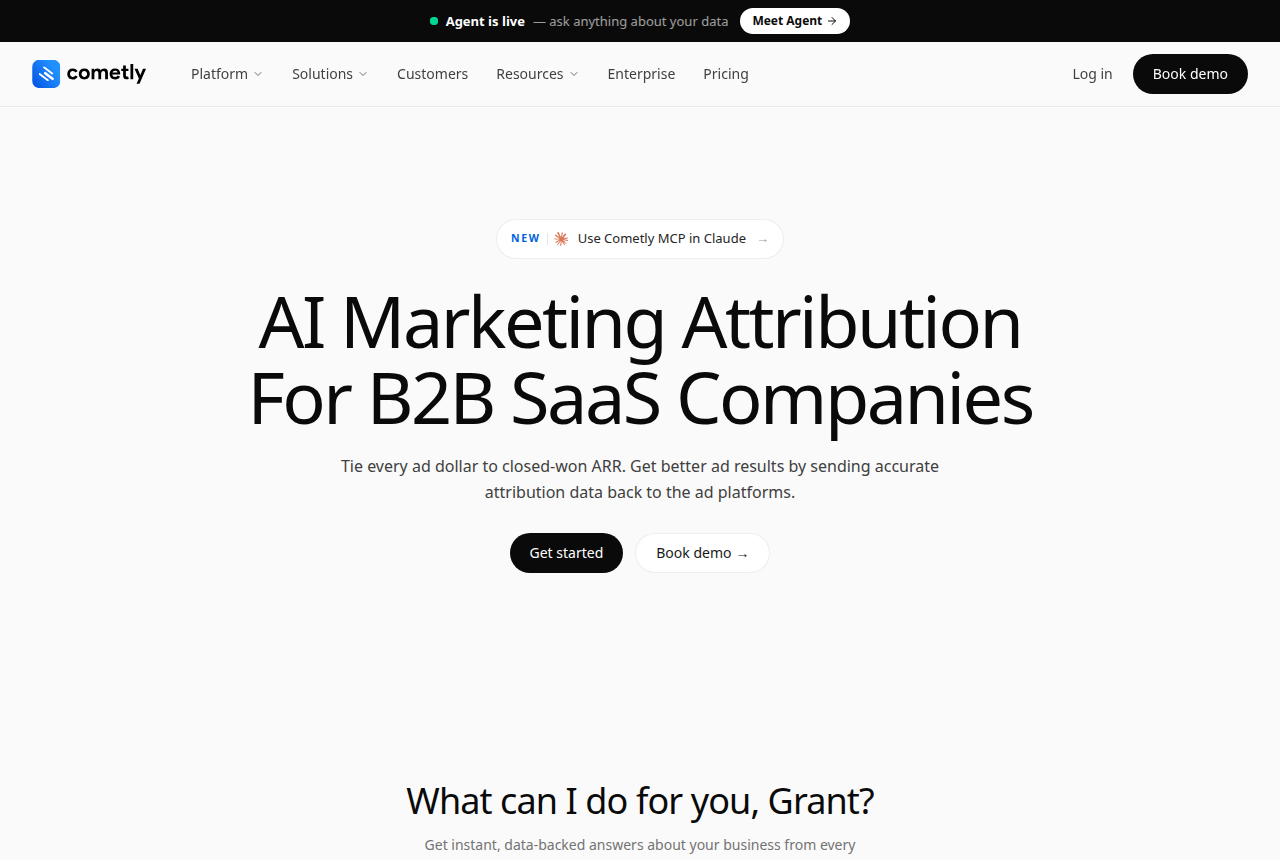
Cometly and PeerClick both send conversions back to the ad platforms, but they are built for different businesses and it shows in everything else. Cometly is a marketing attribution platform for B2B SaaS: it ties an ad to Stripe revenue, CRM pipeline and closed-won ARR, and feeds a cleaner, revenue-verified signal back to Meta and Google. PeerClick is an in-path click tracker for affiliate and iGaming media buyers: you route paid traffic through it, it ties every click to the source, lander and offer that converted, and its Traffic Distribution AI shifts budget toward the winners every minute. One measures a subscription funnel; the other runs offer traffic. Pick Cometly if you sell software on subscriptions and need every ad dollar tied to Stripe revenue, CRM pipeline and closed-won ARR; pick PeerClick if you route paid traffic to offers and want in-path click tracking with per-minute optimization for a few hundred dollars a month.
By Marcus Flynn, tracking and attribution editor. Updated 1 October 2026.
Quick answer
PeerClick is our top pick for most people. For an affiliate, iGaming or performance buyer routing paid traffic to offers, PeerClick fits the daily work: route clicks in-path, see which source, lander and offer converted, and let the Traffic Distribution AI shift weight toward the winners minute by minute. Cookieless server-side tracking and native CAPI to Meta, Google and TikTok hold attribution up under iOS and ad blockers, and it starts at $99 a month with a free plan to prove it out. Know the costs first: outside proof is thin, support is inconsistent, the AI distribution sits on the $199 tier and the anti-fraud kit on the $399 tier, and billing takes no refunds. It wins this pairing because it does the routing-and-optimizing job Cometly does not, for the reader this site is written for.
- Cometly. Best for B2B SaaS teams tying paid ad spend to Stripe revenue, CRM pipeline and closed-won ARR.
- PeerClick. Best for Affiliate and iGaming media buyers routing paid traffic who want per-minute optimization. Has a free tier.
Side by side
| Tool | Core job | Built for | Ties together | Access & price | From |
|---|---|---|---|---|---|
| 1. Cometly | SaaS revenue attribution | B2B SaaS teams | Ads to Stripe and ARR | Quote only, no trial | Not listed |
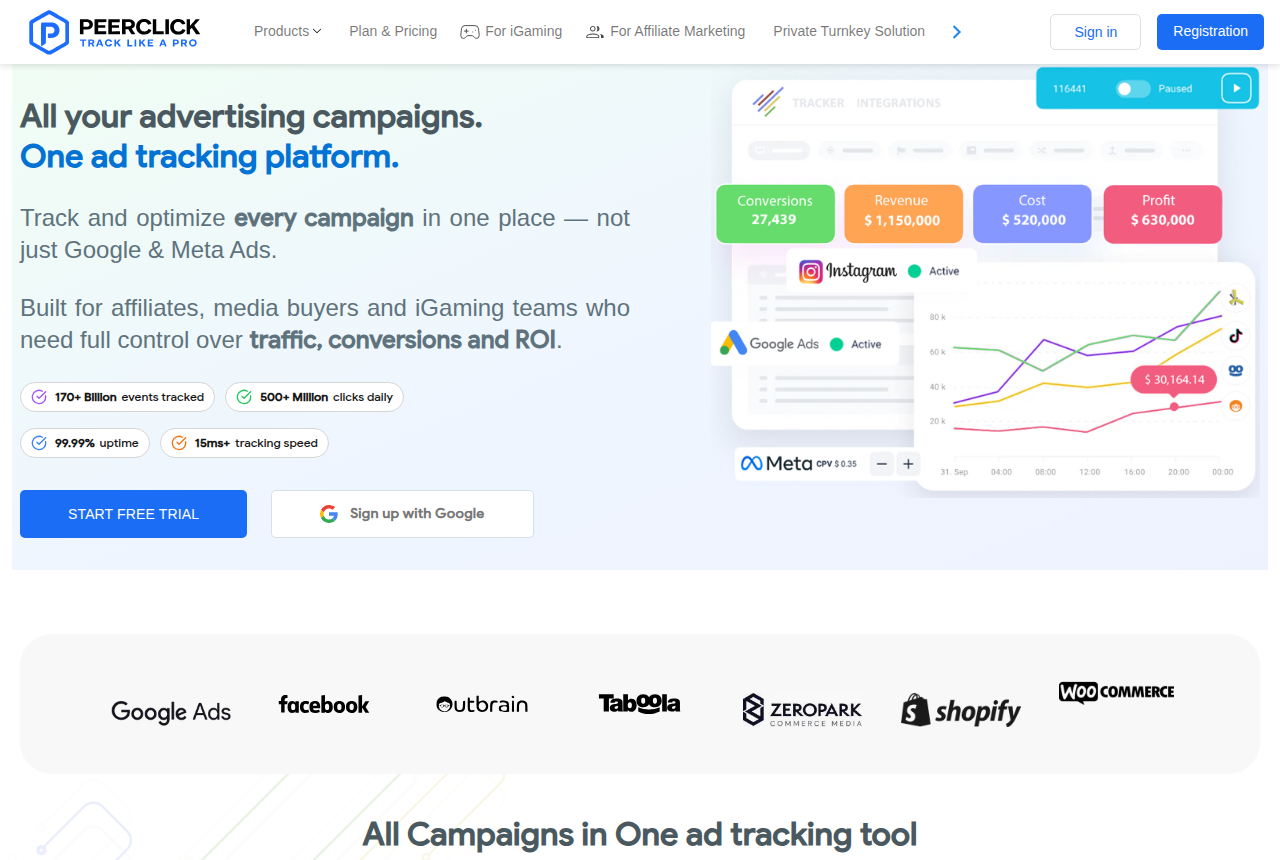
| 2. PeerClick | In-path click tracking | Affiliate & iGaming buyers | Clicks to offers, auto-routed | From $99/mo, free plan | Free tier |
Cometly: pros and cons
What works
- Server-side Conversion API is the genuine strength. Cometly sends deduplicated conversions back to Meta, Google, LinkedIn and TikTok, and reports Meta event match quality up to 9.3 out of 10 where a manual setup sits at 4 to 5. Buyers on r/FacebookAds confirm it pushed more matched data to Meta than other trackers they had run.
- Revenue attribution built around Stripe and the CRM, not just clicks. The native Stripe sync ties trials, new customers, recurring revenue and LTV to the originating ad, and HubSpot and Salesforce lifecycle stages map onto the same touchpoints, right through to closed-won ARR. That is the report a SaaS finance team will actually defend.
- Modern data plumbing under it. A cookieless Comet Pixel with cross-device identity, 70-plus native integrations, an Agent you query in plain English instead of writing SQL, and on Enterprise a warehouse sync to Snowflake or BigQuery.
- Established and reviewed, not a new app. Comet LLC has tracked paid spend for years, with named case studies and aggregate ratings of 4.8 out of 5 on G2 across 36 reviews and 3.6 out of 5 on Trustpilot across 92.
What to watch
- It is not a route-through campaign tracker. Cometly attributes traffic to your own site and funnel; it does not rotate offers, split traffic across landers by rule, or distribute clicks the way PeerClick, Voluum or RedTrack do. That matters most to an affiliate or iGaming media buyer running many offers through a redirect.
- It has left the DTC and ecommerce market it once served. Cometly's own site now names other tools for ecommerce and positions itself for B2B SaaS. Shopify still integrates, but reviewers report weaker matching on cash-on-delivery and email-less orders, so an ecom brand should demand proof on its own orders first.
- No public price and no free trial. Every plan is usage-based on monthly pageviews and quoted on a sales call, and Cometly says it does not run a trial because attribution needs setup first. Buyers who want to test against their own numbers before paying, or just want a price before a call, get neither.
- Support and journey timing draw the recurring complaints. The long-running r/FacebookAds thread reports support replies measured in business days and trouble seeing the full pre-purchase journey. The sample is small, but consistent enough that you should test response times and event latency during onboarding.
PeerClick: pros and cons
What works
- Traffic Distribution AI re-weights offers, landers and paths every minute toward your chosen metric (ROI, earnings per visit, or conversion rate). That is real automation, not another dashboard.
- Cookieless server-to-server tracking with native CAPI to Facebook, Google Enhanced Conversions and TikTok, so attribution holds up under iOS restrictions and ad blockers.
- Built for redirect-style affiliate and iGaming flows: incoming and outgoing postbacks, FTD and RevShare tracking, offer routing, A/B testing and 100-plus integrations.
- Operators call the reports fast and campaign setup intuitive, and rate the tracker reliable and fairly priced for what it does.
What to watch
- Outside proof is thin. One Trustpilot review at 3.2, no G2 footprint, and most write-ups are affiliate-network blog posts rather than candid operator threads. That is a reason to run the trial hard, not proof it is bad.
- Support reads as a coin flip. One buyer praised a named rep as helpful and friendly; another called support terrible and said the tracker just stopped working. There is no consistent middle to plan around.
- Billing is strict. No refunds, a card required to access the panel, and cancellation is a request a technician processes within three business days, not a button you press.
- The anti-fraud kit is gated to the $399 Advanced plan and above. The $199 most-popular tier does not include it, and events over the plan cap bill as per-1,000 overage on top.
The real differences
Two tools that barely overlap
If you are genuinely down to these two, start by noticing that they are not two versions of one product. They share a single feature, server-side conversion tracking, and almost nothing else. Cometly is a marketing attribution platform built for B2B SaaS: it ties an ad to Stripe revenue and CRM pipeline, all the way to closed-won ARR. PeerClick is an in-path click tracker built for affiliate and iGaming media buyers: you route paid traffic through it and it moves budget toward the offers that convert, minute by minute. So the real question is not which is better in the abstract. It is which business you run, because that decides the answer cleanly.

What Cometly is built to do
Cometly is a marketing attribution platform. You install its Comet Pixel with one line, it captures visitors cookielessly and across devices, records the conversion server-side so ad blockers and iOS restrictions do not drop it, and models the multi-touch journey back to the ad and creative that drove it. In 2026 its headline job is revenue attribution for software companies: a native Stripe sync ties trials, new customers, recurring revenue and lifetime value to the originating ad, and HubSpot or Salesforce lifecycle stages map onto the same touchpoints, right through to closed-won ARR. Its genuine strength is the server-side Conversion API: it pushes deduplicated conversions back to Meta, Google, LinkedIn and TikTok and reports Meta event match quality well above a hand-rolled setup. What it does not do is route offers, rotate landers by rule or distribute clicks. It attributes traffic to your own funnel and hands a cleaner signal to the ad platforms. The full Cometly review has the detail.
What PeerClick is built to do
PeerClick is a cloud ad tracker for affiliates, media buyers and iGaming teams, and it sits in the click path the way Voluum and RedTrack do. You route paid traffic through it, and it ties every visit, click and conversion back to the source, landing page and offer that produced it, then optimizes toward the metric you pick. Its edge over a plain tracker is the Traffic Distribution AI, which re-weights offers, landers and paths every minute toward ROI, earnings per visit or conversion rate, so the winners take more traffic without you touching a dashboard. Tracking is cookieless and server-to-server, with native CAPI to Facebook, Google Enhanced Conversions and TikTok, and it handles the redirect-style flows these buyers actually run: incoming and outgoing postbacks, FTD and RevShare tracking, offer rotation and A/B testing across 100-plus integrations. The PeerClick review covers where it holds up and where it does not.
The one place they touch, and where they split
Both send server-side conversions back to the ad platforms, and if you squint that looks like overlap. It is not. Cometly's conversion is a Stripe-verified revenue event: a trial that became a paid plan, a renewal, an expansion. That is the signal a finance team will defend, and it is what Cometly feeds Meta and Google so the auction optimizes toward paying customers rather than form fills. PeerClick's conversion is an offer action inside a path it is actively routing, a lead, a sale or a first-time deposit, fed back so the auction learns while the same engine shifts traffic toward whichever offer is winning right now. One measures a funnel and improves the ad signal; the other runs the traffic. If your world is a set of offers and creatives you push paid clicks at, PeerClick sees exactly what matters and acts on it every minute. If your world is one SaaS funnel where the money shows up weeks later in Stripe, PeerClick cannot see that revenue and Cometly is built for nothing else.
Which one is you
The fit question is really a business-model question, and it settles the pick. Cometly is the answer if you sell software on subscriptions, your conversions live in Stripe and a CRM, and the number you defend to a board is customer-acquisition cost against ARR rather than cost per click. Be clear-eyed about the trade: it has left the DTC and ecommerce market it once served, there is no public price and no free trial, so you are quoted on a call and cannot test against your own numbers first, and its recurring complaints are support measured in business days and trouble seeing the full pre-purchase journey. PeerClick is the answer for the operator this site is mostly written for: an affiliate, iGaming or performance buyer routing paid traffic to offers, who needs to see which source and lander converted and move budget the same hour. Its costs are different in kind: outside proof is thin, with one Trustpilot review and no G2 footprint, support reads as a coin flip, the Traffic Distribution AI sits on the $199 tier and the anti-fraud kit on the $399 tier, and billing takes no refunds. Neither cost list is a dealbreaker. They are the price of two different tools, and there is no overlap to agonize over: if you are a SaaS marketer Cometly is the serious answer and PeerClick is not in the running, and if you are a media buyer routing offer traffic PeerClick fits the work and Cometly is the wrong shape and the wrong buying model.
When the tracker is only half the problem
Both of these stop at measurement and the ad signal. Neither builds the page the traffic lands on or hosts the checkout that takes the money, and for a lot of paid-traffic operators the leak is on that side of the line, not in the reporting. Two tools worth knowing sit there.
ElasticFunnels is a funnel platform for teams running paid traffic. Its lead feature is same-URL split testing: variants rotate server-side under one campaign link, so Meta, Google and TikTok keep their learning and a test never resets the ad's optimization by pointing traffic at a new address. Around that it builds the pages, hosts the checkout with order bumps, one-click upsells, subscriptions and multi-MID routing, and keeps the click, the order, the rebill and the refund on one data layer with a CRM and attribution, so nobody reconciles four exports to find which angle actually made money. It starts at $97 a month with a 14-day trial that needs no card, every feature is on every plan, and plans differ by traffic. The honest caveat is that it is newer than the platforms on this page and there is very little independent third-party review coverage yet, which is what you would expect of a product this recent, so until you run real volume through it you are largely weighing the vendor's own account rather than a stack of outside reports.
TrackPlay matters if the offer runs on a video sales letter, which neither an attribution platform nor a click tracker can see inside. It is a VSL player and analytics platform that ties every second watched to who actually bought, draws retention per second split into buyers and non-buyers, and posts the cart-verified sale back to Meta, TikTok and GA4 on the play that earned it. It has a no-card free tier of 1,000 plays a month and paid plans from $29 a month. It is narrow by design, though: built for paid-traffic VSL conversion, it is not a general video host or a B2B content library and has none of the channels or webinar tooling of a Wistia, so it is the wrong tool if the video's job is content marketing rather than a direct-response sale.
What each one costs
Cometly. No public price and no free trial. Every plan is usage-based on monthly pageviews and quoted on a sales call, and Cometly says it does not run a trial because attribution needs setup first. That means you cannot test it against your own numbers before paying, and one G2 reviewer flagged that pricing has changed over time. If your conversions are subscription revenue, the value is a report a finance team will defend; the buying process is a call, not a signup.
PeerClick. Events-based pricing from $99 a month, with a free plan that is genuinely useful for a first look. Two things move the real number: the Traffic Distribution AI sits on the $199 most-popular tier, not the entry plan, and the anti-fraud kit is gated to the $399 Advanced tier and above. Events over your plan cap bill as per-1,000 overage, a card is required to open the panel, and there are no refunds, so run the trial hard before you commit.
Prices and buying terms checked on each vendor's own pages, current as of 30 September 2026.
Our pick
PeerClick
For an affiliate, iGaming or performance buyer routing paid traffic to offers, PeerClick fits the daily work: route clicks in-path, see which source, lander and offer converted, and let the Traffic Distribution AI shift weight toward the winners minute by minute. Cookieless server-side tracking and native CAPI to Meta, Google and TikTok hold attribution up under iOS and ad blockers, and it starts at $99 a month with a free plan to prove it out. Know the costs first: outside proof is thin, support is inconsistent, the AI distribution sits on the $199 tier and the anti-fraud kit on the $399 tier, and billing takes no refunds. It wins this pairing because it does the routing-and-optimizing job Cometly does not, for the reader this site is written for.
Frequently asked questions
Cometly or PeerClick: which should I pick?
Do Cometly and PeerClick do the same thing?
Can Cometly route or split-test paid traffic like PeerClick?
Which is cheaper, Cometly or PeerClick?
Does either one send conversions back to the ad platforms?
Sources
From Cometly and PeerClick
- https://www.cometly.com/
- https://www.cometly.com/solutions/stripe-revenue-attribution
- https://www.cometly.com/platform/conversion-api
- https://peerclick.com/
- https://help-center.peerclick.com/en/articles/5973039-subscription-payments
- https://elasticfunnels.io/
- https://trackplay.io/
Other sources
3 discussions and reviews read for this page. Quotes are excerpts; open a link to read the original in context.
- [pc-afflift-speed] PeerClick ratings on afflift
- [pc-afflift-support] PeerClick support experience on afflift
- [pc-trustpilot] PeerClick review on Trustpilot
How we compared these
We do not run paid campaigns through either tool. We read each vendor's own documentation and pricing, verify every number against the source, and weigh the long-term reports of operators who run them at real spend. The full rubric is on the methodology page.