Head-to-head
Polar Analytics vs PeerClick
You are down to two tools that barely belong on the same shortlist, which usually means the real question is which job you are solving. Polar Analytics is a Shopify-native analytics platform: it reads your whole store, ad and email stack and turns it into blended profit dashboards, priced by your gross merchandise value and quoted after a demo. PeerClick is a route-through click tracker for the affiliate and media buyer: it routes clicks across a pool of offers, records the conversions, and re-weights the split every minute toward your best metric, on a self-serve plan from $99. The pick turns on which of those two operators you are.
By Marcus Flynn, tracking and attribution editor. Updated 29 September 2026.
Pick Polar Analytics if you run a Shopify brand and want your store, ad and email data pulled into one set of profit dashboards on a warehouse you can query; pick PeerClick if you route and rotate paid traffic across many offers and landers and want a tracker that re-weights the split every minute and feeds conversions back to Meta, Google and TikTok.
Quick answer
PeerClick is our top pick for most people. A capable cloud ad tracker for affiliates, media buyers and iGaming teams. Minute-by-minute AI traffic distribution, cookieless server-side tracking, native CAPI to Meta, Google and TikTok, and an anti-fraud kit on the higher plans. The gaps are outside proof and support that reads as a coin flip, plus a strict no-refund billing policy you should know before you attach a card.
- Polar Analytics. Best for Shopify brands centralizing profit and marketing reporting. From $750/mo.
- PeerClick. Best for Affiliate and iGaming media buyers who want automation-heavy click tracking. From $99/mo.
Side by side
| Tool | Core job | Optimization | CAPI feed | Built for | From |
|---|---|---|---|---|---|
| Polar Analytics | Profit BI dashboards | No, reporting | Meta + Google | Shopify DTC brands | $750/mo |
| PeerClick | Route-through tracker | Per-minute AI | Meta, Google, TikTok | Affiliate, iGaming | $99/mo |
Polar Analytics: pros and cons
What works
- Pulls Shopify, Meta, Google, TikTok, Klaviyo and more into one dashboard with CAC, MER, LTV, cohort and contribution-margin reports out of the box, so a team stops reconciling platforms by hand.
- You can build and edit any report rather than living inside fixed dashboards, and reviewers repeatedly single out fast onboarding and responsive support.
- Advertising Signals sends conversion events server-side to Meta and Google Ads to lift Event Match Quality, and a first-party pixel with a Lifetime ID improves attribution where browser tracking breaks.
- Every plan bundles a dedicated Snowflake warehouse, unlimited users and unlimited historical data, so it doubles as a data foundation you can query directly, not just a dashboard.
What to watch
- Pricing is tiered by gross merchandise value and quoted after a demo. The Shopify listing shows a Core Plan from $750 a month, and a Plus operator reported a quote near $20k a year, so below serious scale the cost is hard to justify.
- It is a reporting and BI layer more than a deep attribution engine: operators say it gets restrictive once you need messy custom attribution or business-specific nuance, and point to a data engineer or a heavier tool for that.
- No free trial and no free tier on the paid platform. You book a demo for a GMV-based quote, and the Shopify listing gates the Polar Pixel out of any trial; the only free look is an instant demo running on sample data.
- Like every cross-platform tool its numbers will not match Shopify or Meta exactly (revenue definitions, refunds, time zones, attribution windows), and clean UTMs plus the pixel are required or ad traffic falls into Direct or Unknown.
PeerClick: pros and cons
What works
- Traffic Distribution AI re-weights offers, landers and paths every minute toward your chosen metric (ROI, earnings per visit, or conversion rate). That is real automation, not another dashboard.
- Cookieless server-to-server tracking with native CAPI to Facebook, Google Enhanced Conversions and TikTok, so attribution holds up under iOS restrictions and ad blockers.
- Built for redirect-style affiliate and iGaming flows: incoming and outgoing postbacks, FTD and RevShare tracking, offer routing, A/B testing and 100-plus integrations.
- Operators call the reports fast and campaign setup intuitive, and rate the tracker reliable for what it does.
What to watch
- Outside proof is thin. One Trustpilot review at 3.2, no G2 footprint, and most write-ups are affiliate-network blog posts rather than candid operator threads. That is a reason to run the trial hard, not proof it is bad.
- Support reads as a coin flip. One buyer praised a named rep as helpful and friendly; another called support terrible and said the tracker just stopped working. There is no consistent middle to plan around.
- Billing is strict. No refunds, a card required to access the panel, and cancellation is a request a technician processes within three business days, not a button you press.
- The anti-fraud kit is gated to the $399 Advanced plan and above. The $199 most-popular tier does not include it, and events over the plan cap bill as per-1,000 overage on top.
The real differences
What each one actually is
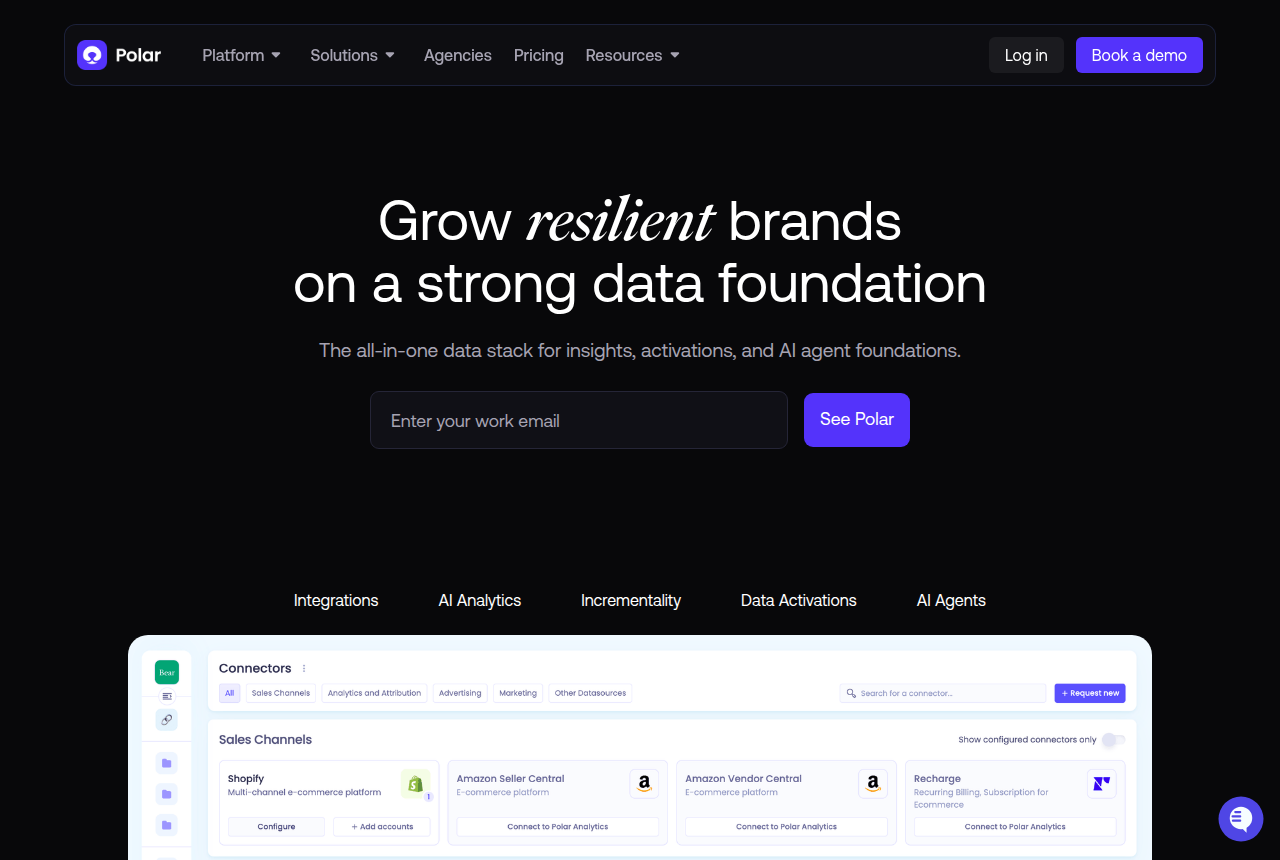
Polar Analytics is a Shopify-native analytics and business-intelligence platform for direct-to-consumer brands. It is not a redirect or click tracker like most of the tools on this site. It connects your store, your ad accounts, your email tool and the rest of your stack, then turns the lot into one set of dashboards: blended CAC and MER, ROAS, LTV, cohorts, retention and contribution margin, ready out of the box and editable. Every plan bundles a dedicated Snowflake warehouse, unlimited users and unlimited historical data, so it doubles as a data foundation you can query, not just a dashboard to read. It is tiered by your gross merchandise value and quoted after a demo.
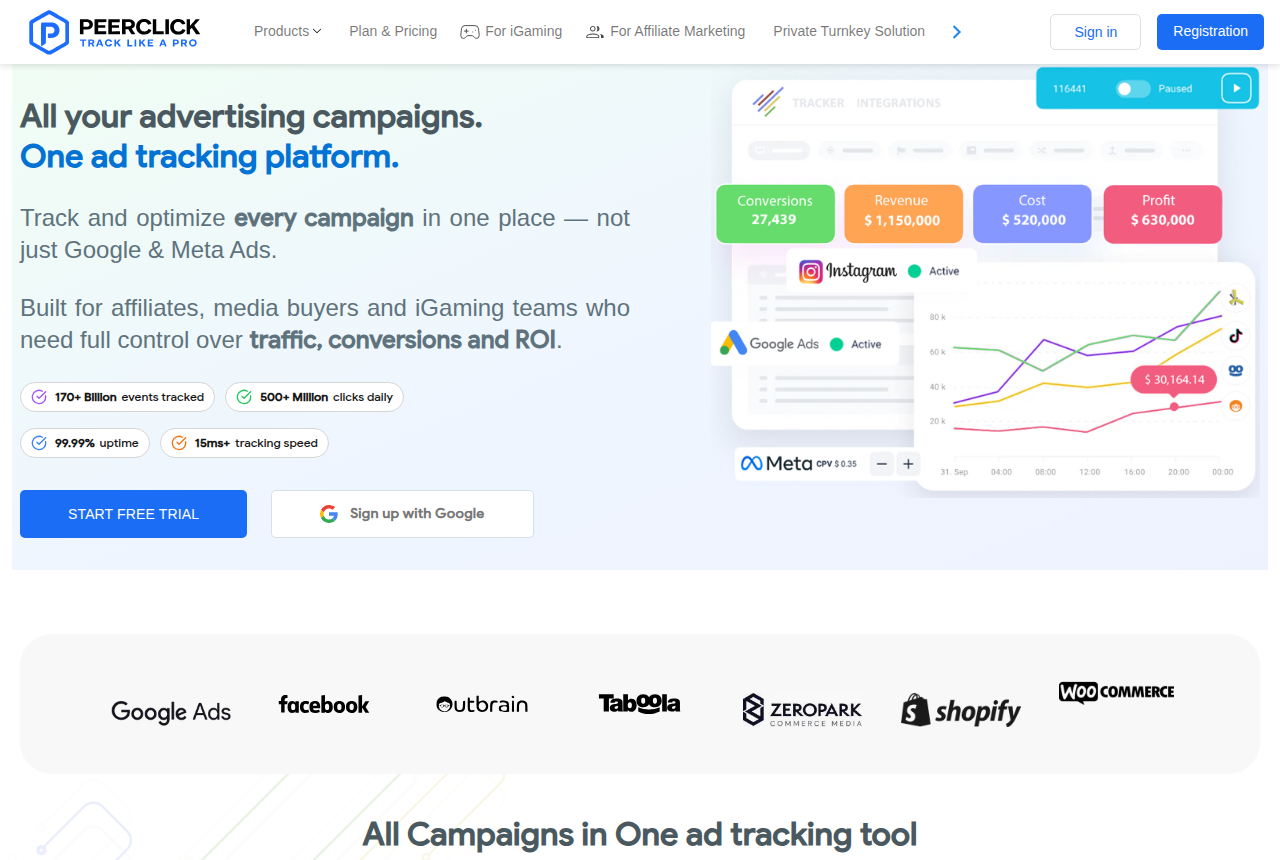
PeerClick is a cloud ad tracker built for affiliates, media buyers and iGaming teams. It sits in the click path the way Voluum and RedTrack do: every visit passes through it, and it ties each click and conversion back to the offer, landing page and source that produced it. Around that sit the parts a media buyer lives in: offer and lander routing, A/B testing, incoming and outgoing postbacks, and FTD and RevShare tracking for gambling and dating flows. The feature it leads with is Traffic Distribution AI, which re-weights the split across your offers and landers every minute toward the metric you set. It is cloud and managed, so there is no server on your side.
Do they even compete?
Barely, and that is the honest place to start. They overlap in one thing: both can send conversions server-side to the ad platforms. Everything else is different. Polar measures a whole brand. It is built for a Shopify store that wants to stop reconciling Meta, Google, TikTok and Klaviyo by hand and read one blended picture of profit. PeerClick tracks and routes campaigns. It is built for a buyer pushing paid clicks across a pool of offers and landers, who needs to know which source, lander and creative are making money right now, and wants the tracker to shift budget toward the winners on its own.
That gap is a price gap too. Polar's Core plan opens at $750 a month on its Shopify listing, and a Plus operator reported a quote near $20,000 a year. PeerClick's Starter is $99 a month, priced without a sales call. So the choice is rarely close once you know which operator you are. A scaled Shopify brand does not want to run its cross-channel measurement out of an affiliate tracker's dashboard, and a media buyer routing direct-response traffic to offers does not want a demo call and a five-figure reporting platform to see which lander converts. If you genuinely cannot tell which you are, read the two forks below and the answer usually falls out.
Where your conversions go
Both can feed conversions back to the ad platforms server-side, so on the headline both tick the box. The difference is breadth. PeerClick runs cookieless server-to-server tracking with native CAPI to Facebook, Google Enhanced Conversions and TikTok, framed as the way attribution holds up after iOS and ad blockers broke the browser pixel. Polar's Advertising Signals is narrower: it sends conversion events to Meta and Google Ads to lift Event Match Quality, and its first-party pixel with a Lifetime ID improves attribution where browser tracking breaks. It is one feature of a reporting platform, not the whole of it.
So the question is not whether conversions flow, but what you want around them. If the job is getting clean conversions to every platform you buy on and a tracker that optimizes the campaigns, PeerClick is built for exactly that. If the job is a blended read of your whole store with a conversion-API enhancer on the side, Polar covers the two big platforms and gives you the reporting around them.
Reporting versus routing: the fork that decides it
This is the real split. Polar's value is the reporting PeerClick does not attempt: blended CAC and MER across channels, LTV and retention cohorts, contribution margin, and a warehouse you can query directly. Operators single out fast onboarding and responsive support, and the freedom to build any report rather than living inside fixed dashboards. What they also say is where it stops. One operator who ran it reported that Polar is solid for visual reporting and has that one-click Shopify feel, but it can feel restrictive once you need to go deep into the messy attribution work. Another, who used both Polar and its closest rival, said they get you so far but start to fall down when you need customisation or nuance applied to your business. It is a reporting and BI layer more than a deep custom-attribution engine.
PeerClick does the opposite job. It sits in the traffic, distributes clicks across a pool of offers and landers by rule, splits traffic for testing, and then its Traffic Distribution AI adjusts the weights every minute toward ROI, earnings per visit or conversion rate. That is what an affiliate or media buyer running many campaigns needs: a pool of offers, traffic split across them, and a tracker that shifts spend toward the winners without you sitting on the dashboard. It will not model your whole store's blended margin or build LTV cohorts. If you want a trustworthy picture of contribution margin across every channel, PeerClick is the wrong tool and Polar is the right one. If you want to route paid traffic to offers and have the split optimize itself, Polar does not do that at all.
What it takes to try each, and to leave
The two feel least alike before you have run a single click. Polar has no free trial and no free tier on the paid platform. You book a demo for a GMV-based quote, the Shopify listing gates the Polar Pixel out of any trial, and the only free look is an instant demo running on sample data. It is a considered purchase with onboarding, not something you switch on in an afternoon.
PeerClick is self-serve. The homepage offers a trial with 10,000 tracked events and no card, so you can build a campaign and watch the tracking before you pay. The catch is the commercial policy once you are in: there are no refunds, and cancelling is a request a technician processes within three business days rather than a button you press. Its support also reads as a coin flip in the threads: one operator praised a named rep as helpful and friendly, another called support terrible and said the tracker just stopped working. Its outside proof is thin rather than negative, one Trustpilot review at 3.2 and no real G2 presence, so run the trial hard and read the billing terms before you commit.
Who each one is for
Pick Polar Analytics if you run a Shopify brand, sell across several channels, and your real pain is that nobody can read one trustworthy picture of profit without stitching platforms together by hand. Polar gives you blended CAC, MER, LTV and contribution margin out of the box, a Snowflake warehouse you can query, and Advertising Signals to feed Meta and Google. Its catch is the cost and the commitment: pricing is tiered by your gross merchandise value and quoted after a demo, the Shopify listing shows a Core plan from $750 a month, and a Plus operator reported roughly $20,000 a year. Below serious Shopify scale, that price is hard to justify, and it is a reporting layer, not a routing tracker, so it does nothing for a buyer whose whole job is pushing traffic to offers.
Pick PeerClick if you route and rotate paid traffic across many offers and landers, on native, pop, push, search or social, and you want a tracker that re-weights the split every minute and feeds conversions back to Meta, Google and TikTok. Its catch is the mirror of Polar's: the outside proof is thin, its support is uneven, its anti-fraud kit is gated to the $399 Advanced plan rather than the $199 tier the vendor pushes, and the billing is strict. Neither is a reason to rule it out; both are reasons to trial it against your own traffic first.
One caveat applies to both. Neither tool fixes a weak offer, a broken pixel setup or low Event Match Quality. They make the numbers clearer. They do not make the funnel better. If you are weighing PeerClick against another route-through tracker, the RedTrack vs PeerClick comparison is the next one to read; if it is Polar against a flat-priced click tracker for the same reader, see Polar Analytics vs ClickFlare.
Changelog
29 September 2026: First published. Prices and features read from each vendor's own site on 28 September 2026.
What each one costs
Polar Analytics does not sell a flat, self-serve price. Pricing is tiered by your gross merchandise value and quoted after a demo. The Shopify listing shows a Core plan from $750 a month, and a Plus operator reported a quote near $20,000 a year. There is no free trial and no free tier on the paid platform; the Shopify listing gates the Polar Pixel out of any trial, so the only free look is an instant demo running on sample data. Every plan does bundle a dedicated Snowflake warehouse, unlimited users and unlimited historical data.
PeerClick is self-serve and priced on events, where every visit, click and conversion counts as one event. Starter is $99 a month for one million events with basic automation and no API. Basic+ at $199 is the plan the vendor marks most popular, adding the AI traffic distribution and API access, though it does not include the anti-fraud kit. That arrives on Advanced at $399, and Exclusive at $849 adds thirty million events. Enterprise is quoted and is the only tier with on-premise deployment. Events over your cap bill as per-1,000 overage, annual billing takes 20% off, and there are no refunds.
The two are not really comparable on price, because they are not the same kind of tool. PeerClick is an order of magnitude cheaper to start, and the only one of the two you can price and switch on without talking to sales. Polar is not expensive for what it is; it is priced for a Shopify brand large enough that one trustworthy profit dashboard saves real time and money. Match the tool to your business and your scale, not to the sticker.
Prices read from each vendor's own pricing page, current as of 28 September 2026.
Our pick
PeerClick
A capable cloud ad tracker for affiliates, media buyers and iGaming teams. Minute-by-minute AI traffic distribution, cookieless server-side tracking, native CAPI to Meta, Google and TikTok, and an anti-fraud kit on the higher plans. The gaps are outside proof and support that reads as a coin flip, plus a strict no-refund billing policy you should know before you attach a card.
Frequently asked questions
Polar Analytics or PeerClick: which should I pick?
Do Polar Analytics and PeerClick even compete?
Is Polar Analytics or PeerClick cheaper?
Can PeerClick do the profit reporting Polar Analytics does?
Sources
Other sources
8 discussions and reviews read for this page. Quotes are excerpts; open a link to read the original in context.
- [pa-home] Polar Analytics official site
- [pc-home] PeerClick - Ad Tracker for Media Buyers and Affiliate
- [pa-restrictive] Triple Whale vs Polar Analytics thread
- [pa-customisation] Triple Whale vs Polar Analytics thread
- [pa-gmv] Shopify analytics pricing thread
- [pc-fast] PeerClick ratings - affLIFT
- [pc-support] PeerClick ratings - affLIFT
- [pc-hard] PeerClick reviews - Trustpilot
How we compared these
We do not run paid campaigns through either tool. We read each vendor's own documentation and pricing, verify every number against the source, and weigh the long-term reports of operators who run them at real spend. The full rubric is on the methodology page.