After the iOS privacy changes and ad blockers, Meta stopped receiving every sale, and the campaign kept spending against the incomplete set of sales that still reached the browser. Pick a setup that posts the paid conversion server-side, with the order value, the currency and the match keys. For affiliate traffic that already runs through a redirect or a postback, that setup is usually a cloud tracker with Facebook CAPI on the plan you pay for.
My take
I'd start with the RedTrack review. The Conversions API is included on every affiliate Solo plan, and those plans include a 14-day trial. If the account is already on ClickFlare, stay there and read the Starter line, because that tier already includes the connector. If the account is already on Voluum, open that review and see how a postback reaches Meta. Each tier's features come from that vendor's pricing page. Operator reports are where the double-counting shows up. We do not run paid campaigns through these tools. The methodology page explains how those calls were made.

What server-side tracking means for paid traffic
Your server, or your tracker's server, records the conversion and forwards it to Meta, Google or TikTok. RedTrack describes that capture as every click and conversion stored server-side, as your first-party data. The conversion is posted from a server, not from the browser pixel alone.
A pixel in the page still fires when the browser loads it and the buyer has not blocked it. The server event fires when the tracker, the store or the cart records the payment. Paid traffic cares about the second event because it is the optimization signal the ad platforms can still train on after the browser copy goes missing.
The useful question is which machine sends the Purchase, and whether that machine knows the order value.
Server-side tagging versus server-side tracking
Client-side tracking versus server-side tracking depends on which machine sends the hit. Google's Tag Manager help page describes client-side tagging as one container on the site. When someone acts, the browser dispatches HTTP requests to Google or to an advertising partner. A pixel on the thank-you page fires that request while the page loads.
Server-side tagging keeps the collection in the browser and moves the forwarding onto a container you host. The same help page describes a second container in a cloud environment. The web container sends one request, and the cloud container builds the vendor calls from it. Stape's tagging guide says the website still collects the event in the browser, and the server container processes that event, then sends it to GA4, to Google Ads and to Meta's Conversions API. A Stape host forwards a hit that reached your tagging domain.
A hosted tracker posts from a row it already holds, and the cart does that from the charge. The click arrived on a redirect, or the charge landed in the cart, and the Purchase they send is that order row. A comment on r/ServerSideTagging separates a Tag Manager container used as a proxy from a shop webhook that fires on the store's servers when the order is placed. RedTrack, ClickFlare and AnyTrack work the same way once the offer network reports the conversion.
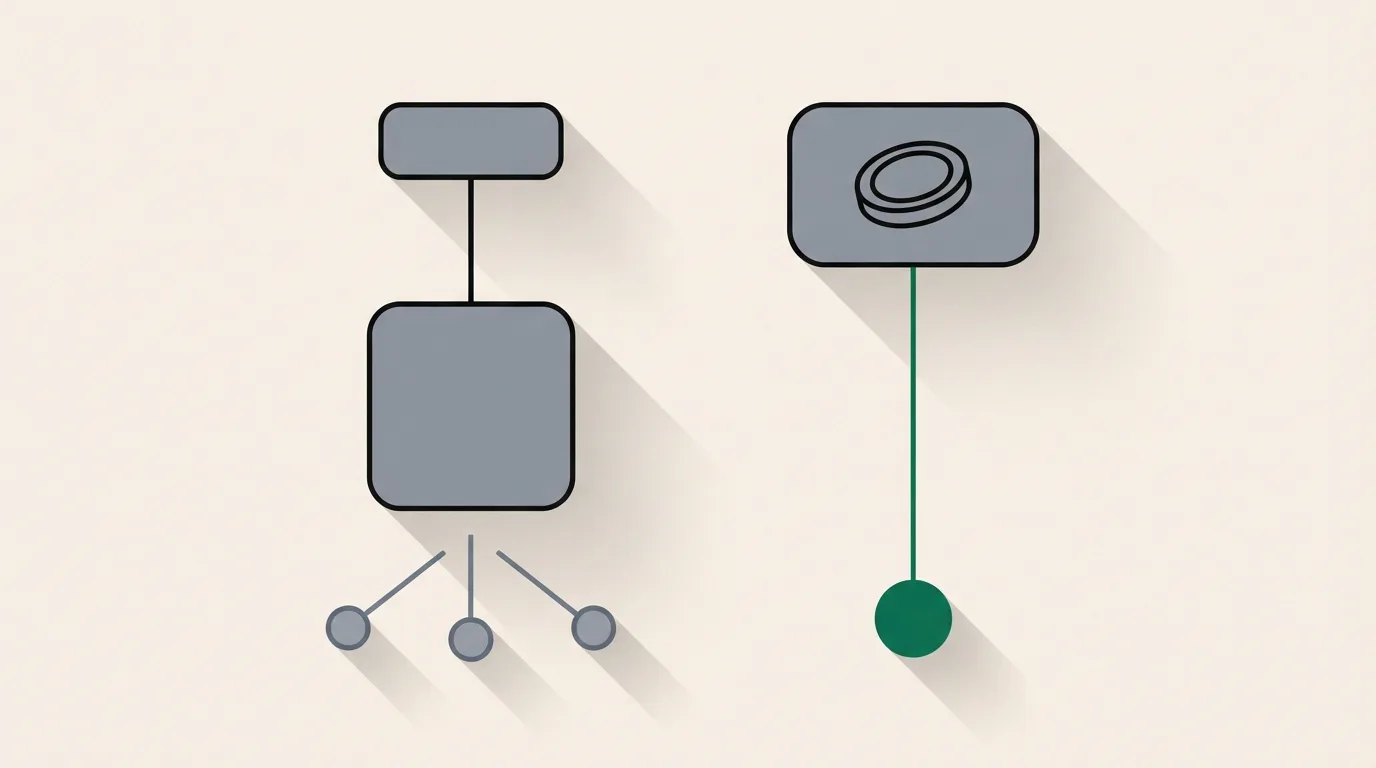
Server-side tracking versus cookies
The cookie question splits at that order row. Google's help page says that in a first-party context, website data and cookies stay within your domain, and vendors lose access to third-party cookies on that request. On Stape, a custom tagging domain sets those cookies as first-party. Cookie Keeper refreshes them for up to 400 days, where browsers would otherwise delete them after 3 to 7 days.
A blocker aimed at a vendor domain often misses a request to your own subdomain, and it sometimes stops that request as well. Stape also says a custom domain and Custom Loader reduce some of that blocking, and that some browser blocks remain. When the request never arrives, the container has no hit to forward. The tracker and the cart send the order they stored, and a thank-you page that never paints leaves that post intact.
Own-domain stores can send page views and checkout hits through the tagging host, and the same host can accept a webhook once the shop has the order. Affiliate traffic that ends on a network offer already has the sale on the tracker that accepted the postback. On a VSL, the sale comes back from the cart and the player passes it to the ad platform.
What Facebook CAPI needs from your stack
CAPI, Facebook's name for the Conversions API, wants a Purchase that carries value and currency. The match keys travel with it. Send a hashed email or phone when you have one, and send the fbc and fbp click ids when the click left them behind.
If the pixel still fires, both copies need one shared event id, one event name and one pixel id. SyncTag's note on double counting records Meta's merge rule. The two copies merge only within 48 hours of the first copy arriving. If that shared id is missing, the ad account can count one order as two sales.
Events Manager will look wrong even when the merge works. Meta says the Overview counts events before deduplication, which SyncTag spells out: send every purchase from the browser and from the server, and that Overview can show roughly twice the orders. The count that trains the ads is the smaller one. Use last week's purchases in Ads Manager for that check, and leave the raw Overview total out.
Facebook CAPI vs Pixel walks through what the Pixel sends, what the Conversions API sends, and how one event id holds the purchase to a single count. One browser source and one server source are enough for the sale.
Three setups operators actually run
Affiliate offer traffic usually lands in a cloud tracker after a redirect or a network postback. RedTrack, ClickFlare and AnyTrack each publish the Meta connector on a named plan. Voluum's features page says you can pass conversion data to Google or Meta even when the conversion was recorded with a postback. For the longer account of that tracker, open the Voluum review, and set it beside RedTrack in RedTrack vs Voluum.
FunnelFlux sits in the same redirect family when the path has more than one step. You draw the journey and see which step produced the revenue. Read RedTrack vs FunnelFlux if the visual canvas is why you would switch trackers. The stack picker pairs the tracker with the checkout and the player in one pass.
A store you own is a different machine. Server Google Tag Manager, hosted somewhere like Stape, is the layer for GA4 server-side tracking and for Google Ads server-side tracking on Shopify or WordPress. The click never has to pass through an affiliate redirect for that container to matter.
A video funnel is the third case. The sale happens on a cart the landing page does not own, the cart posts the order back, and the player sends the Purchase. Offer routing stays on the tracker. The player reports the sale and the watch time.
CAPI on the first paid tier
A server-side tracking platform, for affiliate traffic, is the cloud tracker that posts the conversion after the click. The split that matters is which plan turns the connector on. Two of these three include it from the first paid tier. One waits until you leave the free plan.
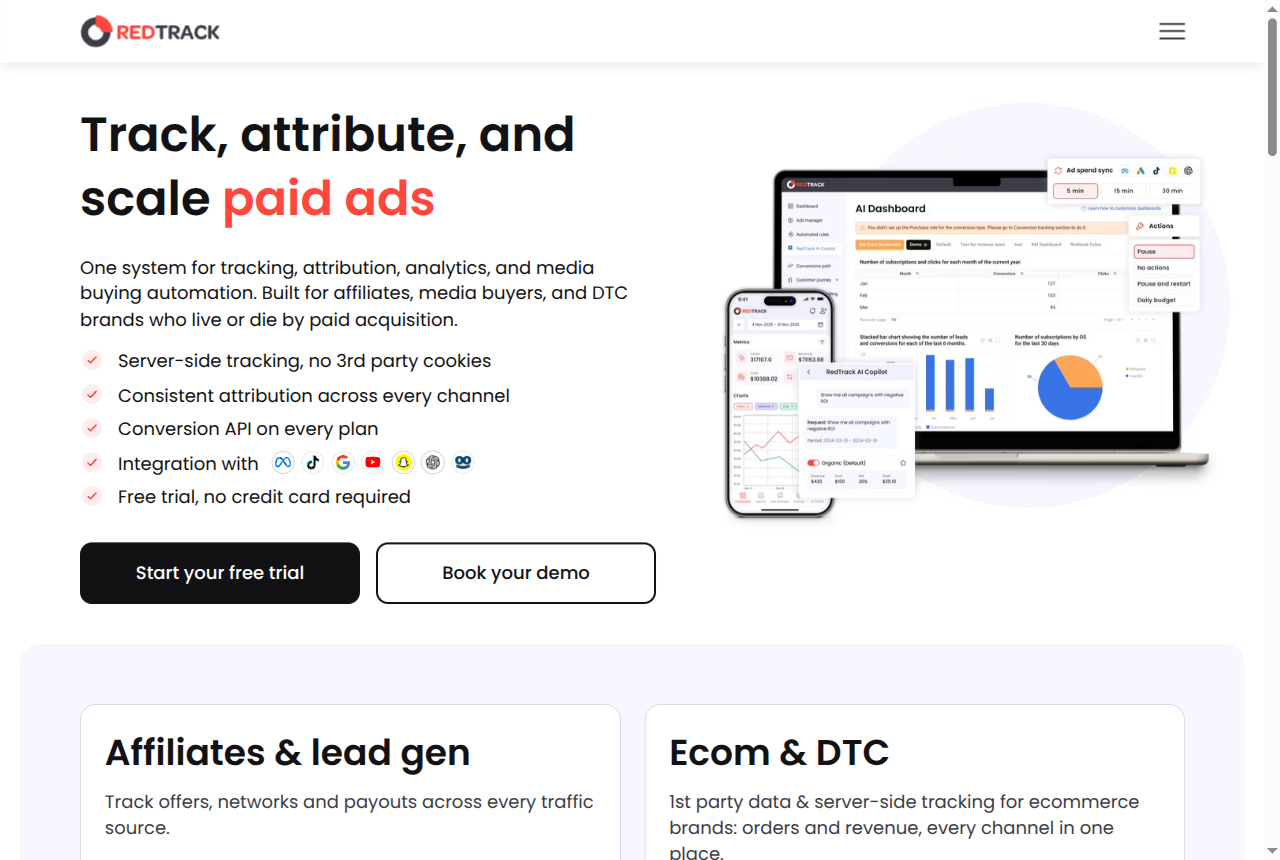
RedTrack's pricing page puts the Conversions API, ad spend sync and Stop Rules on every affiliate plan. The native connectors named there cover Meta, Google, TikTok, Snapchat, Microsoft/Bing, X, Pinterest and OpenAI Ads. The free Relay tier includes the same server-side send for one Shopify store. Event caps for that plan are written up in the RedTrack review.
RedTrack
- 23 Nov 2026
- Solo annual rate on the pricing page: $118. The Conversions API, ad spend sync and Stop Rules are on every affiliate plan.
Paid-social affiliate traffic, with the connector on the entry affiliate plan.
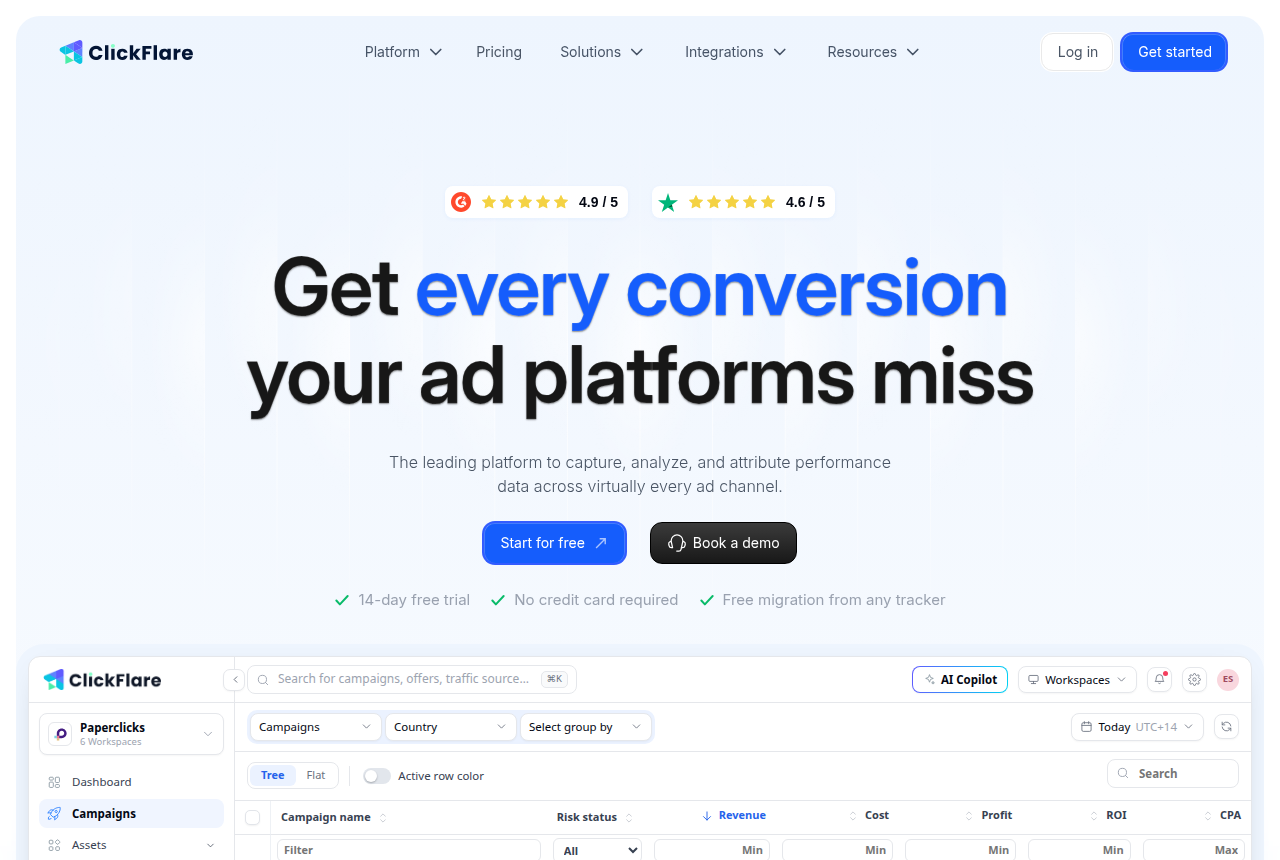
ClickFlare's pricing page includes the connector on every paid tier from Starter, next to the tag manager and cost sync. The Starter line describes server-side event tracking for Facebook, Google, TikTok, Snapchat, Reddit and more. Support and the event meter are explained in the ClickFlare review.
ClickFlare
- 23 Nov 2026
- Starter is $69 a month on yearly billing, or $89 month to month, with 10 CAPI integrations.
Affiliate traffic on paid social, where Starter includes the connector.
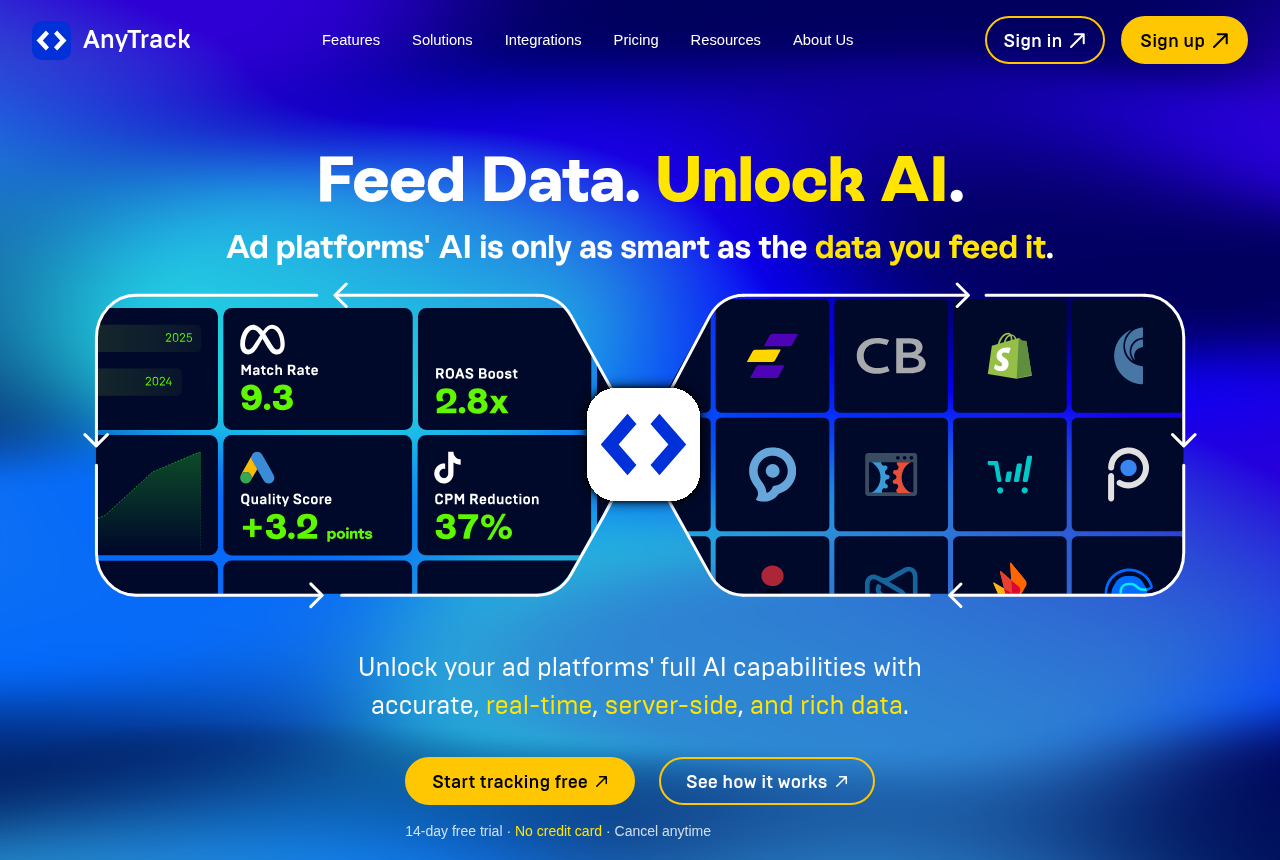
AnyTrack's free plan is the one that stops short. AnyTrack's pricing page leaves the Conversions API off that free plan. Starter is the first self-serve tier with real-time sending, and it lists seven ad platforms. Both the session count and what increments the cap are explained in the AnyTrack review. A click tracker bills events. AnyTrack bills sessions. Run the event math in the ad tracker cost calculator.
AnyTrack
- 23 Nov 2026
- The free plan is capped at 5,000 sessions a month and leaves out the Conversions API. Starter is $100 a month for 100,000 sessions and sends events in real time.
A mixed stack that can move off the free plan before it needs the connector.
Stape for stores on Tag Manager
Stape server-side tracking is hosting for a server Google Tag Manager container, plus dedicated gateways for a single ad platform. Stape's homepage sells those gateways as a lighter setup than a full container. Campaign routing stays on the tracker you already run.
GA4 server-side tracking and Google Ads server-side tracking are the jobs that container is for. A Shopify or WordPress store that already has Google Tag Manager can host the server container here and forward the store's events. An affiliate click that ends on a network offer page leaves you without a site of your own for that container, unless you also run a brand store.
Stape's pricing page marks a free plan as the way to get started, and prices Pro as the server GTM tier.
Stape
- 23 Nov 2026
- Free plan, 10,000 requests, marked for getting started. Pro server GTM is $17 a month billed annually, for up to 500,000 requests. Dedicated gateways from $8 a month.
A store that already runs Google Tag Manager and needs a host for the server container.
Course funnels that send the purchase back
A course or coaching stack lives in a CRM and an email tool. SegMetrics follows the person from the ad through the inbox to the purchase, then can hand that purchase back to the ad platforms.
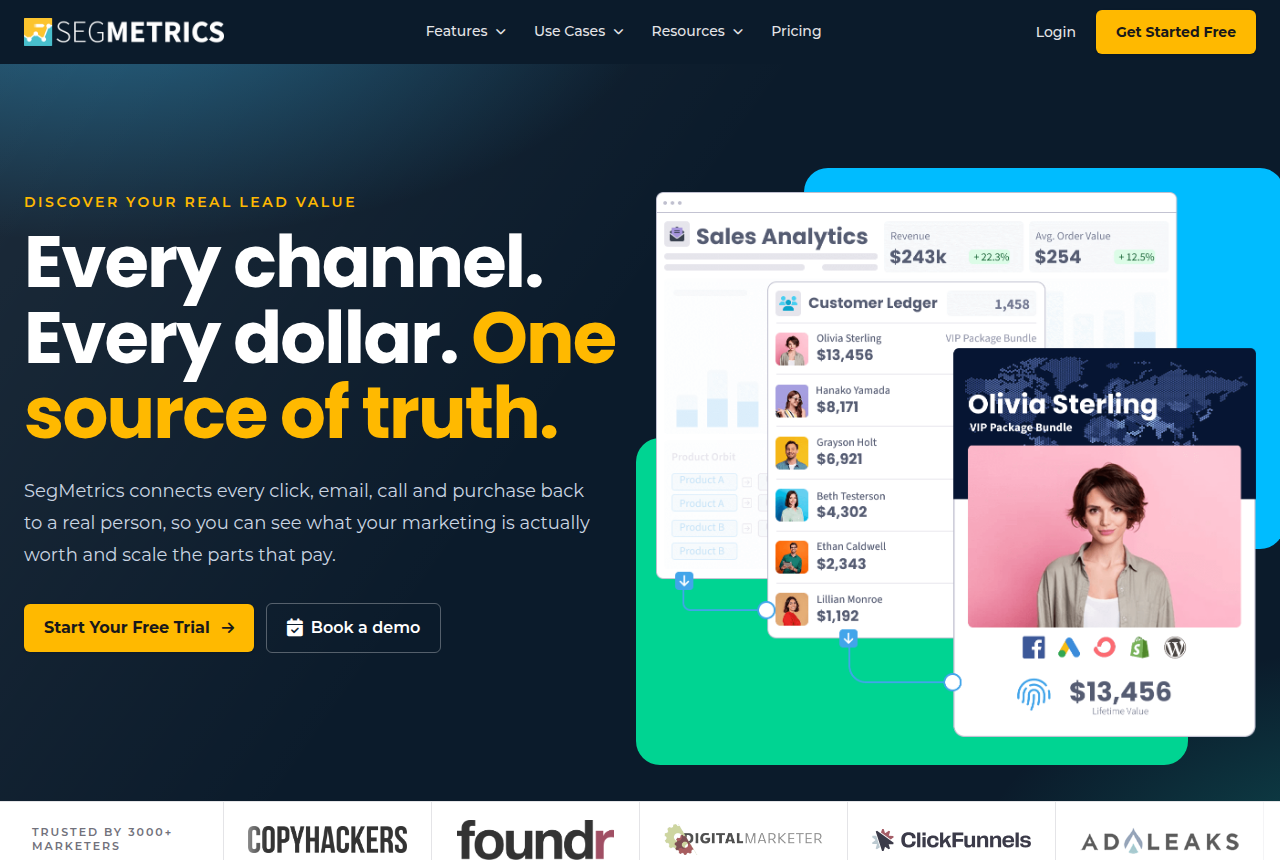
On the SegMetrics pricing page, Launch is the analytics tier. Conversion Feeder, which sends purchase conversions back to the ad platforms, starts on Grow. Hosting the tracking pixel on your own domain is a Scale feature. SegMetrics calls that server-side tracking. Person-level attribution is the subject of the SegMetrics review. A Shopify store under six figures of ad spend belongs in the guide to ecommerce attribution under $100k a month.
SegMetrics
- 23 Nov 2026
- Launch is $57 a month and includes analytics only. Grow is $197 a month and adds Conversion Feeder. Scale is $397 a month and adds server-side tracking on your own domain.
A course or coaching funnel that already runs through a CRM and email.
VSL funnels: post the cart-verified sale
When you run a video ad and the charge happens on ClickBank or Digistore24, the landing page never sees the order. The cart has to post the sale back, and something on your side has to tell Meta. TrackPlay is the player built for that handoff. Its Meta integrations page says that when the cart posts a sale back, TrackPlay sends a Purchase to Meta from the server, with value and currency, using hashed personal details and the click ids.
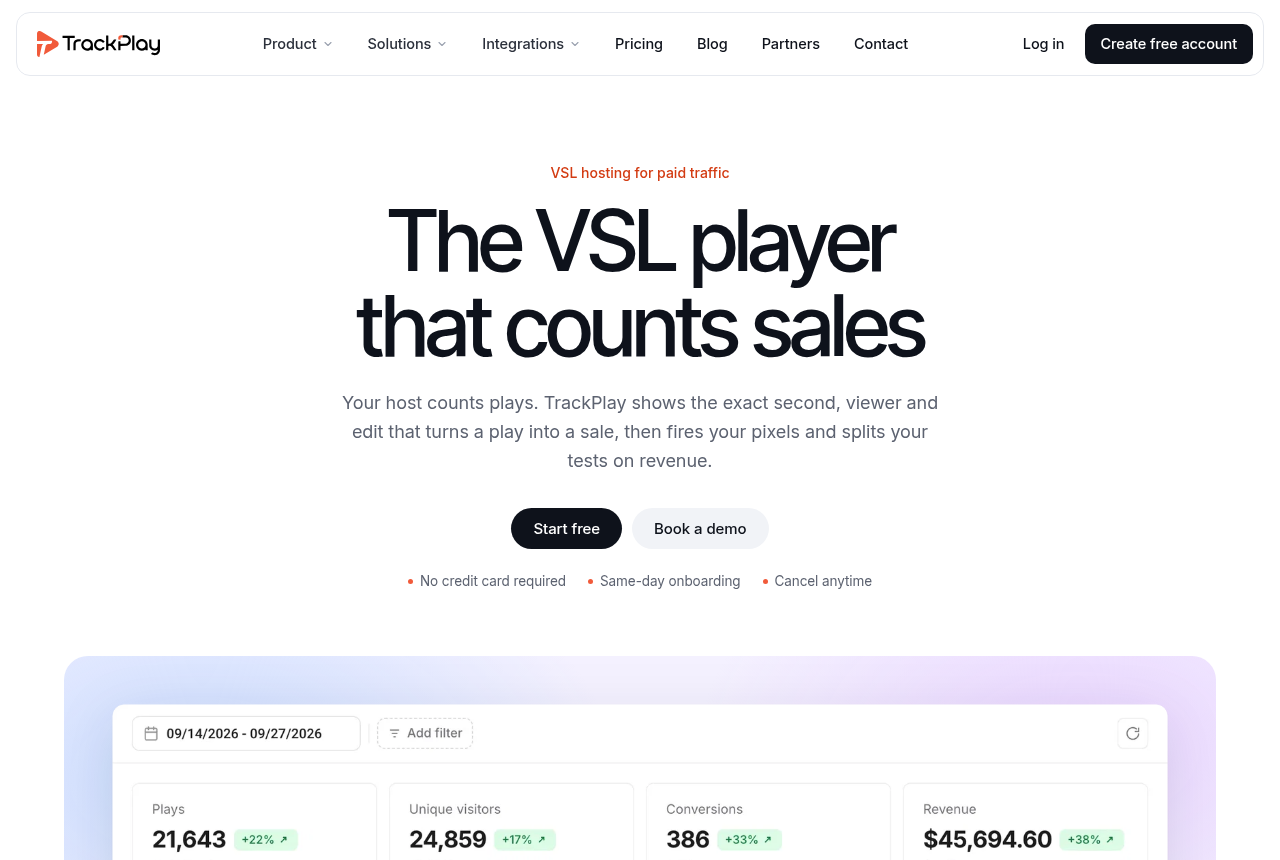
TrackPlay also sends ViewContent for a CTA click and for a watch milestone, and it sends a custom HotLead before the purchase. That matters when the campaign is still learning from how far people watch, and the purchase is hours later. Offer links, lander rotation and a network postback stay on the tracker. This layer is the player. It is built for a paid-traffic sales video, so webinar tooling, channels and SEO pages sit outside it. The cart post and the watch reports still apply on that sales video.
Outside reviews are still sparse, which is expected for a player this new. Signup requires an invitation code. Play-based plans and the cart list are written up in the TrackPlay review. Read that before you point a live ad at it.
Checks before you trust the purchase count
Keep the browser copy and the server copy on that shared id, inside the 48-hour window SyncTag records. Then set those Ads Manager purchases next to the orders the cart took. The Overview total counts both copies before the merge, so it is the wrong column.
Operators using Elevar, a Shopify connector for the browser pixel and the server copy, report deduplication problems, a low catalog match rate and lower event volume. Treat a connector that owns both senders as something you reconcile against store orders for a full week before you scale the campaign that reads those events.
PeerClick's homepage advertises native Facebook CAPI, and Google Enhanced Conversions, as part of its cookieless server-to-server tracking. The anti-fraud kit starts on Advanced at $399 a month. The PeerClick review breaks the plans down.
Voluum's features page describes that pass-through. Whether Binom's v2 connector for Meta is ready for paid social traffic is the question its review answers. The best ad tracking roundup ranks trackers by traffic type and monthly cost.
Questions on tagging and cookies
Does a tagging host do the same job as the tracker that posts the sale?
Do cookies still matter once the sale posts from the server?
Start with the RedTrack review
That review is the next page when paid social is the traffic and the tracker has to post the sale. The other guides cover the rest of the paid-traffic stack, and every tool named here has its own review.
Sources
The merge rule and the Overview count are from SyncTag on Meta double counting. The tier details are from RedTrack pricing, ClickFlare pricing, AnyTrack pricing, Stape pricing and SegMetrics pricing.
The cart Purchase and the watch events are from TrackPlay's Meta integrations page. The postback pass-through is from Voluum's features page, and the homepage CAPI line is from PeerClick's homepage.
The two-container setup and the first-party cookie line are from Google's client-side versus server-side tagging page. A comment on r/ServerSideTagging describes the shop webhook that fires when the order is placed. The 3 to 7 day cookie window, the 400-day refresh, and the remaining browser blocks on a custom loader are from Stape's tagging guide.
Related reading

Written by
Marcus Flynn
Tracking and attribution editor
Marcus Flynn runs OfferROAS's tracking and attribution desk. He covers direct-response paid media for this site, from the tracker to the merchant account. He reads operator threads, vendor changelogs and pricing pages, then writes what those sources support. He sets the methodology and puts his name on the commercial pages.
Last checked 2026-11-24
Comments
No comments yet. Questions and your own experience are welcome.
Thank you. Your comment will appear once it has been reviewed.