Head-to-head
RedTrack vs FunnelFlux Pro
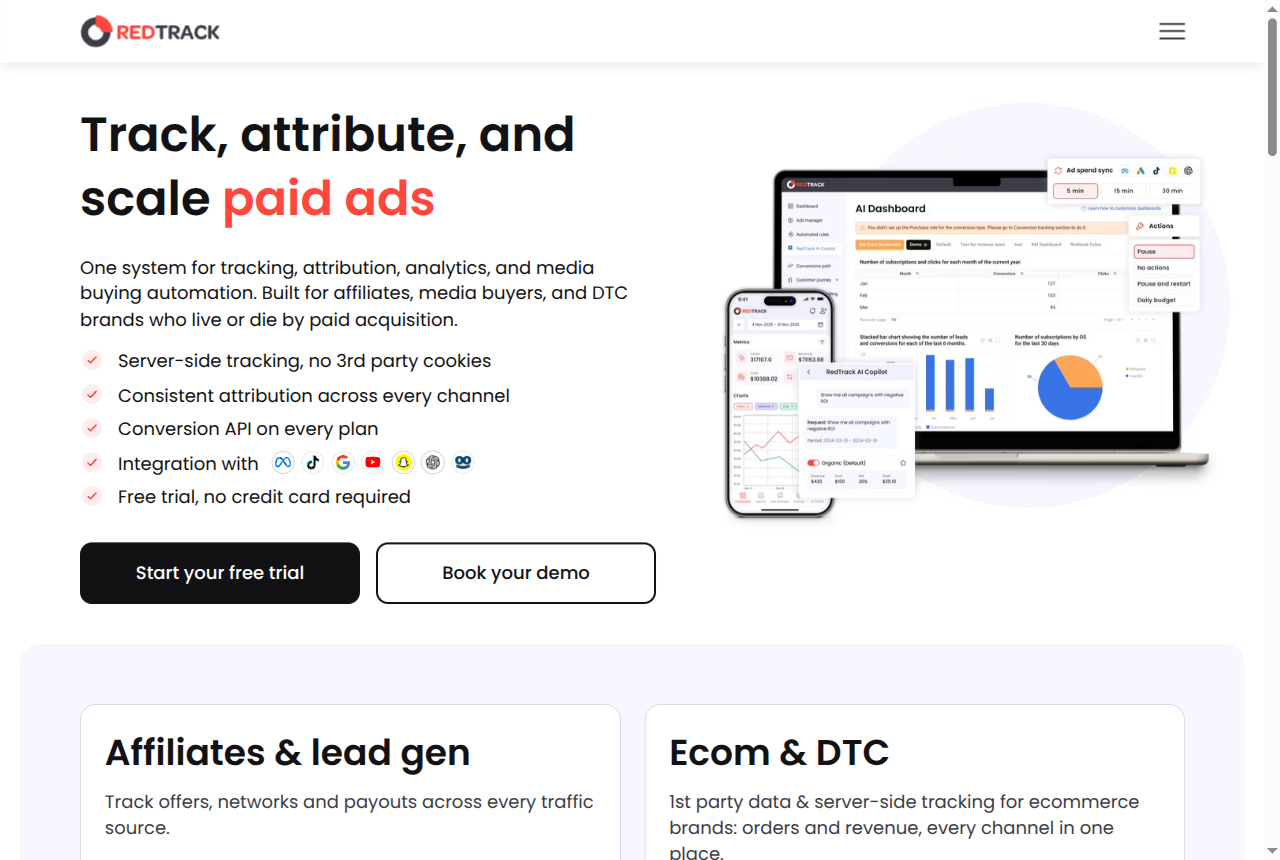
You are choosing between two cloud trackers. Both record the clicks and conversions of paid traffic, both are hosted for you, and both send conversions back to the ad platforms. RedTrack matches spend to each ad, and CAPI is included on the Solo plan. FunnelFlux draws the funnel as nodes on a canvas.
By Marcus Flynn, tracking and attribution editor. Updated 23 October 2026.
Quick answer
Pick RedTrack if you want spend matched to each ad on Solo, with conversions sent back to the ad platforms. Pick FunnelFlux if the funnel branches across landers, splits and upsells and you want that path on a canvas.
- RedTrack. Ad-level spend, with CAPI on the Solo plan
- FunnelFlux. A node canvas for a branching funnel
Side by side
| Tool | CAPI | Cost sync | Layout | Events | Trial | From |
|---|---|---|---|---|---|---|
| RedTrack | On Solo | By the ad | Tables | 5 million | 14 days | $169/mo |
| FunnelFlux | Included | Manual | Canvas | 2 million | 14-day card | $99/mo |
RedTrack: pros and cons
What works
- The Solo plan includes server-side CAPI for Meta, TikTok, Google and Snapchat. Several rivals offer that only on a four-figure plan.
- Ad-spend sync down to the ad level keeps ROAS and CPA tied to current spend.
- It sits between a pure click tracker and a revenue-attribution suite, so one tool covers affiliate offers and a store you own.
- Published tiers run from Solo through Enterprise, so you can forecast the bill as seats and events grow.
What to watch
- Faster ad-spend sync, every 5 or 15 minutes, and the Ads Manager control layer are paid add-ons on top of the plan, so the real monthly cost at scale runs above the headline price.
- It is a media-buying tracker. Long, call-heavy sales cycles that need full multi-touch attribution fit Hyros better.
- You supply the UTMs, the pixel and the CAPI setup. RedTrack shows what is broken and leaves fixing it to you.
FunnelFlux: pros and cons
What works
- The visual builder maps the whole path, from source and prelander through quiz, split, offer and upsell, as connected nodes. Drop-off and revenue are visible at each step.
- Cookieless JavaScript tracking plus server-to-server postbacks, and server-side conversions to TikTok, Facebook, Microsoft and Google Ads.
- Reporting drills down across many grouping levels with geo and device breakdowns, so you can find the country, placement or lander carrying a campaign.
- The canvas and server-side conversions are both on the single base plan.
What to watch
- You still host your own landers. Pages are built in another tool.
- Cost from Facebook, native ads and other CPM sources does not sync automatically. You bring that cost in through Argosync, a separate tool, or a manual upload.
- The bill climbs with events, so a high-volume pop or push buyer can pay more than on a flat license such as Binom.
- The user community is smaller than Voluum's, and long-time users describe a learning curve and less help from other buyers.
The real differences
What each one actually is
RedTrack is a cloud tracker you log into. You connect ad accounts, send clicks through it, and it records each click and conversion on its servers. Spend is matched back to the ad, and conversions go out through the ad platforms' APIs. The audience is affiliates, media buyers and DTC brands buying paid traffic. One account can cover an affiliate offer and a store you own. The vendor hosts it.
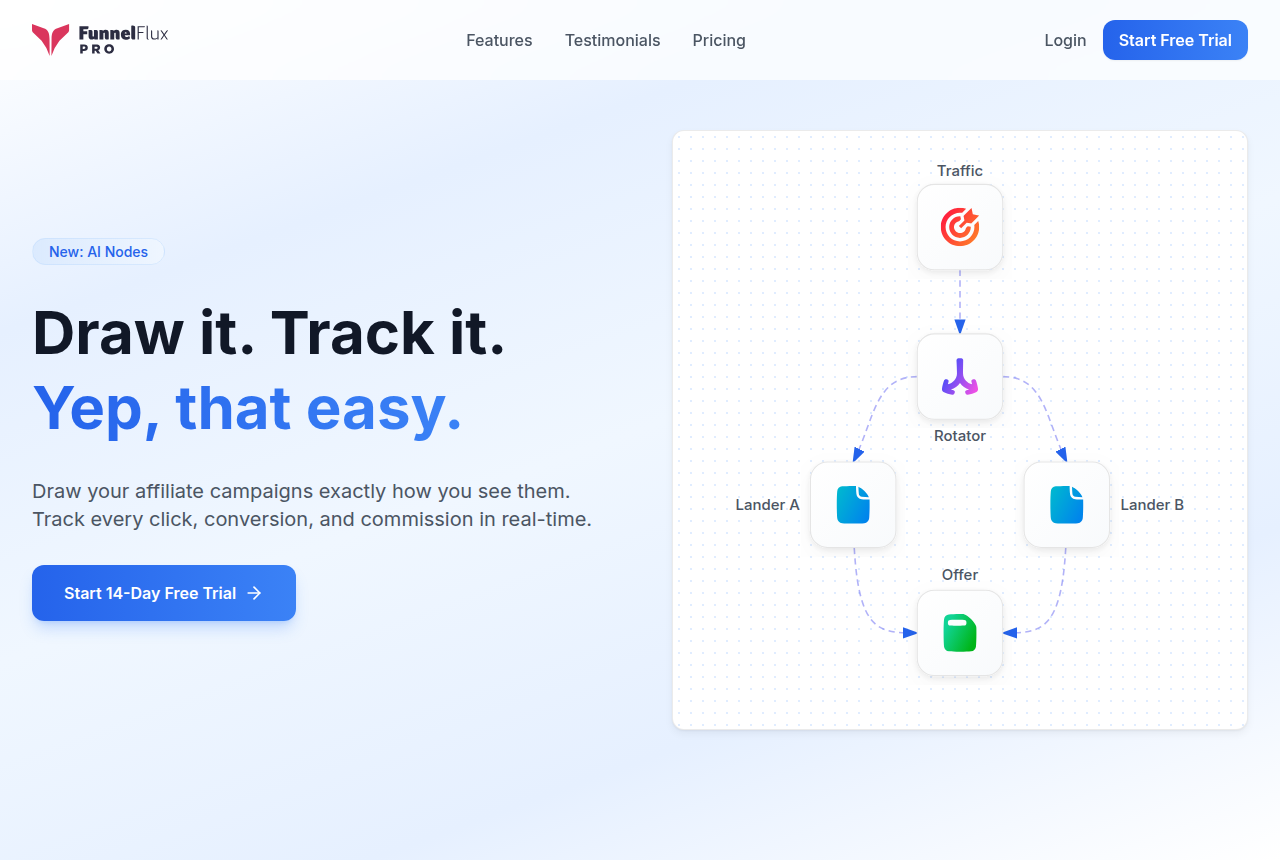
FunnelFlux is a cloud tracker for the same buyer, built around a canvas. You map the visitor's path as connected nodes. The homepage headline uses the words draw it and track it.
Under the diagram, tracking uses cookieless JavaScript and server-to-server postbacks. Reports group by several levels at once. FunnelFlux Original was a self-hosted product sold under a one-time license. FunnelFlux Pro is the cloud product you can buy today. A forum thread about a license you install is about the original.
How they track
RedTrack is built for the paid-media loop. The Solo plan includes CAPI for Meta, TikTok, Google and Snapchat. Spend syncs to the ad every 60 minutes on that plan, and every 30 minutes on Team and Enterprise. ROAS and CPA then follow what that ad spent, rather than a campaign average that is hours old.
FunnelFlux is built for the path. A source can lead to a prelander, a quiz, a conditional split and two offers, with upsells and email steps on the same diagram. You can read where people enter, where they drop and which node earns. Conversions go server-side to TikTok, Facebook, Microsoft and Google Ads, and Snapchat is in the works. Cookieless JavaScript keeps the record when a redirect pixel fails. You enter cost by hand for Facebook, native ads and other CPM sources. Pass it in URL tokens, upload a file, or run Argosync, a separate tool.
Where they part
Two differences decide this match. RedTrack attributes ad spend to each ad. FunnelFlux leaves that to tokens, uploads or Argosync. FunnelFlux turns a branching funnel into a diagram you can read node by node. RedTrack keeps campaigns in tables, which is faster for one ad and one offer, and harder to read once the funnel branches.
Buyers who need live profit by ad get more from RedTrack. That is why RedTrack stays the default for this job. Buyers running prelanders, quizzes, splits and upsells get more from the canvas.
Who each one is for
RedTrack fits buyers on paid social, Google and other networks, including stores that reconcile refunds and repeat purchases with ad spend. Tables get clumsy once a funnel has many branches. Phone sales that close weeks later belong with a revenue-attribution tool.
FunnelFlux fits the buyer who wants the whole path on one diagram. For a plain ad-to-offer campaign it is more machinery than the job needs. The user community is smaller than Voluum's, and long-time users describe a learning curve. You still bring your own landers.
What each one costs
Builder is gone. The affiliate plans are Solo, Team and Enterprise.
- Solo. The monthly price is $169. A year paid up front is $1,420, a 30% discount, and RedTrack's pricing page keeps that rate when the year renews. The same page lists the yearly price as $118 a month. The plan includes 5 million events, one user and five ad accounts on each ad platform. Past that allowance, events are $0.04 per 1,000. An event is a click, a conversion or a postback. Ad spend syncs down to the ad every 60 minutes.
- Team. Team costs $399 a month and $3,352 for the year. Coverage is 20 million events and five users. Extra events are $0.035 per 1,000, and spend syncs every 30 minutes.
- Enterprise. Enterprise is $999 a month, or $8,392 billed once for the year. It covers 75 million events and 15 users. Past the cap, events are $0.025 per 1,000. Ads Manager and Scale Rules are included on this plan.
Each affiliate plan opens with a 14-day trial. Faster sync, and Ads Manager on Solo and Team, are add-ons priced by monthly ad spend.
FunnelFlux has one base plan at $99 a month, with 2 million events included. Extra events are $10 per million. The trial is 14 days, and a card is required to start it.
Month to month, that base plan is the smaller bill. Getting to 5 million events on the FunnelFlux plan costs $129, which is under Solo's monthly price. The yearly Solo rate of $118 a month is lower than that $129. A buyer who uses the full allowance and pays for the year spends less with RedTrack. Adding another million events beyond Solo costs an extra $40. Beyond the Solo allowance, FunnelFlux's overage is the lower charge, so its monthly bill falls below RedTrack again.
Our pick
RedTrack
RedTrack is the pick when you want the vendor to host the tracker, send conversions back to the ad platforms, and match spend to each ad.
Frequently asked questions
RedTrack or FunnelFlux: which should I pick?
Is RedTrack or FunnelFlux cheaper?
Does FunnelFlux sync ad spend the way RedTrack does?
Does RedTrack have a visual funnel builder like FunnelFlux?
Do both send conversions back to Meta and Google?
What changed on this page
-
Builder is off the affiliate card. The plans are Solo, Team and Enterprise at the current list prices and the yearly rate. FunnelFlux is the lower monthly price. RedTrack stays the pick when spend has to match the ad.
Sources
Other sources
5 discussions and reviews read for this page. Quotes are excerpts; open a link to read the original in context.
- [rt-capi] RedTrack | All-in-one Performance Marketing Analytics Platform
- [rt-pricing] Plans & Pricing - RedTrack
- [ff-draw] FunnelFlux Pro - The #1 Funnel Tracker
- [ff-only] FunnelFlux Pro - The #1 Funnel Tracker
- [ff-s2s] FunnelFlux Pro - The #1 Funnel Tracker
How we compared these
We do not run paid campaigns through either tool. We read each vendor's documentation and pricing pages, verify the figures there, and weigh long-term reports from operators. The full rubric is on the methodology page.
Related reading
- RedTrack review
- FunnelFlux Pro review
- RedTrack vs Voluum
- Binom vs FunnelFlux Pro
- Best ad tracking and attribution software
- All head-to-head comparisons
Comments
No comments yet. Questions and your own experience are welcome.
Thank you. Your comment will appear once it has been reviewed.