Skip to content
Menu

Review

Sticky.io review: is it legit, and is it worth it?

By Marcus Flynn, tracking and attribution editor. Updated 14 October 2026.

Quick answer

Sticky.io is our top pick for most people. Sticky.io is a real, long-running subscription CRM that bundles billing, a drag-and-drop checkout builder and routing across 160+ payment gateways under one published fee schedule. It is the pick if you run continuity offers on paid traffic and want the CRM, a checkout you can split test and automatic cascading between gateways in one contract, with fees you can model before the demo. You will regret it if your volume is small, if you want to try it yourself before talking to sales, or if nobody on the team has time to check billing rules, because the licence and revenue share are sized for operators doing real subscription volume.

  • Sticky.io. Best for continuity sellers who want billing, checkout and gateway routing on one contract. From $499/mo.

Where Sticky.io fits

Sticky.io is a real, long-running subscription CRM that bundles billing, a drag-and-drop checkout builder and routing across 160+ payment gateways under one published fee schedule. It is the pick if you run continuity offers on paid traffic and want the CRM, a checkout you can split test and automatic cascading between gateways in one contract, with fees you can model before the demo. You will regret it if your volume is small, if you want to try it yourself before talking to sales, or if nobody on the team has time to check billing rules, because the licence and revenue share are sized for operators doing real subscription volume.

It is at its best for continuity sellers who want billing, checkout and gateway routing on one contract. That is the lens the rest of this review uses: not whether it is the biggest tool on the market, but whether it is the right one for that operator.

Is Sticky.io legit?

You saw Sticky.io next to Konnektive or Checkout Champ on a list of continuity CRMs, clicked through, and found a demo form where a signup button usually sits. Before you give an hour to a sales call, you want to know whether the company is solid and whether the bill will make you regret it.

The company is real and has been around a long time. Sticky.io, which was called Limelight before the rename, says it has been in the market for more than 17 years and processes about $12 billion a year for its merchants. Konnektive, its closest rival, quotes after a call. Sticky.io prints its licence, revenue share and decline fee on its pricing page. When buyers do regret it, the reasons are cost at volume and the billing screens, and both are covered below. If cost is your first question, see the Sticky.io fee schedule worked out.

What the Sticky.io CRM handles

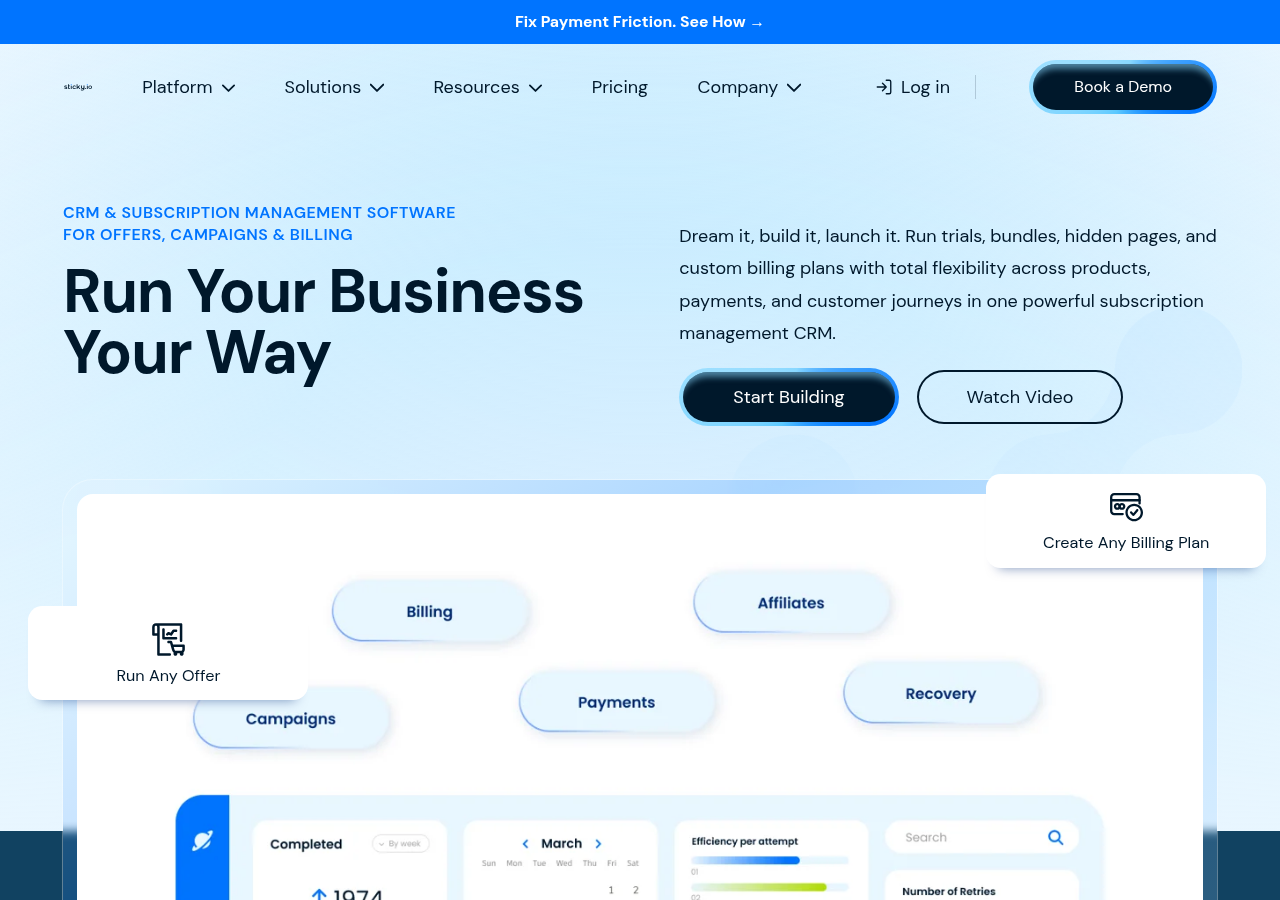
The CRM is the back office of a subscription offer. Sticky.io's CRM page lists campaigns, flexible billing plans, affiliate tracking and analytics. That covers how and when each customer is charged, which affiliate a sale is credited to, and the reporting on who stays and who cancels.

It also works headless. The pricing page lists full API access and more than 400 integrations, so a team with its own landers can run the CRM behind them and ignore the builder. Attribution stays outside it: the CRM records orders, and an ad tracker such as RedTrack is still what ties each order to the campaign that paid for it. Recovery is a separate add-on, priced on request and charged only on revenue it recovers.

The checkout and funnel builder

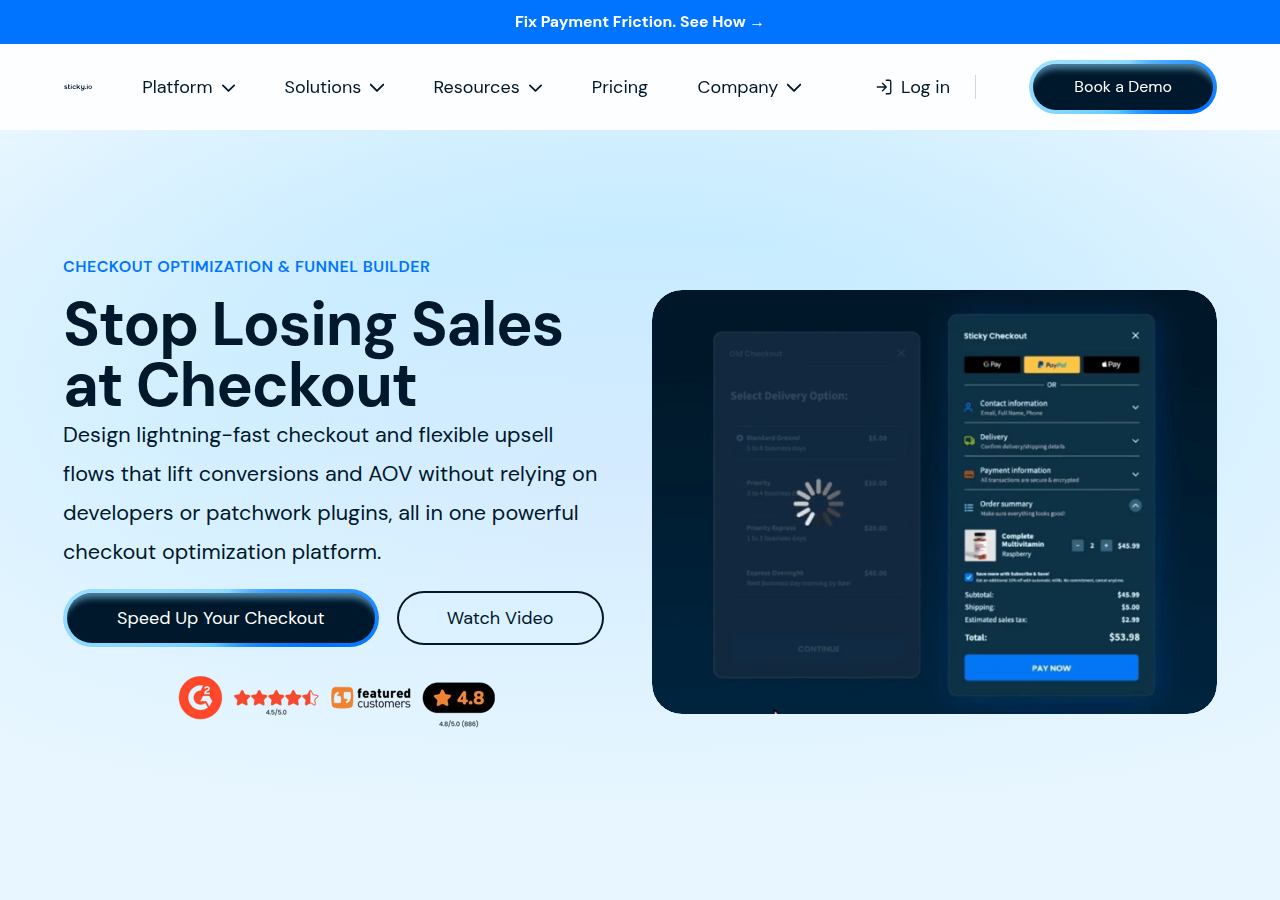
The second half of the bundle is where Sticky.io parts ways with Konnektive. Konnektive hands you form code to paste into pages you build elsewhere. Sticky.io includes a drag-and-drop funnel and checkout builder aimed at cold paid traffic, with a single-page checkout, order bumps and one-click upsells after the first purchase.

Testing lives in the same builder. The checkout page describes A/B and multivariate tests on headlines, styles and field options, so a media buyer can test the order form without bolting on a second tool. Our Konnektive vs Sticky.io head-to-head sets the two side by side on builder, gateways and billing.

Payments: 160+ gateways and automatic cascading

Sticky.io routes payments across more than 160 gateways and cascades a declined charge to another gateway automatically. For a continuity seller with rebills spread over several merchant accounts, that routing is usually the reason it makes the shortlist.

The support center documents the outage case too. In a payment routing profile, if the primary gateway goes down, all sales traffic moves to the backup gateway. How much routing lifts approvals depends on your MIDs and your traffic, so ask on the demo how the rules are set and how the results are reported. With several MIDs in play, our chargeback ratio calculator shows where each one sits against the card-network thresholds.

Who should look elsewhere

A store with one product, one Stripe account and modest volume would pay a licence and a revenue share for routing it barely uses. Funnelish prices on visitors and keeps no commission on sales, and SamCart is built for sellers of courses and downloads.

Konnektive advertises more than 250 processors and suits a team that already builds its own pages and accepts a quoted, prepaid contract. Checkout Champ licenses the Konnektive engine and adds funnel pages, which makes it the most direct rival to the Sticky.io bundle. The rest of the options are on the Sticky.io alternatives page.

When Sticky.io is worth the fee

It earns its cost when billing logic is the hard part of the business: several subscription products, trials that convert to paid plans, rebills across many merchant accounts and affiliates to credit. Below that level, a simpler cart costs less and goes live faster.

Plan for the onboarding as well. With no trial to explore, the demo is your test. Bring a real scenario, such as a cancelled product with a linked add-on, and ask to see the billing history afterwards, because that is where long-term users have complained.
Pros and cons

What works

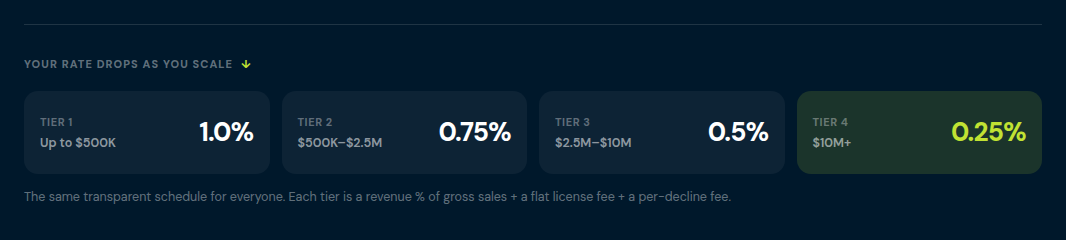
  • The rate card is public: a base licence, a share of gross sales that drops at four volume tiers, and a per-decline fee, so you can model the bill before any sales call.
  • CRM and checkout come in one bundled price, so the subscription records and the funnel pages that feed them sit in the same account.
  • The checkout builder runs A/B and multivariate tests on headlines, styles and field options, with single-page checkout, order bumps and one-click upsells.
  • Routing reaches 160+ payment gateways with automatic cascading after a decline, and the help center documents moving all traffic to a backup gateway during an outage.
  • Long-term users single out gateway cascading and how easy it is to reprocess declines.
  • Full API access and 400+ integrations let a team run the CRM headless behind pages built elsewhere.

What to watch

  • Users call it expensive compared with other billing software, and the revenue share and decline fees rise with every sale and every failed card.
  • Software Advice reviewers report occasional billing glitches and a billing history that is hard to tie to a single product.
  • One reviewer found that a linked product kept billing after its parent was cancelled, so cancellation rules need checking on the demo.
  • There is no free trial or self-serve signup. Every account starts with a demo and onboarding run by the sales team.
  • Outside reviews are few and mostly from 2018 to 2022, which leaves the current product thinly covered by independent users.
  • Recovery is an extra, priced on request as a share of the revenue it wins back.
Sticky.io's pricing page tiers: 1.0% of gross up to $500K, 0.75% from $500K to $2.5M, 0.5% from $2.5M to $10M and 0.25% above $10M, with a note that each tier adds a flat licence fee and a per-decline fee.
Revenue-share pricing tiers. Sticky.io's pricing page tiers: 1.0% of gross up to $500K, 0.75% from $500K to $2.5M, 0.5% from $2.5M to $10M and 0.25% above $10M, with a note that each tier adds a flat licence fee and a per-decline fee. Screenshot: sticky.io,
Sticky.io's CRM page with module labels for Campaigns, Billing, Payments, Affiliates and Recovery above the top of a dashboard showing completed orders, a calendar and retry efficiency.
Subscription CRM. Sticky.io's CRM page with module labels for Campaigns, Billing, Payments, Affiliates and Recovery above the top of a dashboard showing completed orders, a calendar and retry efficiency. Screenshot: sticky.io,
Sticky.io's checkout page with a mock single-page checkout listing Google Pay, PayPal and Apple Pay buttons, contact, delivery and payment sections, an order summary and a subscribe-and-save checkbox above the Pay now button.
Single-page checkout. Sticky.io's checkout page with a mock single-page checkout listing Google Pay, PayPal and Apple Pay buttons, contact, delivery and payment sections, an order summary and a subscribe-and-save checkbox above the Pay now button. Screenshot: sticky.io,

What users actually say about Sticky.io

Research: unverified

Published fee stack

Sticky.io sells CRM and checkout at one bundled price: a monthly licence, a share of gross sales that steps down at four published tiers, and a fee on each declined transaction. Recovery is a separate add-on priced on performance.

“CRM and Checkout in a single bundled price.”

Anonymous Blog

Billing operations friction ↓ common complaint

Software Advice reviewers report billing glitches, a linked product that kept billing after its parent was cancelled, and a billing history that is hard to read product by product.

“It's very difficult to look at billing history and see what charges are associated with a particular product the customer has purchased.”

David G. Capterra: David G. review

“Sometimes it can experience billing glitches. Program needs a command feature if "product a" is cancelled auto cancel "product b" so it doesn't continue to bill”

Anonymous Capterra

Payments strength ↑ frequently praised

Users praise cascade billing and how easily declines can be reprocessed, and the vendor documents moving all traffic to a backup gateway when the primary one goes down.

“The best feature of sticky.io for our business was the cascade billing and the ease of use of the reprocessing of declines”

Austin O. Capterra: Austin O. review

“If an outage takes place with Gateway 1 and you are using this feature, all of your sales traffic would route to Gateway 2.”

Anonymous Blog

Cost and fit

One reviewer finds it expensive compared with other billing tools. Sellers weighing checkout platforms recommend Sticky once subscription logic gets complex.

“The software is very expensive compared to other billing softwares.”

Austin O. Capterra

“Sticky fits when billing logic and subscription management get more complex.”

u/Netalico Reddit

Checkout and testing ↑ frequently praised

The checkout product is a visual builder with A/B and multivariate tests on headlines, styles and field options, aimed at paid-traffic funnels.

“Run effortless A/B and multivariate tests on headlines, styles, and field options to uncover high-converting variations and squeeze every drop of revenue from your traffic”

Anonymous Blog

The evidence, quoted

“CRM and Checkout in a single bundled price.”

Anonymous Blog

“Run effortless A/B and multivariate tests on headlines, styles, and field options to uncover high-converting variations and squeeze every drop of revenue from your traffic”

Anonymous Blog

“It's very difficult to look at billing history and see what charges are associated with a particular product the customer has purchased.”

David G. Capterra: David G. review

“Sometimes it can experience billing glitches. Program needs a command feature if "product a" is cancelled auto cancel "product b" so it doesn't continue to bill”

Anonymous Capterra

“The best feature of sticky.io for our business was the cascade billing and the ease of use of the reprocessing of declines”

Austin O. Capterra: Austin O. review

“The software is very expensive compared to other billing softwares.”

Austin O. Capterra

“Sticky fits when billing logic and subscription management get more complex.”

u/Netalico Reddit

“If an outage takes place with Gateway 1 and you are using this feature, all of your sales traffic would route to Gateway 2.”

Anonymous Blog

The praise is about payments. A reviewer on Software Advice wrote: "The best feature of sticky.io for our business was the cascade billing and the ease of use of the reprocessing of declines". In an r/shopify_growth thread about leaving Checkout Champ, one commenter summed up where it fits: "Sticky fits when billing logic and subscription management get more complex."

The complaints are about cost and the billing screens. The same Software Advice reviewer who praised cascading found the platform far more expensive than other billing tools. Another wrote that "it's very difficult to look at billing history and see what charges are associated with a particular product the customer has purchased." An older review reports billing glitches and asks for a rule that cancels a linked product when its parent is cancelled. These reviews date from 2018 to 2022, so they describe earlier versions of the platform.

Sticky.io pricing: licence, revenue share and declines

Sticky.io sells CRM and Checkout as one bundle. The bill has three parts: a monthly licence, a share of monthly gross sales that falls as volume grows, and a fee on each declined transaction.

FeeAmount
Licencefrom $499/mo
Gross to $500K1.0%
$500K to $2.5M0.75%
$2.5M to $10M0.5%
Above $10M0.25%
Per decline$0.04, less at scale
RecoveryOn request

At $300K of monthly gross you sit in the first tier, so the revenue share alone comes to $3,000 a month before the licence and decline fees. Sticky.io's own calculator, set to $1M of monthly gross, estimates $10,080 a month: a $2,500 licence, plus 0.75% of sales, plus estimated decline fees. That example also shows the licence rising with volume, so ask for the licence figure at your own volume on the demo. Your processor's fees come on top of all of it.

Sticky.io pricing: licence, revenue share and decline fees

Changelog

  • 14 October 2026: First published. Fees and features come from Sticky.io's pricing, checkout, CRM and payment routing pages, and user reports from Software Advice and Reddit.

Frequently asked questions

How much does Sticky.io cost?
From $499 per month. One bundled CRM and Checkout licence, plus a share of monthly gross sales that steps down across four published tiers, plus a fee on each declined transaction. Recovery is sold separately on a performance basis. No free trial; signup runs through a demo.
Does Sticky.io offer a free trial?
No. Sticky.io advertises no free trial, and every account starts with a demo booked through its sales team.
Is Sticky.io legit?
Yes. It is an established billing vendor that publishes its fees. Most outside reviews are a few years old, so confirm how billing behaves during the demo.
How is Sticky.io different from Konnektive?
Sticky.io ships a visual checkout builder with its CRM and prints its rate card. Konnektive expects you to bring your own pages and gives you a price after a call.
Does Sticky.io include a funnel builder?
Yes. The Checkout half of the bundle is a drag-and-drop builder for funnels and order forms, with split testing built in.
Will I still need an ad tracker?
Yes, if you buy traffic. Sticky.io records the order, and a tracker connects that order to the ad and the click that produced it.

Sticky.io's own pages

How we reviewed this

We do not run paid campaigns through Sticky.io. We read its own documentation and pricing, verify every number against the vendor, and weigh the long-term reports of operators who run it at real spend. The full rubric is on the methodology page.

Related reading

Marcus Flynn

Written by

Marcus Flynn

Tracking and attribution editor

Marcus Flynn runs OfferROAS's tracking and attribution desk. He has spent years close to direct-response paid media, and he reads the operator threads, vendor changelogs and pricing pages so you do not have to, then writes down what holds up once real budget runs through it. He owns the methodology and signs the site's money pages.

marcus@offerroas.com

Last checked 2026-10-14