Push for the NMI payment gateway when your ISO or funnel stack already supports it and you need several merchant accounts on one gateway login. Approval of a high-risk file stays with the processor behind that ISO.
My take
I would ask the ISO whether the contract already names NMI before I looked for another provider. I would skip a pitch that treats the gateway as the bank's approval. I would judge the quote by which bill changed: the processor markup, the partner's gateway fee, or the checkout software.

Who NMI is built for
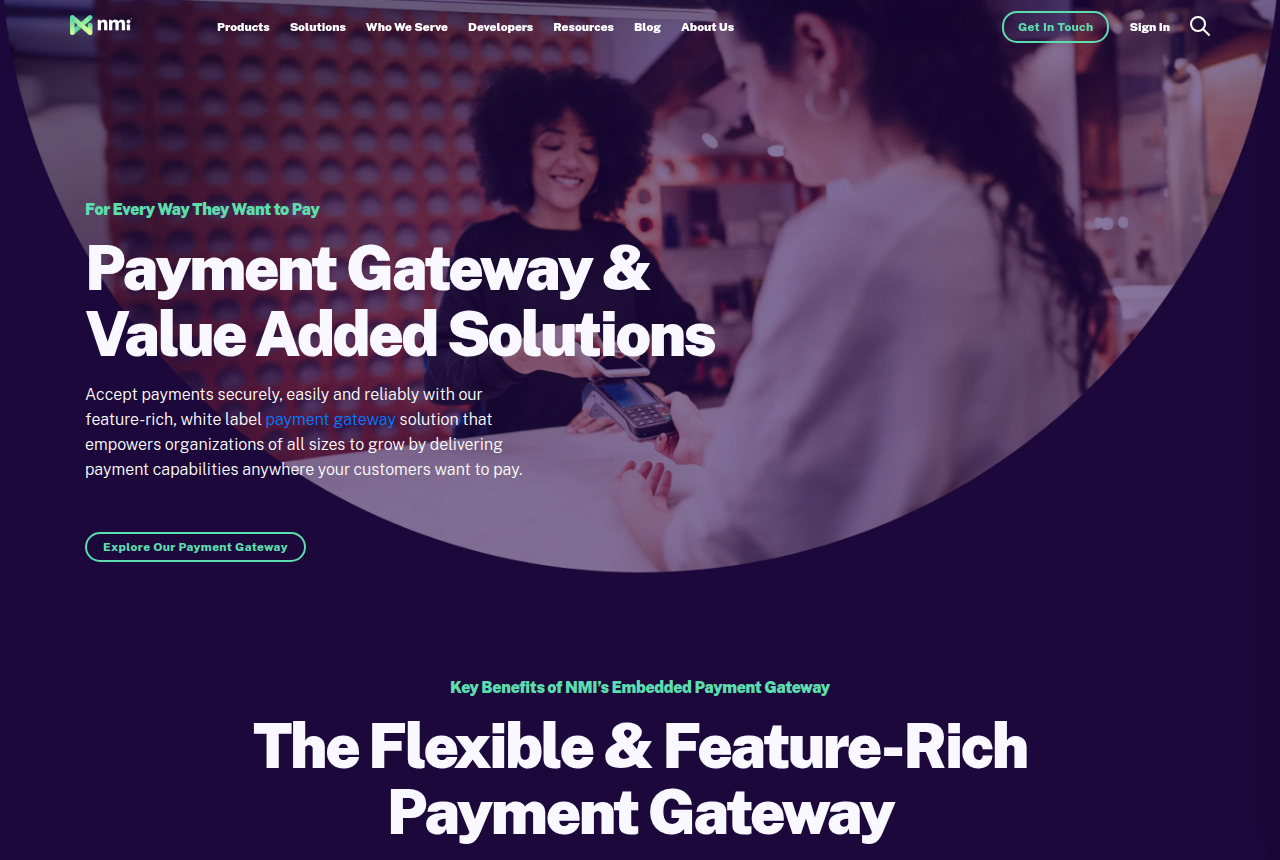
NMI's homepage describes an embedded payments platform for ISOs and software vendors. The white-label gateway is one module inside that platform. A merchant usually reaches it through a reseller, a CRM, or a checkout integration. Stripe is an account you open on Stripe's own site.
The same homepage sends prospects to Talk to Our Team. That page is the sales path. There is no rate card sitting next to a signup button.
NMI's IntegralPay case study says that company specializes in medium- and high-risk ecommerce merchants, a group that has a hard time finding payment services that are both affordable and reliable. The study says placing those merchants takes a large number of processors. It is NMI's own write-up of a customer. It shows a high-risk ISO using the gateway for processor breadth. The underwriting decision stays with the acquirer on that placement.
Why a high-risk seller ends up here
The gateway product page says NMI integrates with 200+ payment processors and 125+ shopping carts. An ISO can move a difficult file to another processor and keep the same gateway in the checkout. That is the breadth the IntegralPay study is describing.
The same page, and NMI's payments FAQ, say a merchant can onboard and manage several MIDs inside one account, with reporting pulled together there. You can spread volume, keep brands separate, or split card types. Reconciliation stays in that same account.
Which vertical a given processor will board is in the ISO's contract, not in NMI's marketing. A payments-forum thread treats a partner signup as a commercial relationship with its own minimum. The processor behind the ISO is still the party that accepts the file.
NMI gateway fees come in three bills
One sale can generate three charges, and they are set by three different companies.
- The acquirer bills interchange, assessments, and its own markup.
- The ISO or reseller bills the gateway's monthly charge and the per-transaction gateway fee.
- The checkout or CRM can add a platform fee on its own contract.
NMI's FAQ says Tap to Pay uses the same gateway per-transaction fee as any other card-present sale, and that processing fees are set by the processor. A rep who quotes a number you did not see on nmi.com is quoting that partner's schedule. Compare the statement the partner sent with the quote you were given. A blog post is a different document.
A payments-forum post and a Trustpilot review from someone who calls themselves a reseller both describe a monthly minimum on a partner signup, including months when no merchants were submitted. NMI's marketing pages do not publish that minimum.
NMI
- Public rate card
- None. Prospects go to Talk to Our Team
- User reports (16 Oct 2026)
- $100 a month on some partner signups
For a seller whose ISO or checkout already runs on NMI and who needs several MIDs on one login.
How one account routes each sale
On the account above, active routing directives decide which MID receives each sale. The gateway product page describes that choice as automatic, from the directives that are turned on, still inside the one account.
A weighted split that a funnel runs across accounts is a different control. It lives in the checkout software. The gateway page and the FAQ describe directives on one account.
What operators report once they are live
An integrator on a payments forum describes the developer tools as old-fashioned. A merchant who moved from Stripe describes everyday use as frustrating, and behind Stripe.
Partner billing shows up in the two monthly-minimum reports above. Those are single posts. They are not a rate card, and they are not a finding from a regulator.
Reliability praise in the IntegralPay study is the vendor writing about its own customer. Read it as a picture of why a high-risk ISO picked the gateway, then go back to the processor list on the placement you were actually offered.
When to ask for NMI
Ask when the ISO on the contract already runs it, when you need several MIDs with one reporting login, or when a custom checkout has to call one gateway API.
Read the NMI vs Authorize.net comparison when you want a gateway path with a published price and a small-business account bundled beside it.
When the job is subscriptions or a CRM in front of the gateway, start with the Konnektive CRM review, then the Konnektive review or the Checkout Champ review. The Funnelish review and the Sticky.io review cover the other checkout write-ups on this desk.
The ads still need a tracker. The stack picker matches the tracker, the checkout, and the sales-video player to the offer. The ratio that can close a MID is a separate question from which gateway carries the sale. Model a month in the chargeback ratio calculator before you promise an underwriter a number you have not computed.
Sources
Related reading
Written by
OfferROAS Editorial
Editorial desk
OfferROAS Editorial is the desk behind the site's reviews and rankings. We read long-term operator reports, vendor documentation and pricing pages, verify every price against the source, and update the money pages on a fixed schedule. When the sources leave a gap, the page says so in plain words.
Last checked 2026-10-20
Comments
No comments yet. Questions and your own experience are welcome.
Thank you. Your comment will appear once it has been reviewed.