Stripe, PayPal, or Square froze the account, or the continuity rebills keep coming back as disputes. A dedicated merchant account, underwritten for subscriptions, supplements, or direct-response billing, is the relationship that can stay open. Pick an ISO that matches how you bill, and bring a complete file. Searching for instant approval does not skip the bank's review.
PaymentCloud's own high-risk guide says providers underwrite to limit risk, so there is no path that skips that review.
My take
I would start with the chargeback calculator, then the ISO whose limits match how you bill. I would skip PaymentCloud when the funnel enrolls people by negative option. I would judge Durango and PayKings by the reserve they hold and by whether the markup is written down before the first sale.
See where your chargeback ratio sits
Why a direct-response offer gets the high-risk label
Recurring billing, a trial that flips into a paid rebill, card-not-present upsells, supplement or aggressive health claims, and a sudden volume ramp from paid traffic are the patterns that draw the label. PaymentCloud's continuity page classifies those subscription merchants under MCC 5968, Direct Marketing, Continuity/Subscription Merchants, and ties the label to chargeback exposure.
The merchant account is the bank relationship. The gateway is the pipe that carries each transaction. The checkout, whether that is a hosted cart or a billing platform, sits on top of both. Applying to the wrong one of those three is how a seller spends a month in the wrong queue.
The same PaymentCloud guide says payment service providers such as Stripe and Square often close accounts without the upfront underwriting conversation a dedicated MID requires. That is the freeze people are trying to get ahead of.
The bank still reviews
Underwriting still runs. Fast means the documents were complete and a bank would take the vertical. Durango's high-risk page says the phrase does not mean no underwriting. Durango treats many of those offers as a preliminary decision, or as a PayFac signup that can still freeze later.
PaymentCloud's high-risk landing page markets an approval rate over 98 percent, with several acquiring banks. That figure is the company's own marketing. The blog, on a different URL, says the review still happens. Read both and treat the percentage as a marketing claim.
Scaling paid traffic on a PayFac, and planning to move the volume after a freeze, leaves the ads spending against an account that can close without that conversation. Open the dedicated MID before the spend ramps.
The underwriting file to assemble before you apply
Durango expects the site to show a refund and cancellation policy, a shipping or fulfillment timeline, clear subscription billing terms, a way to reach support, and terms and privacy pages before you apply.
PaymentCloud's high-risk page lists the usual file: a government ID, a signed application, a voided check or bank letter, three months of bank statements, three months of processing statements if you already have a processor, and the business and product details.
Durango cites 1 to 3 business days as the most common window for full approval and account setup once that packet is complete.
PaymentCloud after earlier declines
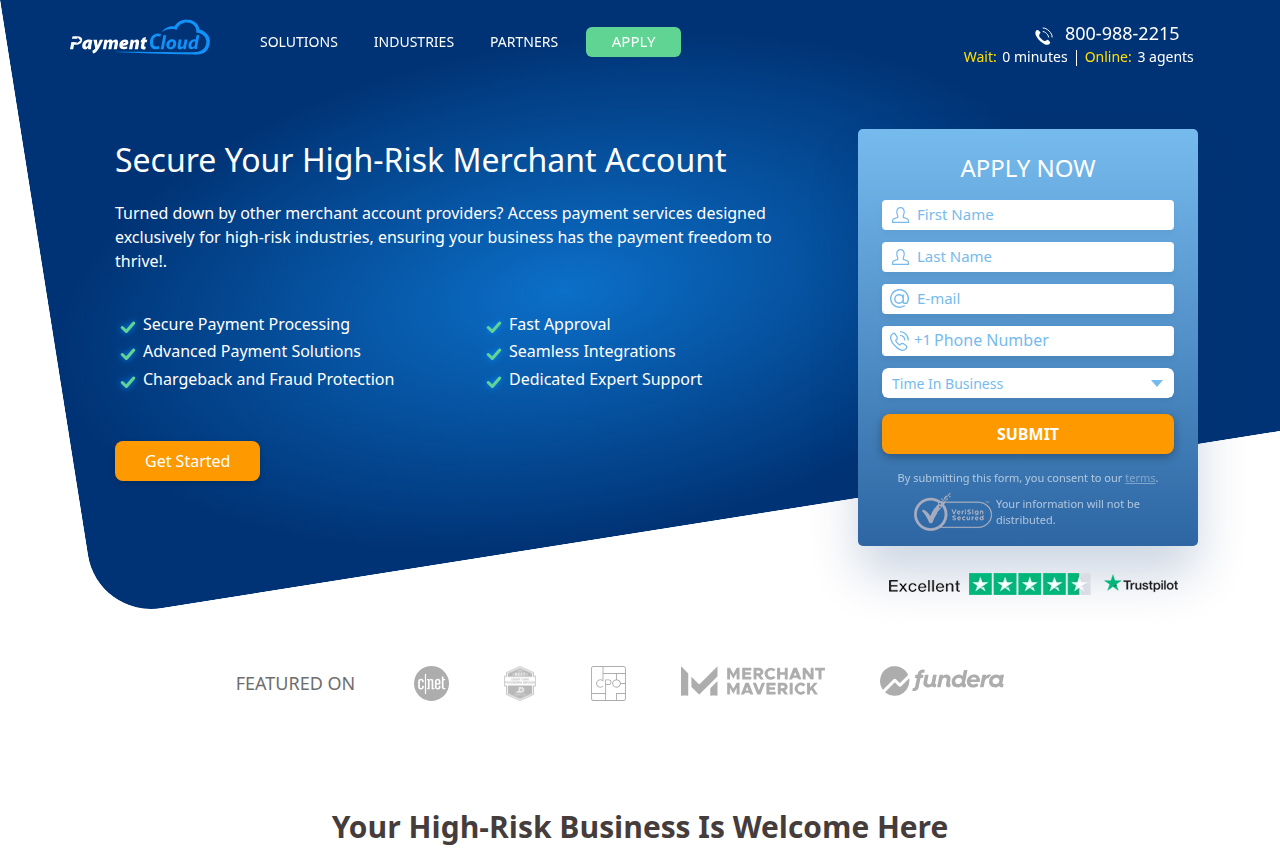
PaymentCloud fits a continuity or online-supplement offer that has already been turned down, when you want a choice of gateways and help moving cardholders off a processor that shut you off. The 98 percent approval line above is marketing from that landing page. It is not an independent count.
The limit that matters for a lot of direct-response continuity is on the continuity page: negative option and auto opt-in are not supported on these accounts. A funnel that enrolls the buyer into rebills unless they uncheck a box cannot run that billing here. Offers that disclose the subscription and require an active opt-in are the ones this account can board.
On a payments forum, one operator described PaymentCloud as the party that moved the paperwork, while EMS, the bank, did the underwriting. That thread is a single report. It is a useful picture of the broker role. It does not name which bank the next applicant will get.
PaymentCloud
- Fee example (16 Oct 2026)
- 3.5% + $0.30 per transaction at $25,000 a month
- Gateways named
- Authorize.net, NMI, and USAePay
For continuity and supplement offers already declined elsewhere, when billing is not negative option.
Durango shapes the underwriting file
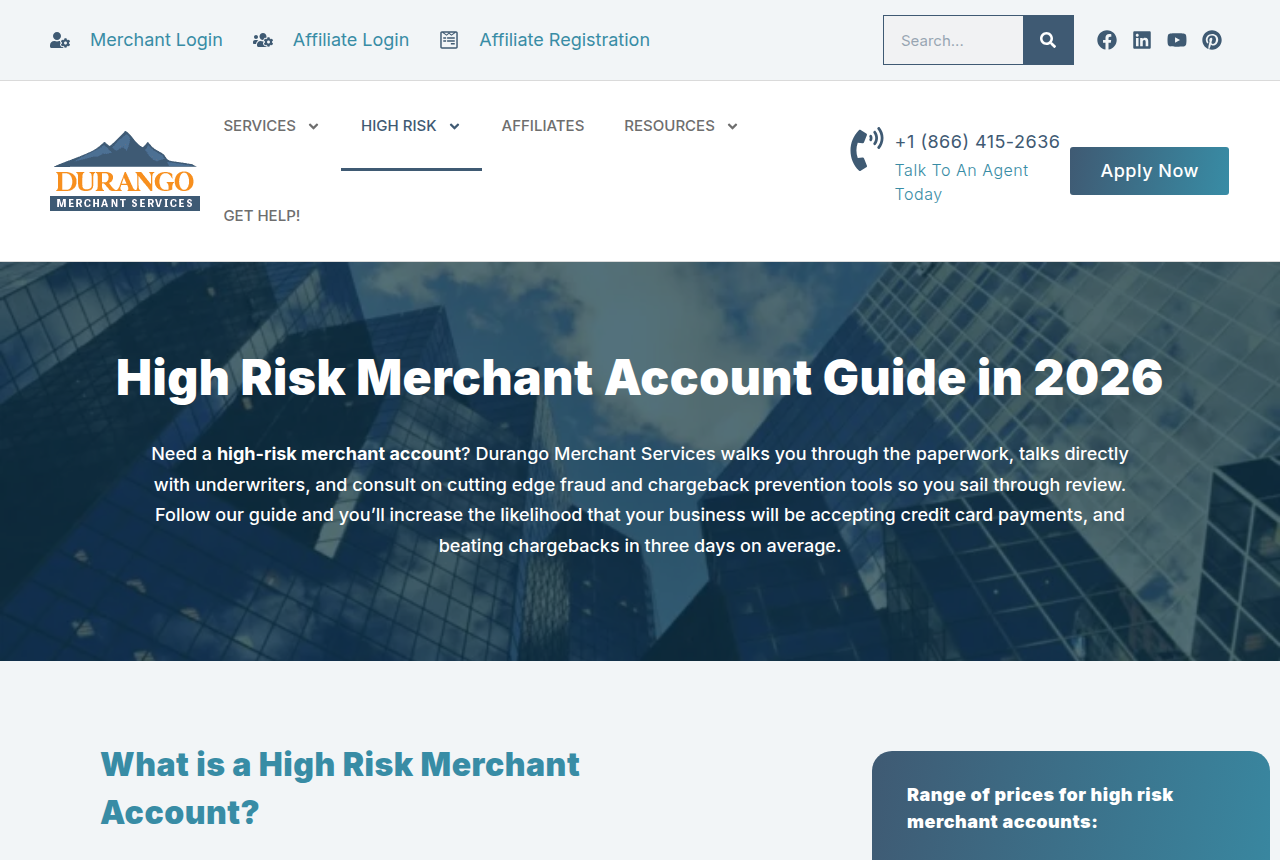
Durango fits a subscription or continuity model that needs a specialist to shape the file, and the reserve, before the volume scales. The public page prints ranges for the discount rate, the per-item fee, and the application cost, and it is the source of the site checklist and the approval window above. The number you are offered is still decided in underwriting.
Durango's own definition of instant approval is in the section above. Use it when a salesperson leads with a same-day yes.
Durango Merchant Services
- Published band
- 1.9% to 5%, per-item fees above 10 to 15 cents, $0 to apply
- Full approval
- 1 to 3 business days when the file is complete
For subscription billing that needs the file and the reserve set before you scale.
PayKings, when you want the markup in writing
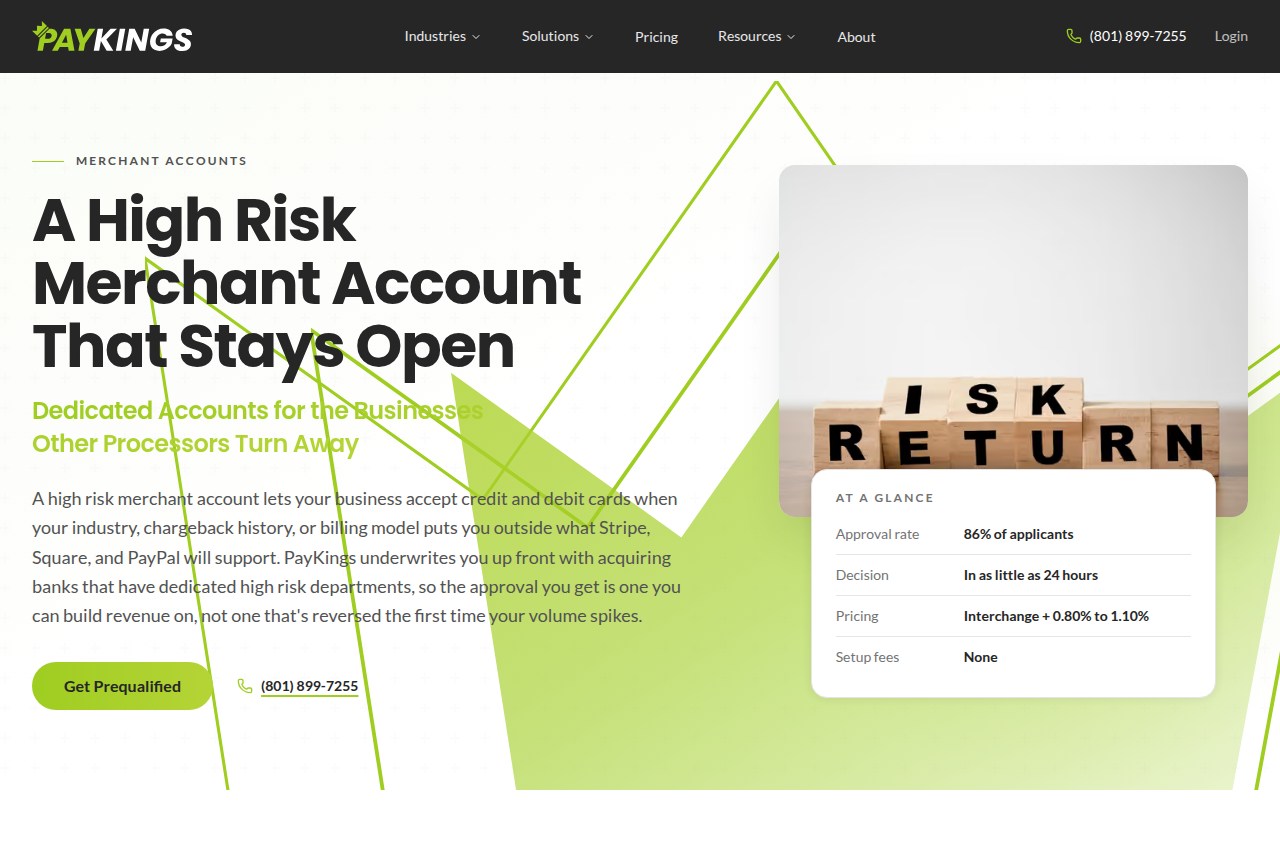
PayKings fits a seller who wants published interchange-plus markups and a dedicated account underwritten before the first sale. The company states that 86 percent of applicants are approved, and that a decision can arrive within 24 hours once the file is complete. Both lines are PayKings' own. The tiers on the card are markups on top of interchange. The effective rate still moves with the card mix, so those percentages are not an all-in price.
A payments-forum thread calls PayKings and Durango decent for this work, and warns that the fees run higher than a standard account. The thread is a single conversation.
PayKings
- Up to $100k a month
- Interchange + 1.10% + $0.25, no setup fee
- $100k to $300k
- Interchange + 0.80% + $0.10, custom above $300k
For a seller who wants the interchange markup published before the first sale.
Where the gateway and the checkout sit
NMI is a payment gateway sold to ISOs and software companies. It routes transactions, and it can host several MIDs on one gateway account. Hosting those MIDs is a routing feature. It is not an approval of the risk, and NMI does not issue the merchant account. The NMI payment gateway review covers the fees and the routing rules.
PaymentCloud names Authorize.net, NMI, and USAePay among the gateways it connects for subscription businesses. The gateway on a given account is decided in that same placement.
The checkout you put in front of that gateway changes how volume spreads across processors. The stack picker matches the checkout to the processor you already have. When the MIDs span more than one processor, pick the billing engine on its own. The Konnektive review and the Checkout Champ review cover platforms that connect to a long list of gateways. Our method page explains how those write-ups are researched.
The chargeback ratio that can close the MID
PayKings says the card networks start monitoring a merchant when chargebacks reach roughly 0.9 percent to 1 percent of monthly transactions. That is one anchor from a processor. Visa's VAMP math and Mastercard's ECP math use different months and different counts, so the same dashboard total can sit under one line and over the other.
Model a month of sales and disputes in the chargeback ratio calculator for Visa VAMP and Mastercard ECP before you promise an underwriter a ratio you have not computed.
Plan the cash around the hold. Durango publishes rolling reserves of 5 percent to 10 percent, held for 90 to 180 days. PayKings says reserves are typically held for six months, and the percentage is set in underwriting. Neither figure is a surprise if it is in the model before the ads scale.
Frequently asked questions
What is a high-risk merchant processing account?
Can I get a high-risk merchant account with instant approval?
How do you judge the best high-risk merchant account for a continuity offer?
Sources
- PaymentCloud, high-risk merchant account guide
- PaymentCloud, high-risk landing page
- PaymentCloud, continuity and subscription accounts
- Durango Merchant Services, high-risk merchant account
- PayKings, high-risk merchant account
- NMI payment gateway
- r/PaymentProcessing thread on PaymentCloud and EMS
- r/PaymentProcessing thread on PayKings and Durango
Related reading
Written by
OfferROAS Editorial
Editorial desk
OfferROAS Editorial is the desk behind the site's reviews and rankings. We read long-term operator reports, vendor documentation and pricing pages, verify every price against the source, and update the money pages on a fixed schedule. When the sources leave a gap, the page says so in plain words.
Last checked 2026-10-14
Comments
No comments yet. Questions and your own experience are welcome.
Thank you. Your comment will appear once it has been reviewed.