Head-to-head
RedTrack vs SegMetrics
One is the tracker most media buyers reach for first, built to stamp every click and post the conversion back into the ad platforms in near real time. The other builds one timeline per contact from ads, email, the CRM and payments. Both beat a last-click pixel, and both feed sales back to the platforms. The funnel you run decides which one you need.
By Marcus Flynn, tracking and attribution editor. Updated 14 November 2026.
Pick RedTrack if you run paid traffic to offers and funnels you route yourself and you want spend recorded on each ad. Pick SegMetrics if you sell courses, coaching or memberships by email over weeks, and you want each contact's lifetime value.
Quick answer
RedTrack is our top pick for most people. RedTrack is the pick when you route paid traffic and you want spend on each ad. SegMetrics is the pick when sales come in after an email sequence and you need each contact's lifetime value. Launch has the lower starting price, and Conversion Feeder is on Grow.
- RedTrack. Best for offers you route yourself. From $169/mo.
- SegMetrics. Best for course and coaching email lists. From $57/mo.
Side by side
| Tool | Core job | Method | Feeds back? | Built for | From |
|---|---|---|---|---|---|
| RedTrack | Route clicks | Per click | CAPI on Solo | Traffic you route | $169/mo |
| SegMetrics | Value per person | Per contact | Sales on Grow | Email-led offers | $57/mo |
RedTrack: pros and cons
What works
- Server-side CAPI for Meta, TikTok, Google and Snapchat comes with the entry Solo plan, where several rivals gate it behind four-figure tiers.
- Ad-spend sync down to the ad level keeps ROAS and CPA tied to current spend instead of a figure hours out of date.
- Sits between a pure click tracker and a revenue-attribution suite, so one tool covers affiliate offers and owned DTC.
- Published, tiered pricing all the way up to Agency, so you can forecast cost as you scale seats and events.
What to watch
- Faster ad-spend sync (every 5 or 15 minutes) and the Ads Manager control layer are paid add-ons on top of the plan, so the real monthly cost at scale runs above the headline price.
- It is built as a media-buying tracker. Long, call-heavy sales cycles that need full multi-touch attribution fit Hyros better.
- Setup still needs clean UTMs, working pixels and a correct CAPI connection. RedTrack flags what is missing, and you fix it.
SegMetrics: pros and cons
What works
- Person-level attribution buyers say they trust. It ties every conversion and its lifetime value back to a named individual across ads, email, funnel and payments, so a decision rests on a real person's path rather than a black-box number. One Capterra reviewer said the tool feels more trustworthy because every lead links back to a named person.
- Built for the funnel most of this category ignores: email-heavy, long-cycle info-product, course and coaching businesses where the value of a lead shows up weeks or months after the first click. A native email connection and full lifetime-value tracking follow the money the whole way, which a first-click ad tracker misses.
- Conversion Feeder sends your real sales back to Meta, Google, TikTok and Bing every day, and you can filter what you send by funnel or customer value, so a one-time buyer and a high-lifetime customer stop looking identical to the ad algorithms.
- Transparent, self-serve pricing and a low bar to try it. Plans are published, with a trial, a 30-day money-back guarantee and no long-term contract. Unlimited users are on every tier, and 130-plus integrations can import historical data so the first login has years of context.
What to watch
- Setting it up takes real time, and a small team feels that more than a staffed one. Reviewers describe it as expensive and convoluted on Trustpilot, and a small-business analysis flags the hidden cost as the time to configure it and the mental load of learning another reporting layer. A team with someone who owns reporting gets the value the setup unlocks.
- The interface and onboarding have rough edges. Capterra reviewers say the user interface could look better and that setup is tricky until you understand the full scope of what it tracks. Some wanted more in-depth onboarding and tutorials. Setup takes time to learn. Concierge onboarding on the paid tiers shortens that.
- Watch the billing. There is a report on Trustpilot of a customer being charged after cancelling because an add-on was not removed. The published terms include a 30-day money-back guarantee and cancel-anytime billing, so keep the confirmation and check your invoice after any plan change.
- It is a person-level record aimed at info-product funnels. Its numbers are its own reconciled view and sit apart from Meta, GA4 and Shopify, which is the point of an independent source. A large store selling physical goods should look at a media-mix model. Traffic sent to affiliate offers needs a click tracker.
The real differences
What each one actually is
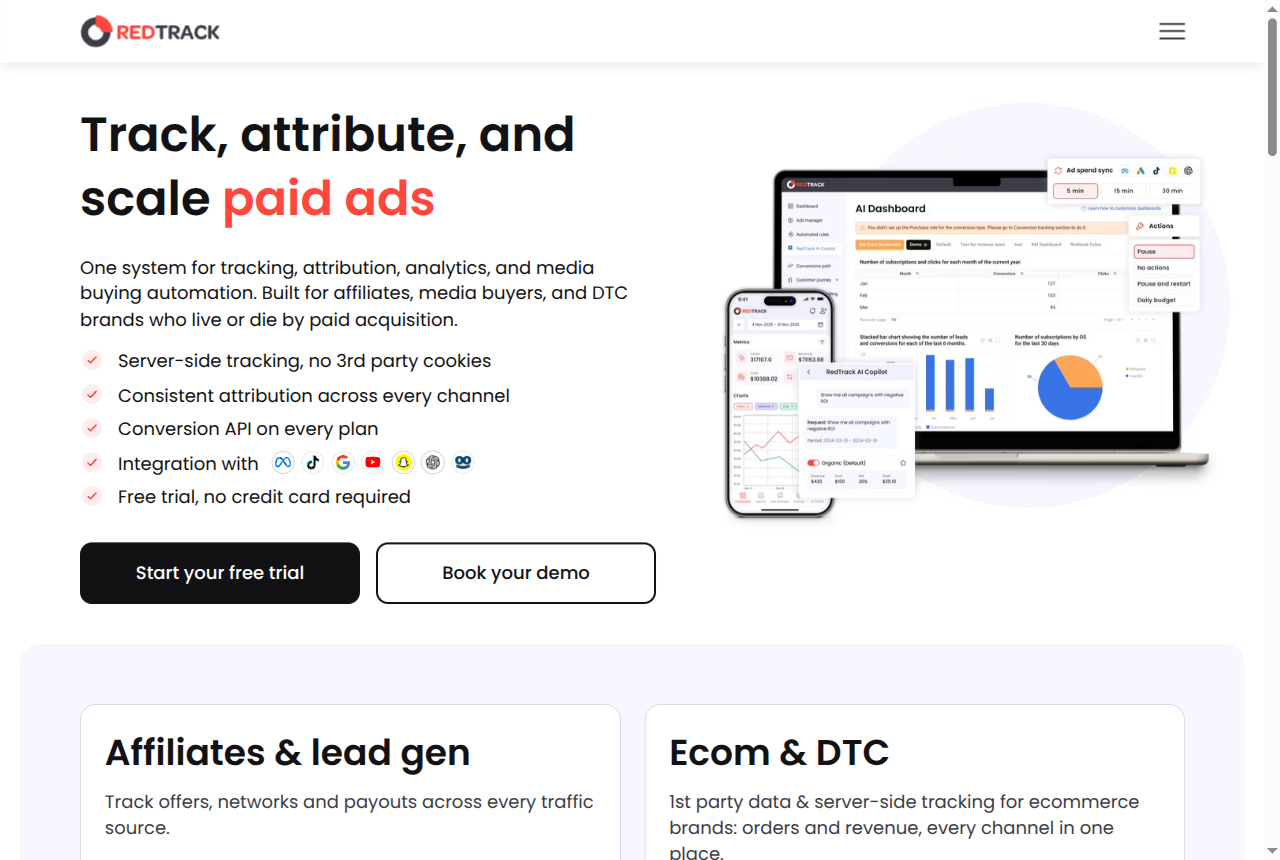
RedTrack is a cloud click tracker for people who buy paid traffic. It stamps every click with the ad, source, campaign and offer behind it, records the conversion server-side, and posts that conversion back to Meta, Google, TikTok and Snapchat through their conversion APIs so the algorithms optimize on the sale. It also syncs ad spend down to the individual ad, so the ROAS and CPA you read use the amount that was spent. One account covers affiliate offers you route to networks and a store you sell from directly.
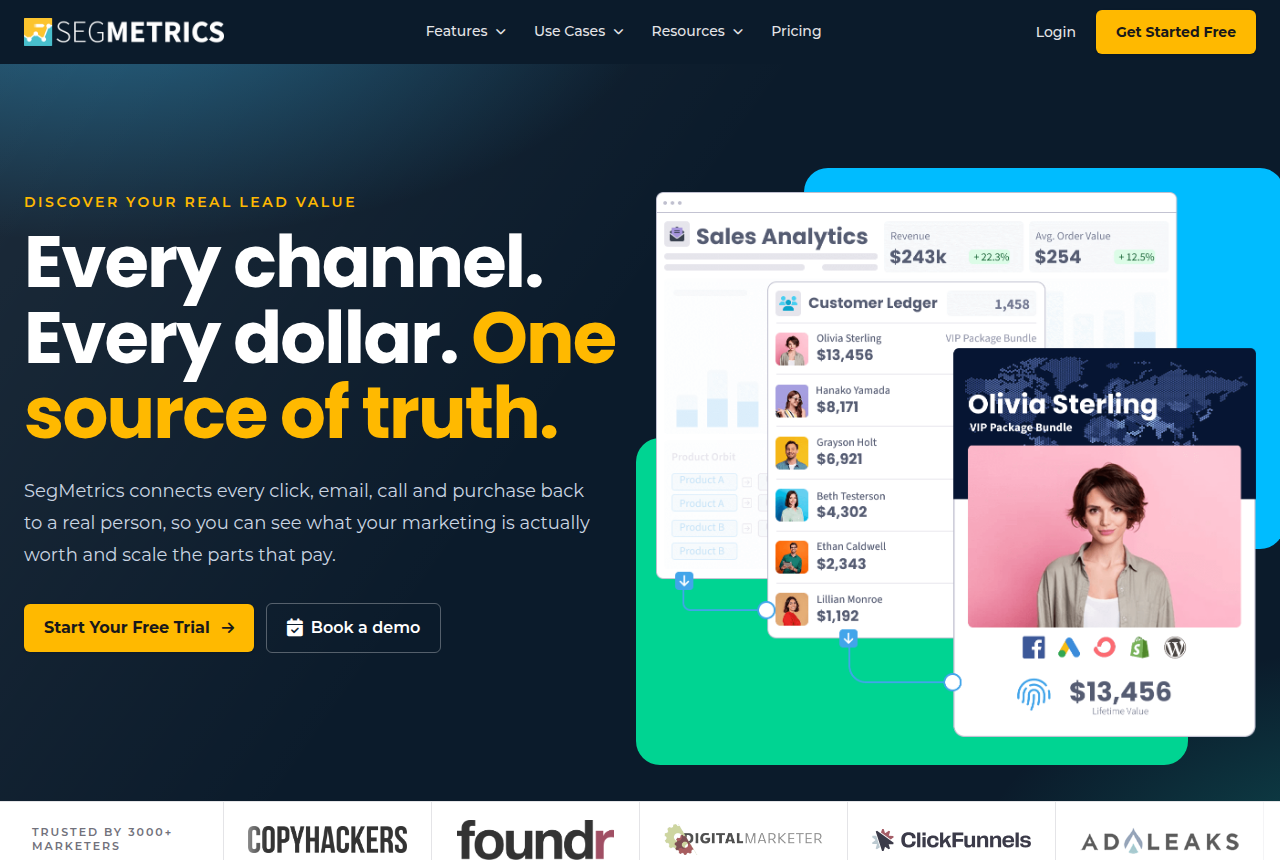
SegMetrics starts from the person, once the click has already landed. It connects the ad platforms, the CRM, the email tool and the payment processor into one timeline for each person, then follows that person from the first click through opt-in, email, webinar and sale and reports what they are worth at each step. The home page sums the product up as one source of truth across every channel and every dollar. Two features do most of the work. Contact reporting lays out every tag, sequence, charge, refund and renewal for a person in order. Conversion Feeder sends real sales back to Meta, Google, TikTok and Bing each day, starting on the Grow plan. SegMetrics builds that record around the person.
The click versus the person
This is the fork. Each tool is built to measure a different unit. RedTrack ties one click on one ad to one conversion, and the loop back to the platform carries that event within minutes. For an operator buying paid traffic, that is the read you need, because the day's decisions sit at the ad and the campaign, and you want the platforms learning from real conversions fast.
SegMetrics is built around what a contact is worth over time. It stitches identity across tools and devices into one contact record, then reports value at each funnel step, so a webinar attendee, a lead-magnet downloader and a cold ad click each carry their own worth. That is the read a course, coaching or membership business needs, because the value of a lead shows up over email days or weeks after the first click, and a native connection to the email tool follows the money the whole way. A Capterra reviewer trusts it because every lead ties back to a named person. On a live campaign, RedTrack has the ad-level number within minutes. Over the following weeks, SegMetrics has what that lead is worth.
The funnel each was built for
Most of the decision settles here. RedTrack is built for paid-traffic funnels where the same day's numbers drive the next day's bids: affiliate offers routed to networks, direct-response offers, and owned stores bought on Meta, Google, TikTok and native. If you route traffic yourself and live in the ad managers, RedTrack is the default first tracker. If the offers sit on affiliate networks, it is still the right shape of tool, and you might also weigh RedTrack vs Voluum.
SegMetrics is built for the email-driven info-product world: courses, memberships and coaching sold through multi-step funnels where the money arrives over time. It fits agencies well, because unlimited users and client-ready dashboards are part of the product. The trade is effort. Reviewers call it convoluted, and an independent small-business analysis flags the time to configure it and the mental load of learning another reporting layer. That weighs heaviest on a solo operator and least on a team with someone who owns reporting. A high-ticket funnel that closes on the phone, with heavy ad spend, fits a deterministic engine such as Hyros. The RedTrack vs Hyros comparison covers that choice.
Why the numbers differ from Meta and Shopify
Both tools keep their own count, because both exist to catch what a last-click pixel drops. RedTrack reconciles at the click and posts a cleaner server-side conversion back, so on paid traffic it should read closer to backend truth than the platform pixel does, especially where iOS and cookie loss have thinned the pixel. SegMetrics starts from actual sales and reassembles each contact's identity across tools, so its total is a second reconciliation and it sits apart from Meta, GA4 and Shopify. That independent read is the point. Treat whichever you choose as a decision layer you reconcile against backend revenue, and keep your attribution windows consistent when you compare.
Who each one is for
RedTrack is the better default for an operator running paid traffic to offers and funnels they route themselves, who wants per-ad ROAS in near real time and a server-side conversion back to the ad platforms. It spans affiliate offers and an owned store in one account, on published tiers. Lifetime value across a long email cycle stays with SegMetrics. Faster spend sync, and Ads Manager on Solo and Team, are paid add-ons. The full RedTrack review has the detail.
SegMetrics is the better pick for a course, coaching or info-product business that wants value per lead and a published price it can model before it commits. It closes the loop back to the ad platforms, adds Bing, and lets you filter which sales you send by value, so a one-time buyer and a long-term customer stop looking identical to the algorithms. It rewards a business with a real email list and someone to own the reporting. A physical store at scale is a different job, and a modeled measurement platform such as Northbeam or Fospha fits that store. See the full SegMetrics review, the plan-by-plan SegMetrics pricing, or the wider SegMetrics alternatives. At spend under $50,000 a month, clean UTMs, server-side events and blended metrics such as MER and new-customer CAC cover most of the job. A weak offer, a broken pixel or a low conversion rate is still a funnel problem. These tools make the numbers clearer. For the full field, see the best ad tracking and attribution software.
What each one costs
Builder is no longer an affiliate plan. Solo, Team and Enterprise are the three that remain.
- Solo. The monthly price is $169. A year paid up front is $1,420, a 30% discount, and RedTrack's pricing page keeps that rate when the year renews. The same page lists the yearly price as $118 a month. The plan includes 5 million events, one user and five ad accounts on each ad platform. Past that allowance, events are $0.04 per 1,000. An event is a click, a conversion or a postback. Impressions cost extra. Spend on each ad updates every 60 minutes. CAPI for Meta, TikTok, Google and Snapchat is on this plan.
- Team. Team costs $399 a month and $3,352 for the year. Coverage is 20 million events and five users. Extra events are $0.035 per 1,000, and spend syncs every 30 minutes.
- Enterprise. Enterprise is $999 a month, or $8,392 billed once for the year. It covers 75 million events and 15 users. Past the cap, events are $0.025 per 1,000. Ads Manager and Scale Rules are included on this plan.
Each affiliate plan opens with a 14-day trial. Faster sync, and Ads Manager on Solo and Team, are add-ons priced by monthly ad spend.
Stores have their own plans. Relay has no monthly charge for one store and uses last-click attribution from UTMs. Brand is $99 a month at the $250,000 revenue tier, with three stores and multi-touch attribution, or $832 for the year. Agency is $599 a month at that tier, with unlimited stores, or $5,032 for the year.
SegMetrics publishes Launch at $57 a month, Grow at $197 and Scale at $397. Enterprise pricing is quoted for companies over $10 million a year. Plans scale by active contacts, and every tier includes unlimited users. Conversion Feeder, which sends sales back to Meta, Google, TikTok and Bing, starts on Grow. Server-side tracking on your own domain starts on Scale. The trial is 14 days, with a 30-day money-back guarantee and no long-term contract. Annual billing includes two months free.
When you pay each month, Launch is cheaper than Solo. Solo is cheaper than Grow on that same monthly bill. Solo's yearly rate is also lower than Grow's monthly price. Events and active contacts are different meters.
Our pick
RedTrack
RedTrack is the pick when you route paid traffic and you want spend on each ad. SegMetrics is the pick when sales come in after an email sequence and you need each contact's lifetime value. Launch has the lower starting price, and Conversion Feeder is on Grow.
Frequently asked questions
RedTrack or SegMetrics: which should I pick?
Do RedTrack and SegMetrics even compete?
Which one is cheaper?
Do both send conversions back to Meta and Google?
Can SegMetrics track paid affiliate traffic the way RedTrack does?
What changed on this page
-
Builder is off the affiliate card. The RedTrack plans are Solo, Team and Enterprise, at list and at the yearly rate. SegMetrics still opens on Launch, and Conversion Feeder starts on Grow. The old line that the two entry prices were close is retired. RedTrack stays the pick when you route offers and want spend on each ad.
-
First published. Prices and features were read from each vendor's own site.
Sources
Other sources
4 discussions and reviews read for this page. Quotes are excerpts; open a link to read the original in context.
- [rt-capi] Plans and Pricing trial line
- [rt-events] Plans and Pricing
- [rt-impressions] What qualifies as an event
- [sm-home] SegMetrics - Marketing Attribution & Analytics
How we compared these
We do not run paid campaigns through either tool. We read each vendor's documentation and pricing pages, verify the figures there, and weigh long-term reports from operators. The full rubric is on the methodology page.
Related reading
- RedTrack review
- SegMetrics review
- SegMetrics pricing
- RedTrack vs Hyros
- RedTrack vs Voluum
- Hyros vs SegMetrics
- Alternatives to SegMetrics
- Best ad tracking and attribution software
- All head-to-head comparisons
Comments
No comments yet. Questions and your own experience are welcome.
Thank you. Your comment will appear once it has been reviewed.