Head-to-head
Funnelish vs ClickFunnels
A checkout for a product that ships, or one account for courses, email and a community.
By Marcus Flynn, tracking and attribution editor. Updated 25 November 2026.
You already cut the list to two. ClickFunnels vs Funnelish comes down to the product you sell, and to whether the bill follows visitors or contacts.
Quick answer
Pick Funnelish if you run a physical or Shopify-backed offer and need the custom checkout, the bumps, the upsells and optional Scale routing, with the bill set by visitors; pick ClickFunnels if you sell info, coaching or courses and want unlimited visitors plus email, a CRM and a community in one login, with the plan set by contacts.
ElasticFunnels is the third situation: a team buying traffic that needs the test to stay on one ad URL, with the click, the order, the rebill and the refund on one record.
- Funnelish. Physical products and Shopify catalogs, with bumps and upsells in the checkout.
- ClickFunnels. Courses, coaching and info products, with email and a community included.
- ElasticFunnels. Tests that must keep the ad's current URL, with the order on the same record.
Side by side
| Tool | Built for | Checkout | Billed on | Routing | Trial | From |
|---|---|---|---|---|---|---|
| Funnelish | Store checkout | Bumps on all tiers | Visitors | Scale cascade | 14 days, no card | $49/mo |
| ClickFunnels | Courses and info | Offer in checkout | Contacts | –Unknown | Days not listed | $97/mo |
| ElasticFunnels | Paid traffic | Bumps and upsells | Page views | NMI first sale | 14 days, no card | $97/mo |
Funnelish: pros and cons
What works
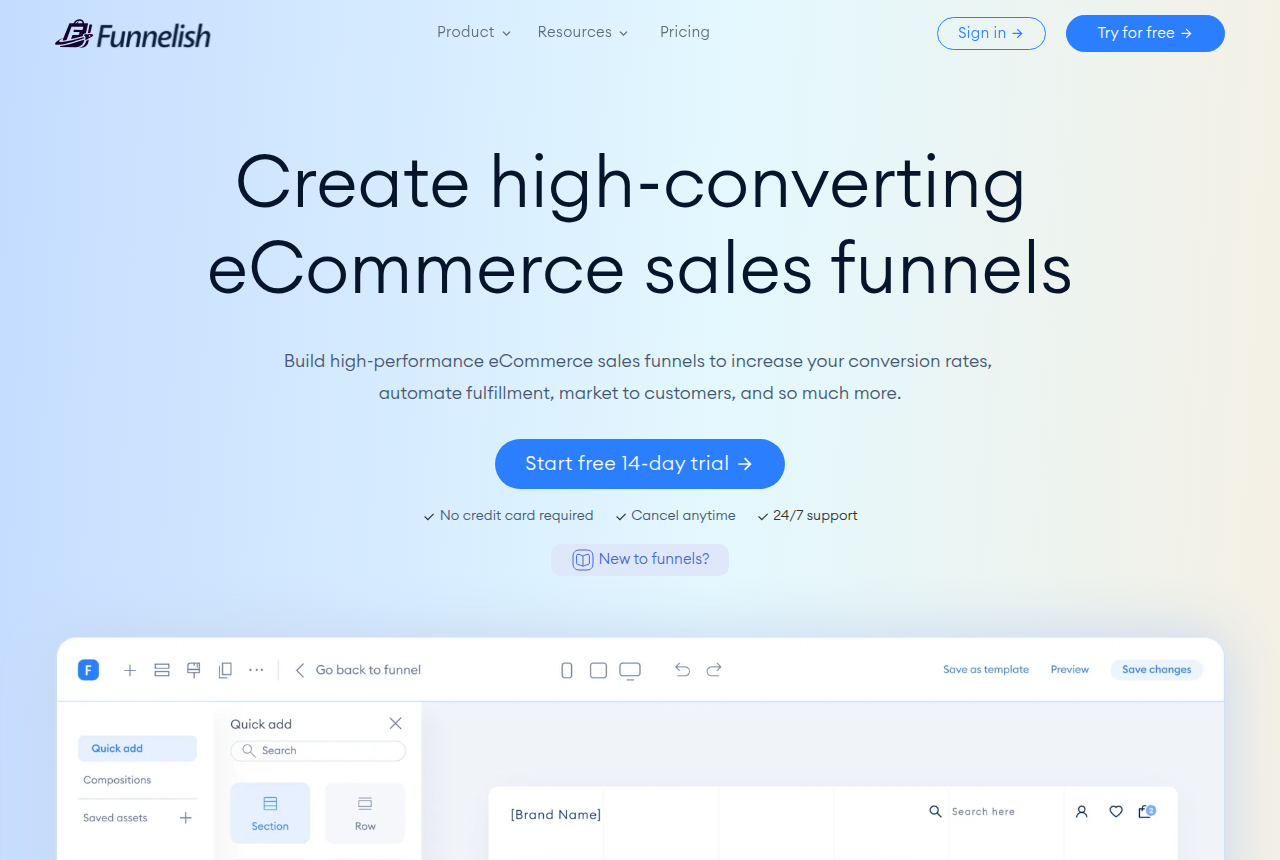
- Funnelish takes no commission on sales. Your costs are the plan fee and your processor's charges, with nothing added per order.
- The 14-day trial starts without a card, which leaves room to build a funnel and connect a store before paying.
- Order bumps and one-click post-purchase upsells come with the plan, with no extra app to install.
- Hybrid mode keeps Shopify for the catalog and fulfilment while ads land on Funnelish's checkout, and the standalone route drops Shopify entirely.
- Funnelish Pay connects Stripe, PayPal, Airwallex, Checkout.com and NMI, with Klarna, Apple Pay and Google Pay at checkout.
- Trustpilot reviewers describe a page builder simple enough to run without a developer.
What to watch
- Plans are capped by monthly visitors and funnels, so a store that scales its ad spend moves up a tier with it.
- The cascade across gateways and MIDs is on Scale only. Starter and Pro still include the checkout, the bumps and the one-click upsells.
- Support is uneven. Some Trustpilot reviewers wait more than 12 hours for a reply, and one describes servers going down with funnels offline.
- Shopify sync takes setup work. Every SKU, bumps included, needs a product automation, and orders fail to sync when address fields are off.
- Conversion is disputed. One media buyer reports weaker checkout conversion than ClickFunnels, with no controlled test on either side.
- Funnelish lists Stores and Customer Portals as coming soon, so judge the platform on what ships today.
ClickFunnels: pros and cons
What works
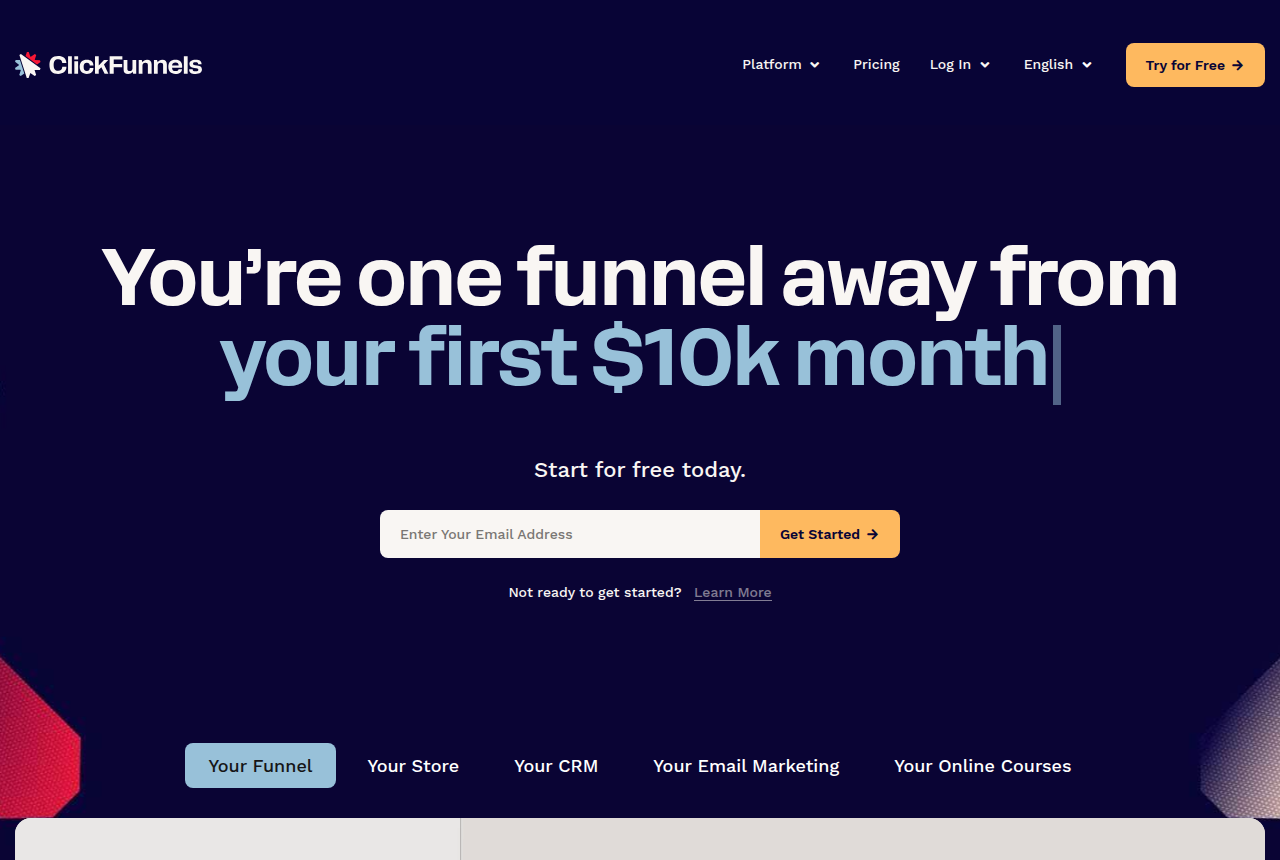
- Funnel sellers stay for the checkout. You get order bumps before the sale, one-click upsells and one-time offers after the buyer pays, and Smart Checkout pages in the account. Capterra reviewers name those features when they explain why they stay.
- One bill covers most of an info-product business. Funnels, a store, email marketing, automations, a CRM with pipelines, courses, community groups and appointment booking come in the same account, so a coach or course seller can drop three or four separate subscriptions.
- Your bill does not grow with your sales or your traffic. ClickFunnels takes no percentage of revenue, and every plan includes unlimited visitors and unlimited funnels, the second labelled a limited-time offer. The bill rises with contacts, emails, workspaces and team seats.
- You can try it before paying. Launch, Scale and Optimize each start with a free trial, and the pricing page promises your money back within 30 days, which lowers the cost of finding out it is the wrong fit.
What to watch
- ClickFunnels 2.0 is harder to learn than Classic and still has rough edges. G2 reviewers say the new version is harder to figure out, and long-term subscribers on Trustpilot describe bugs and workarounds for functions they expected at launch. Set aside time for setup, and build the funnel you actually sell during the trial. Someone new to ClickFunnels, with no Classic habits to unlearn, notices this the least.
- Contact caps move you to a higher plan. Launch allows 10,000 contacts, 50,000 emails a month, one workspace and two team members, so a growing list forces the move to Scale even when your funnels have not changed. A solo seller with a small contact list can stay on Launch for a long time.
- API access, webhooks and the custom code editor start on Scale. A team that wants to send orders into its own systems, or add its own scripts, needs Scale. The built-in third-party integrations are available on Launch too.
- The pitch, the training and the onboarding are written for creators launching a first funnel. Tying each sale to the ad that paid for it is a tracker's job, and paid-traffic teams usually run one beside ClickFunnels, as they do beside most funnel builders. A creator selling mainly to an email list may never need one.
The real differences
Two products, two businesses
Funnelish is the ecommerce checkout. The vendor sells it to a store that wants its own landers, a checkout it controls, order bumps and one-click upsells, either beside Shopify or in place of it. Shopify can keep the catalog and the shipping while the ad lands on the Funnelish checkout, or the funnel can stand alone. People still ask whether a ClickFunnels subscription has to come first. In the Funnelish community, the posted answer is that Funnelish is sold on its own today. The legacy plugin is deprecated. What you buy now is a standalone builder with a native checkout.
ClickFunnels is the creator stack. One login holds the funnel, a store, courses, email, a CRM and a community. That fits coaching, a course or an info product, where fulfillment is a login rather than a carton. Traffic is unlimited on each tier, and the plan moves when contacts, emails, workspaces or seats grow. Launch is the entry tier. The contact cap, the email cap and the seat count sit in the cost section, because those are the numbers that push a list-heavy business up a tier while the funnel itself has not changed. The longer account of that bundle is the ClickFunnels review.
ClickFunnels vs Funnelish names the same choice from the other side. A cold-traffic offer with a small list and a loud ad account stays on a visitor meter while the list is still small. A large list with modest traffic stays on an unlimited-visitor plan until the contact cap arrives. Match the meter to the number that will actually grow.
The creator bundle is why a course business stays on ClickFunnels. Courses, a community and the email tools that fill them sit in that account, so a coach can drop a separate membership site and a separate email service. Funnelish sells the lander and the checkout. A brand that needs a member area and a warehouse is buying two tools for two jobs. The store side of that pair is the Funnelish review.
Bumps, upsells, and one Shopify order
The margin on a direct-response offer is usually the bump and the upsell, so both have to live in the account you actually buy. Funnelish includes custom checkouts, bumps and one-click upsells on all three tiers. There is no higher plan you have to reach before the bump checkbox exists. When the order syncs to Shopify, the main sale, the bumps and the upsells become one store order. The Funnelish Shopify page says every paid funnel order then becomes a normal Shopify order. The same page says those funnel orders can skip Shopify's third-party checkout transaction fee, and that a custom checkout is available without Shopify Plus. Inventory sync is described there too. A warehouse that already ships from Shopify can keep its labels and its 3PL. The ad can land on the Funnelish checkout while Shopify still ships the order.
ClickFunnels puts the add-on inside Smart Checkout. The page recognizes what is in the cart and can present a one-time offer the buyer adds with a single click, before the charge completes. A post-purchase upsell is a later step in the funnel flow, still inside the same account. That is the right shape when the second item is a digital bump, a coaching call or a course upgrade, and nothing has to be picked and packed. The mechanism is written up on the Smart Checkout page. Other checkouts that keep a one-click upsell are collected in the one-click upsell roundup.
Fulfillment is the cleanest way to choose. A carton, a 3PL and a Shopify order belong with Funnelish, because that sync is written to hand the shipping apps one order that already includes the bump. A member login, a lesson and a community thread belong with ClickFunnels, because those pieces are in the account. Launch includes the built-in integrations. The tier above Launch is the one that opens an API, which matters when each order has to reach a shipping system you run. Read the caps below before you choose Launch.
Where the ad URL stays shared
The split-test docs are where the two products stop looking alike. ClickFunnels explains it in the help center. Add a split at the top of the funnel and both first-step pages are served at the funnel's root URL. That shared URL is what you paste into the ad. Later steps keep their own paths. Each step allows one variant. You can test the first screen under the link the ad platform already knows. A test of the checkout, or of the upsell, is a branch in the flow, still entered from that first URL. The page to read is managing A/B split testing in funnel steps.
Funnelish lists split testing as unlimited on every tier, so the test itself is not a reason to change plan. The visitor allowance on Starter and Pro still applies to the traffic those tests burn. Scale is the tier that removes the visitor cap and the funnel cap. A test that only changes the first screen can live on either product. A test that has to rotate later steps under one campaign link is a different requirement, and it is the one the third column is for.
A tracker still has to tie spend to the sale. A specific failure shows up when Shopify sits behind Funnelish. A buyer on r/FacebookAds wrote that when Purchase is enabled on both Funnelish and Shopify, you sometimes end up with duplicate events. The ad account then learns from two sales where the bank recorded one. Fire that purchase from one system. The same thread ranks Funnelish below ClickFunnels on conversion, with no test linked, so that score stays one person's opinion. The thread is this Facebook Ads discussion.
The Scale cascade is separate from the pages
Routing is a Scale feature, and it is a different decision from the page builder. Funnelish cascades a card across gateways and MIDs, and it describes rebills as gateway-agnostic. Starter and Pro still include the checkout, the bumps and the upsells. They leave out the cascade. The per-transaction rate, and the waiver the routing page prints through the start of 2027, sit with the plan prices below.
ClickFunnels is built so the payment stays in its own checkout. Use it when the buyer should finish inside that account. A brand whose shipping, inventory and 3PL already live in Shopify is in the workflow Funnelish documents, which is built around that sync.
ElasticFunnels keeps one campaign URL
ElasticFunnels is a funnel platform for teams that buy traffic. It builds the pages, including an AI builder that generates a page from a prompt or clones one from a URL, and it hosts the checkout with order bumps, one-click upsells and subscriptions. A click, an order, a rebill and a refund stay on one timeline, with a CRM, automations and a call center on that data. Starter, Growth and Scale share one feature list. The plans differ by page views, brands, domains, seats and automation runs.
The fit here is the URL. Variants rotate on the server under one campaign link, on every ElasticFunnels plan, so Meta, Google and TikTok keep learning on the URL the ad already uses, and a test leaves the ad on that URL. ClickFunnels shares the root URL on the first step, with one variant on that step. Funnelish includes unlimited tests from the first tier. ElasticFunnels is the column when the whole test has to stay on the ad's current link and the sale has to sit on the same record as that click. The pair against ClickFunnels on its own is ElasticFunnels vs ClickFunnels.
Checkout charges run through Stripe, NMI, PayPal, Klarna or Authorize.net. The funnel can also send the buyer to Shopify Checkout, Shop Pay, ClickBank, BuyGoods or Digistore24. Multi-MID routing is NMI only: a weighted split of the first sale across that merchant's NMI accounts, filtered by card brand, product and amount, with a daily cap on each account. The upsell and the rebill stay on the account that took the sale. Stripe, PayPal, Klarna and Authorize.net each remain a single account, outside that split. Funnelish Scale is the cascade across gateways. A team with several NMI accounts is looking at the weighted split. A team that needs the charge to move across different gateways is looking at the Funnelish cascade.
ElasticFunnels is newer than the platforms it competes with, and there is very little independent review coverage to check its claims against. Until you run real volume through it, you are largely taking the vendor's word. That is what you would expect of a platform built since 2023. The pages, the checkout and the same-URL tests are in the product. What is thin is the outside record you can read before you spend.
A video sales letter needs a player
When the offer leads with a video sales letter, the builder is the frame and the player is the pitch. TrackPlay hosts that video behind one embed that drops into either funnel. It is a player and an analytics platform for direct-response video: sound starts where the browser allows it, calls to action appear on a timer, and every second watched is tied to who bought. The cart posts the verified sale back onto the play that earned it. ClickFunnels is one of the carts that can send that postback, along with ClickBank, BuyGoods and Digistore24. The player then fires the conversion server-side to Meta, TikTok and GA4. A split of the cut runs under the same embed and is scored on the verified sale, so the ad link stays put while you try a new edit. Paid plans start at $29 a month.
It is narrow by design. Built for a direct-response sale on paid traffic, it is not a general video host or a content library, so it has none of the channels, SEO pages or webinar tooling of a Wistia. A team whose video is a blog series or a webinar is looking at a different tool. The checkout, the bumps and the pages in Funnelish or ClickFunnels stay in place either way. Signup asks for an invitation code, the testimonials on offer are the vendor's own, and there is little independent coverage, so the watch-to-sale story stays the vendor's until your own plays are in the account.
What each one costs
Funnelish pricing lists Starter at $49 a month for 20,000 visitors and 20 funnels, Pro at $99 a month for 100,000 visitors and 50 funnels, and Scale at $249 a month with unlimited visitors and unlimited funnels. All three tiers list 0% platform transaction fees. You can start the 14-day trial before you add a card. Smart payment routing sits on Scale. The routing page prices it at up to 0.3% per routed card transaction and says that fee is waived until 1 January 2027.
ClickFunnels pricing lists Launch at $97 a month, Scale at $197 and Optimize at $297. Dominate is $5,997 for the year. Each tier lists unlimited visitors. Launch includes 10,000 contacts, 50,000 emails a month, one workspace, two team members, three courses and five custom domains. API access starts on the tier above Launch. The pricing FAQ says you keep every penny you make, and it states a 30-day money-back guarantee. Monthly plans offer a free trial. The pricing page does not state how many days the trial lasts.
ElasticFunnels pricing lists Starter at $97 a month, or $937 for the year: 50,000 page views, 3 brands, 5 custom domains, 10 seats and 10,000 automation runs. Growth is $197 a month, or $1,891 for the year: 250,000 page views, 10 brands, 15 custom domains, 20 seats and 50,000 automation runs. Scale is $497 a month, or $4,771 for the year: 500,000 page views, unlimited brands, 50 custom domains, unlimited seats and 200,000 automation runs. Starter, Growth and Scale share one feature list. Extra page views bill at $1.20, $1.00 or $0.80 per 1,000. Extra automation runs bill at $3, $2 or $1 per 1,000. An extra domain is $5 a month. Crossing a limit adds the overage on the current plan. Bot, datacenter and test traffic is not billed. A 0.5% fee applies to revenue through Stripe, NMI, PayPal, Klarna or Authorize.net. Sales through ClickBank, BuyGoods, Digistore24, Shopify Checkout or Shop Pay are not charged that fee. Pages, funnels and a custom domain can be set up during the 14-day trial, before a card is on file.
Our pick
Funnelish
Funnelish is the pick for a physical or Shopify-backed offer that needs its own checkout. ClickFunnels is the pick when you sell a course, coaching or an info product and the contact list sets the plan.
Frequently asked questions
Do I need a ClickFunnels account before I can run Funnelish?
Which one belongs in front of a Shopify catalog?
How do the trials compare?
Is there a conversion study between them?
Where do ClickFunnels webhooks start?
What changed on this page
-
First published. Funnelish routing is the Scale cascade at the rate on the current routing page. ClickFunnels figures are the monthly list prices.
Sources
From Funnelish and ClickFunnels
- https://funnelish.com/pricing
- https://funnelish.com/smart-payment-routing
- https://funnelish.com/funnelish-for-shopify
- https://www.clickfunnels.com/pricing
- https://www.clickfunnels.com/features/smart-checkout
- https://support.myclickfunnels.com/docs/managing-ab-split-testing-in-funnel-steps/
- https://elasticfunnels.io/pricing
- https://trackplay.io/
Other sources
2 discussions and reviews read for this page. Quotes are excerpts; open a link to read the original in context.
How we compared these
We do not run paid campaigns through either tool. We read each vendor's documentation and pricing pages, verify the figures there, and weigh long-term reports from operators. The full rubric is on the methodology page.
Related reading
- Funnelish review
- ClickFunnels review
- Funnelish pricing
- ClickFunnels pricing
- ClickFunnels vs Unbounce
- ElasticFunnels vs ClickFunnels
- Funnel builder roundup
- One-click upsell checkout
- All head-to-head comparisons
Comments
No comments yet. Questions and your own experience are welcome.
Thank you. Your comment will appear once it has been reviewed.