Head-to-head
ElasticFunnels vs ClickFunnels
You are down to two hosted funnel platforms. One is for teams that buy ads. The other is for a course or a coaching offer and the list behind it.
By Marcus Flynn, tracking and attribution editor. Updated 22 October 2026.
ClickFunnels vs ElasticFunnels comes down to how you are billed and who the buyer is. Decide whether you live in ad URLs and merchant accounts or sell courses to an email list.
Quick answer
Pick ElasticFunnels if you buy traffic and need same-URL split tests on any step, sale-level attribution and NMI merchant routing on one record with the checkout; pick ClickFunnels if you sell your own course or coaching offer and want email, courses and community in one login with a long public record.
- ElasticFunnels. Paid traffic, one ad URL, NMI on the opening charge
- ClickFunnels. Courses, email and a community in one account
Side by side
| Tool | Ad URL | Checkout | Trial | Meter | From |
|---|---|---|---|---|---|
| ElasticFunnels | Yes | NMI only | 14 days | Page views | $97/mo |
| ClickFunnels | First step only | Smart Checkout, bumps, upsells | Yes, length not stated | Contacts, emails | $97/mo |
ElasticFunnels: pros and cons
What works
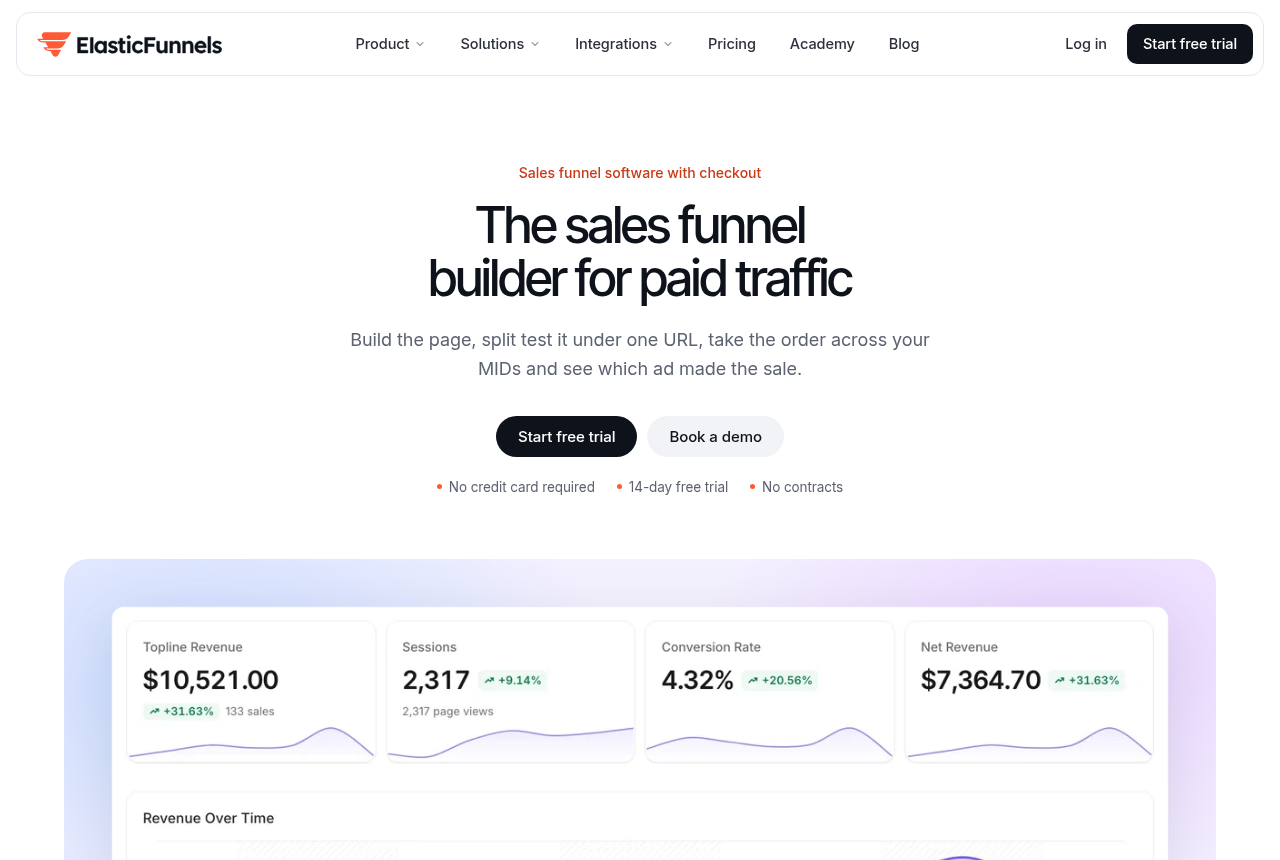
- Pages, split testing, checkout, CRM and attribution sit on one data layer, so a click, an order, a rebill and a refund are one record instead of four exports you reconcile by hand.
- Same-URL split testing rotates variants server-side under one campaign link, so Meta, Google and TikTok keep their learning and a test never sends the ad back through review.
- Revenue, EPC and ROAS report per ad, page and variant, and sales post back to Meta, Google and TikTok from the same record the order lives on.
- Every feature is on every plan. You pay by traffic, and the checkout, the CRM and the call center are not gated behind a higher tier.
What to watch
- ElasticFunnels is newer than the platforms it competes with. Independent reviews are still very thin, so until real volume runs through your account you are largely taking the vendor's word. That is what you would expect from a platform that has been around since 2023. The 14-day trial needs no card, so you can check those claims with your own traffic before you move a campaign that is already spending. During the trial you still have the pages, the tests and the checkout. What is thin is the outside record.
- Because it hosts the funnel, it suits teams that build their pages and checkout on ElasticFunnels. If your pages and cart already live somewhere else and you only want a tracking layer on top, a standalone click tracker is the lighter buy for that job.
- EF-hosted checkouts carry a 0.5% fee on the revenue that runs through them. Sales on external platforms and affiliate networks such as ClickBank or BuyGoods are not charged.
ClickFunnels: pros and cons
What works
- The checkout does what funnel sellers buy it for. You get order bumps before the sale, one-click upsells and one-time offers after the buyer pays, and Smart Checkout pages in the account. Capterra reviewers name those features when they explain why they stay.
- One bill covers most of an info-product business. Funnels, a store, email marketing, automations, a CRM with pipelines, courses, community groups and appointment booking come in the same account, so a coach or course seller can drop three or four separate subscriptions.
- Your bill does not grow with your sales or your traffic. ClickFunnels takes no percentage of revenue, and every plan includes unlimited visitors and unlimited funnels, the second labelled a limited-time offer. The bill rises with contacts, emails, workspaces and team seats.
- You can try it before paying. Launch, Scale and Optimize each start with a free trial, and the pricing page promises your money back within 30 days, which lowers the cost of finding out it is the wrong fit.
What to watch
- ClickFunnels 2.0 is harder to learn than Classic and still has rough edges. G2 reviewers say the new version is harder to figure out, and long-term subscribers on Trustpilot describe bugs and workarounds for functions they expected at launch. Set aside time for setup, and build the funnel you actually sell during the trial. Someone new to ClickFunnels, with no Classic habits to unlearn, notices this the least.
- Contact caps move you to a higher plan. Launch allows 10,000 contacts, 50,000 emails a month, one workspace and two team members, so a growing list forces the move to Scale even when your funnels have not changed. A solo seller with a small contact list can stay on Launch for a long time.
- API access, webhooks and the custom code editor start on Scale. A team that wants to send orders into its own systems, or add its own scripts, needs Scale. The built-in third-party integrations are available on Launch too.
- The pitch, the training and the onboarding are written for creators launching a first funnel. Tying each sale to the ad that paid for it is a tracker's job, and paid-traffic teams usually run one beside ClickFunnels, as they do beside most funnel builders. A creator selling mainly to an email list may never need one.
The real differences
What you are actually buying
ElasticFunnels is a funnel platform for teams that run paid traffic: affiliates, product vendors, agencies and ecommerce brands. Pages, checkout and the customer record live in one hosted account. ClickFunnels is built for creators. Its homepage calls the product Funnels for Creators, and that account holds the funnel, the email, the courses and a community. The ElasticFunnels review and the ClickFunnels review cover each product on its own.
ClickFunnels vs ElasticFunnels on the ad URL
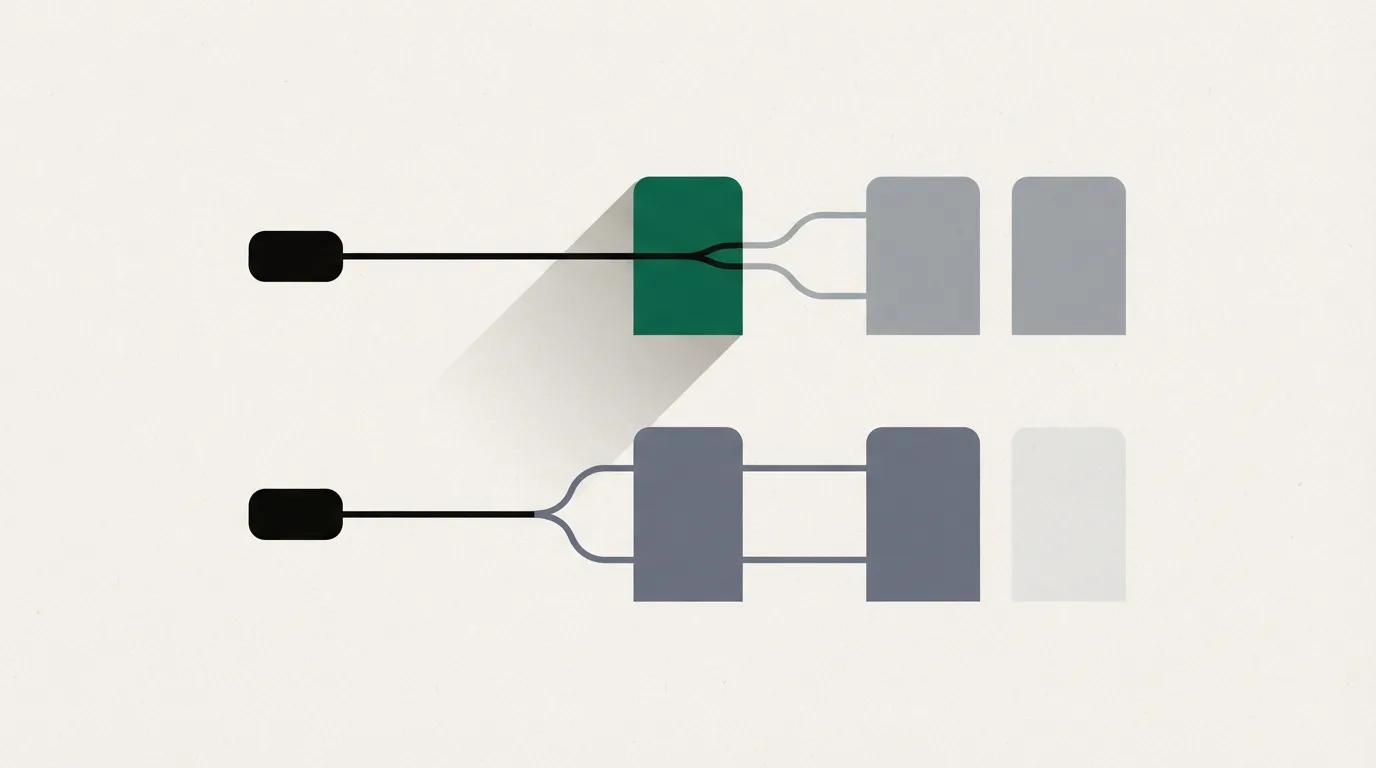
Shoplift's ad-testing guide says changing a running ad's destination URL can reset learning. ElasticFunnels runs same-URL split tests, up to five variants each, on all three plans. Variants rotate server-side under one campaign link. ElasticFunnels says Facebook, Google and TikTok keep optimizing against that same creative and URL pair while the variants swap on the server.
A/B testing is included with a ClickFunnels account, on funnel pages and on email campaigns. The help doc on split tests is stricter than the feature page. Each funnel step holds a maximum of one variant page. Only the first step is served at the funnel's root URL. Later steps use their own paths, so a test past the lander is a new address.
A Classic account adds a second problem. ClickFunnels' upgrade article says you cannot migrate funnels from a Classic account into a 2.0 account. The ElasticFunnels builder can generate a page from a prompt, or clone a page from a public URL. That is how you rebuild a live lander when the Classic funnels stay in the old account.
Checkout, upsells and the merchant account
Both tools let you add an order bump at checkout and a one-click upsell after the buyer pays. ClickFunnels calls the flow Smart Checkout. ElasticFunnels hosts the checkout and can also send the buyer to ClickBank, JVZoo, BuyGoods, Digistore24, Shopify Checkout, Shop Pay or Cartpanda.
On its own checkout, ElasticFunnels charges through Stripe, NMI, PayPal, Klarna or Authorize.net. You can split each new sale across several NMI merchant accounts by weight. Rules can use card brand, product and amount. Each account can have a daily cap, and each account gets a report of sales, revenue and refunds. Upsells and rebills stay on the merchant account that took that sale. Stripe, PayPal, Klarna and Authorize.net are each one account. The weighted split is NMI only.
The order stays tied to the click. A rebill and a refund show on the same timeline as the order. The CRM, the automations and the call center use that timeline, so a failed rebill still names the campaign the customer came from.
Email, courses and who the login is for
ClickFunnels is the better fit if you sell a course or coaching and you send the email yourself. Launch includes 1 workspace, 2 team members, 10,000 contacts, 50,000 emails a month, 3 courses and 5 custom domains, with unlimited visitors and unlimited funnels. Scale is where webhooks, full API access and the custom code editor begin. The pricing page reports more than 100,000 users and more than one million funnels created.
ElasticFunnels puts the CRM, the call center, automations, email and courses on every plan. Plans step up by page views, brands, domains, seats and automation runs. Your plan stays the same when the email list grows. If you are weighing ClickFunnels against a platform whose main job is the CRM, read ClickFunnels vs GoHighLevel.
What you can verify before you switch
ClickFunnels has a long public record, and that record is mixed. G2 reviewers say building past a simple sales funnel leads to repeated problems. A 2025 Reddit thread reports a critical checkout error in ClickFunnels 2.0. Budget time to build the real funnel before the list depends on it.
A VSL still needs its own player
If the offer is a video sales letter, you still need a player that can tie each play to the sale. TrackPlay is a VSL player and analytics platform for paid-traffic funnels. A single embed works in either page builder. It starts with sound where the browser allows it, and where it does not, it starts muted and turns sound on at the first touch, without restarting the video. It records retention second by second, and it shows buyers and non-buyers separately. The checkout sends the verified sale back to the play that earned it, and TrackPlay sends that conversion to Meta, TikTok and GA4. Split tests use that same embed, and the winner can be called from the sales. The sale can post back from ClickFunnels, ClickBank, Kiwify, BuyGoods, Digistore24, WarriorPlus and JVZoo.
It is narrow by design. Built for paid-traffic VSL conversion, it is a poor fit when the video's job is content marketing, and it lacks the channels, SEO pages and webinar tooling of a Wistia. It is a very new product. The testimonials are on the vendor's site, and signup asks for an invitation code, so outside feedback is thin before you spend on ads. Paid plans start at $29 a month, with a no-card free plan and a trial of the paid features.
What each one costs
Both entry plans open at the same monthly price. From there they count different things. ClickFunnels counts contacts, emails, workspaces, seats and courses, and visitors stay unlimited. ElasticFunnels counts page views. Page views from bots, data centers and tests are not counted. If you go past the page-view allowance, you pay the overage and you stay on the same plan. Extra page views are $1.20, $1.00 or $0.80 per 1,000 on Starter, Growth and Scale. Extra automation runs are $3, $2 or $1 per 1,000. An extra domain is $5 a month.
| Plan | Monthly |
|---|---|
| ClickFunnels Launch | $97 |
| ClickFunnels Scale | $197 |
| ClickFunnels Optimize | $297 |
| ClickFunnels Dominate | $5,997/yr |
| ElasticFunnels Starter | $97 |
| ElasticFunnels Growth | $197 |
| ElasticFunnels Scale | $497 |
On annual billing, Launch, Scale and Optimize are $81, $164 and $248 a month. Dominate is $5,997 for the year, and you book a demo to start it. ElasticFunnels yearly totals are $937, $1,891 and $4,771. Starter includes 50,000 page views a month, 3 brands, 5 domains, 10 seats and 10,000 automation runs. Growth is 250,000 page views, 10 brands, 15 domains, 20 seats and 50,000 automation runs. Scale is 500,000 page views, unlimited brands, 50 domains, unlimited seats and 200,000 automation runs.
ElasticFunnels charges 0.5% of revenue through Stripe, NMI, PayPal, Klarna or Authorize.net. ClickBank, BuyGoods, Digistore24, Shopify Checkout and Shop Pay carry no ElasticFunnels fee. ClickFunnels states that it takes no percentage of sales. ElasticFunnels' trial is 14 days with no card required. ClickFunnels includes a free trial on Launch, Scale and Optimize, and a 30-day money-back guarantee. Its pricing page leaves the trial length unstated. The detailed plan pages are the ElasticFunnels pricing page and the ClickFunnels pricing breakdown.
Our pick
ElasticFunnels
ElasticFunnels is the pick when the business buys traffic and wants the pages, the tests, the checkout and the sale on the same timeline. ClickFunnels is the pick for a course creator or a coach who wants email and courses in the same account, with years of public reviews to read.
Frequently asked questions
Do the two entry plans work out the same?
Can ClickFunnels test a lander on the ad's current URL?
Will Classic funnels come over to ClickFunnels 2.0?
When does ElasticFunnels take a percentage of a sale?
Which ClickFunnels plan adds the API?
Which fits an affiliate offer on paid ads?
Sources
From ElasticFunnels and ClickFunnels
- https://elasticfunnels.io/
- https://elasticfunnels.io/pricing
- https://www.clickfunnels.com/
- https://www.clickfunnels.com/pricing
- https://www.clickfunnels.com/features/ab-testing
- https://support.myclickfunnels.com/docs/managing-ab-split-testing-in-funnel-steps
- https://support.clickfunnels.com/en/articles/12734395-upgrading-to-clickfunnels-2-0
Other sources
3 discussions and reviews read for this page. Quotes are excerpts; open a link to read the original in context.
How we compared these
We do not run paid campaigns through either tool. We read each vendor's documentation and pricing pages, verify the figures there, and weigh long-term reports from operators. The full rubric is on the methodology page.
Related reading
- ElasticFunnels review
- ClickFunnels review
- ElasticFunnels pricing
- ClickFunnels pricing breakdown
- ClickFunnels alternatives
- ClickFunnels vs GoHighLevel
- ElasticFunnels vs Builderall
- TrackPlay review
- All head-to-head comparisons
Comments
No comments yet. Questions and your own experience are welcome.
Thank you. Your comment will appear once it has been reviewed.