Head-to-head
Triple Whale vs Measured
Triple Whale and Measured both exist because nobody quite trusts the ROAS the ad platforms report, but they answer that distrust at different altitudes. Triple Whale sits on top of a Shopify store and gives you one real-time dashboard of blended ROAS, CAC, LTV and profit to run the business day to day. Measured runs geo holdout experiments and calibrates a media mix model to prove, for a large brand, which channels actually cause sales. Pick Triple Whale if you run a Shopify DTC brand and want a daily operating dashboard you can start using for free; pick Measured if you spend six figures a month across many channels and leadership needs causal proof of lift, not platform ROAS.
By Marcus Flynn, tracking and attribution editor. Updated 30 September 2026.
Quick answer
Triple Whale is our top pick for most people. The most widely used attribution and analytics app in Shopify DTC, now built around an AI layer called Moby. It joins store, ads, email and SMS into one real-time view of blended ROAS, CAC, LTV and profit, and its free Moby plan lets you judge the numbers before paying. The cautions are pixel figures that read lower than Meta's and need reconciling, paid tiers quoted after a demo that scale with revenue, and a breadth that has grown as convoluted as GA4.
- Triple Whale. Best for Shopify DTC brands that want blended profit reporting and AI insights in one app. Has a free tier.
- Measured. Best for Mid-market and enterprise brands spending six figures a month across many channels that need causal measurement, not platform ROAS.
Side by side
| Tool | Core job | Method | Channels | Access | From |
|---|---|---|---|---|---|
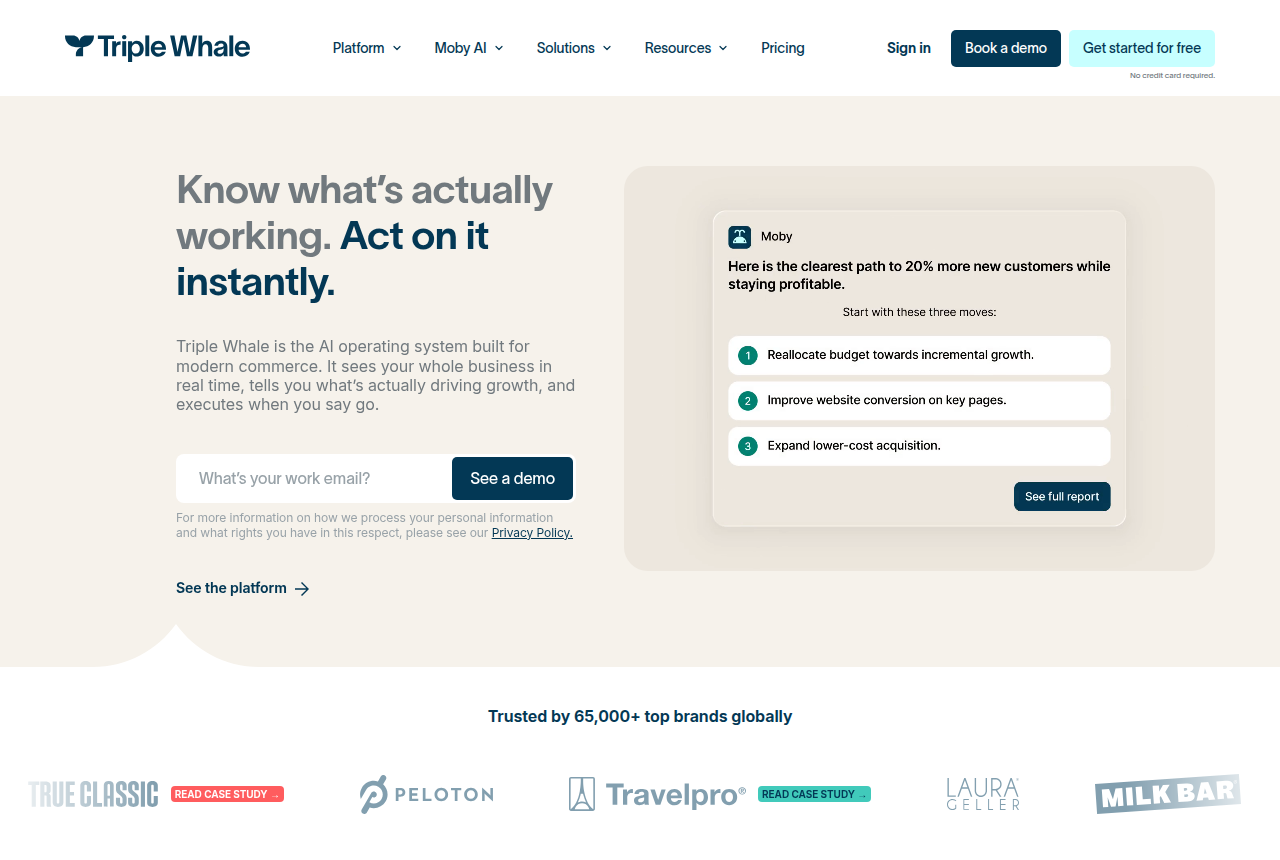
| 1. Triple Whale | Store profit dashboard | Pixel plus blended models | Shopify DTC and digital ads | Free plan, paid quoted | Free tier |
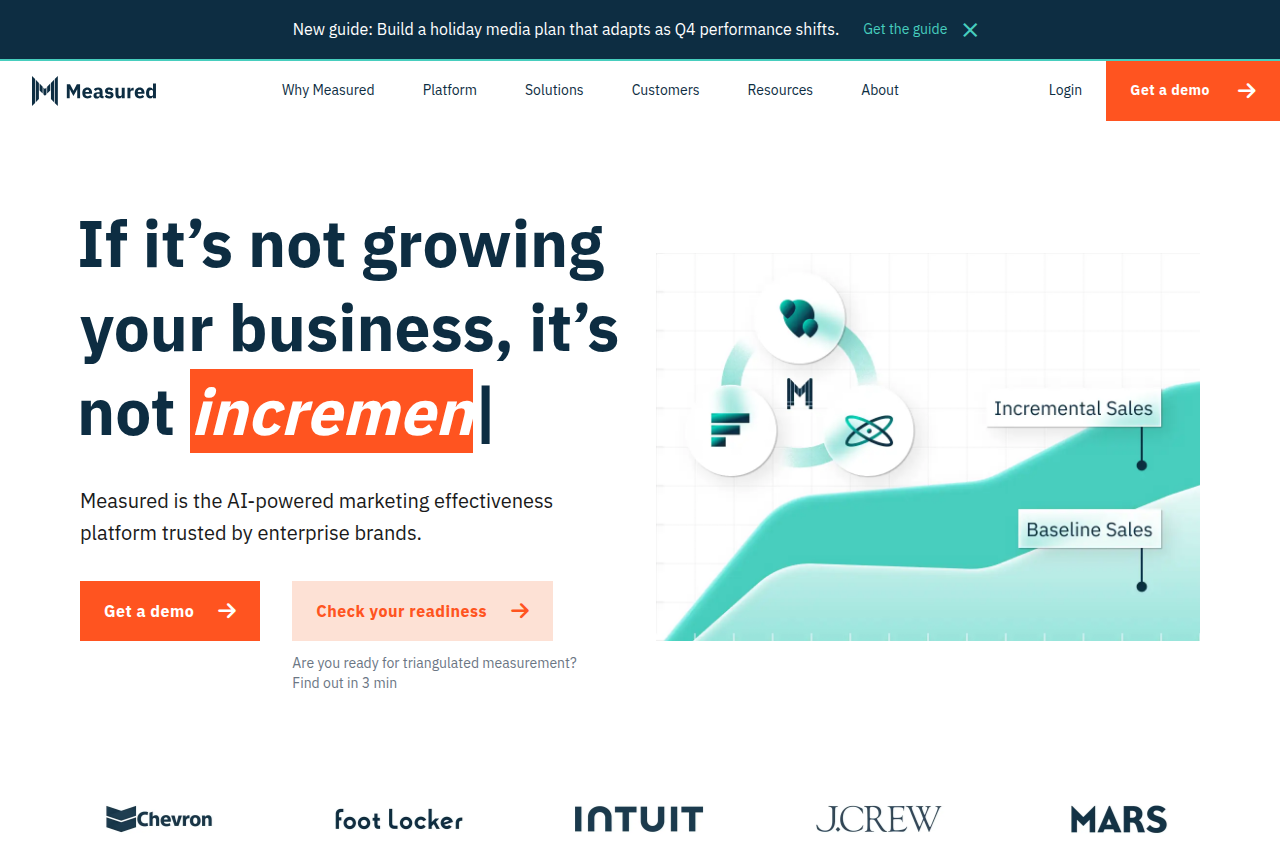
| 2. Measured | Causal media measurement | Geo experiments plus MMM | Digital plus CTV, audio, offline | Quote only, no trial | Not listed |
Triple Whale: pros and cons
What works
- Pulls Shopify, Meta, Google, TikTok, email and SMS into one real-time view of blended ROAS, CAC, LTV and profit once you enter your costs, and agencies call that profitability picture the main reason to keep it.
- Its Sonar pixel adds first-party and server-side signal, and operators at $100k a month and up say that alone, set up properly, more than covers the platform's cost.
- Runs several attribution models side by side, so the channel overlap the ad platforms hide becomes visible: one operator saw 58% of orders overlapping between Google and Meta.
- Moby, its AI layer, is included from a free plan that needs no credit card, so you can point it at your own store and judge the numbers before paying anything.
What to watch
- Pixel-based attribution routinely reports a lower ROAS than Meta, sometimes calling a profitable account unprofitable, and users repeatedly say they cannot tell which number to trust. It is a cross-check to reconcile, not a source of truth.
- The paid Foundation, Automate and Enterprise tiers are quoted after a walkthrough and scale with your store revenue, so the cost climbs as you grow and there is no public price to plan against.
- Below scale it is hard to justify: a four-year user quit calling it a waste of money under about $10 million a year, and others say Facebook's own reporting or a spreadsheet covers it under roughly $50k a month.
- Long-time users say it drifted from simple and clear to as convoluted as Google Analytics, so the breadth now carries a real learning curve.
Measured: pros and cons
What works
- Causal experiments and media mix modeling work together, so budget recommendations are checked against observed lift rather than trusted from one modeled number.
- Measures channels that may leave no useful click path, including connected television, audio, offline and upper-funnel media.
- The Media Plan Optimizer turns saturation and diminishing-return curves into channel-allocation recommendations.
- A serviced implementation gives the brand methodological support for experiment design, market selection and stakeholder adoption.
What to watch
- The vendor publishes no price, self-serve plan or free trial. Buyers start with a demo and need the full platform fee, experiment scope, onboarding work and contract terms in writing.
- Independent coverage flags a high entry barrier, so a small advertiser may not have enough spend, conversion volume or geographic spread for useful holdout tests.
- Onboarding is data-heavy. User reports describe substantial work gathering spend and outcome reports across networks before the first useful read.
- The output is modeled and experimental, so it will not reconcile to Meta, GA4 or Shopify. The vendor pages we checked do not promise to send conversions back to ad platforms.
The real differences
Same distrust, different altitude
Both tools start from the same place: the ROAS your ad platforms report is inflated, because every channel claims the same sale. Where they part is what they do about it. Triple Whale rebuilds the number at the store level, joining your Shopify data, ad accounts, email and SMS into one blended picture you read every morning. Measured throws out the reported number and runs experiments to find out which spend actually caused sales. One is an operating dashboard, the other is a measurement study. That is the whole decision, and it maps almost exactly onto how big you are and how many channels you run.
What Triple Whale is built to do
Triple Whale is the most widely used attribution and analytics app in Shopify DTC, now built around an AI layer it calls Moby. It is not a redirect or click tracker like Voluum or RedTrack. It connects the store, the ad accounts, email and SMS and turns the lot into one real-time view: blended MER and ROAS, CAC, LTV, contribution margin and profit once you enter your costs. Two things sit under that. Its Sonar pixel adds first-party and server-side signal, and operators running six figures a month say that alone, set up properly, more than covers the platform's cost. And it runs several attribution models side by side, so the channel overlap the ad platforms hide becomes visible: one operator saw 58% of orders overlapping between Google and Meta. Moby is included from a free plan that needs no card, so you can point it at your own store and judge the numbers before paying.
What Measured is built to do
Measured is a media-effectiveness platform for mid-market and enterprise brands, and it answers a harder question than any dashboard: across Meta, Google, TikTok, connected TV, affiliates, email and offline, which channels are actually causing sales and which are taking credit for sales that would have happened anyway. It does that with causal geo holdout experiments, feeds the results into a test-calibrated media mix model, then turns the model into channel-allocation guidance through its Media Plan Optimizer. Because it measures lift rather than clicks, it can value channels that leave no useful click path at all: linear and connected TV, audio, offline, upper-funnel. The implementation is serviced, so a brand gets methodological help with experiment design, market selection and getting stakeholders to trust the read.
How each one measures, and how far to trust the number
This is where the two feel least alike. Triple Whale's attribution is pixel-based, and its numbers routinely read lower than Meta's own, sometimes low enough to call a profitable account unprofitable. Users say the same thing over and over: they cannot always tell which number to trust. The honest way to run Triple Whale is as a cross-check you reconcile against platform reporting and your bank, not as a single source of truth, and long-time users add that it has grown from simple and clear to about as convoluted as Google Analytics, so the breadth now carries a real learning curve. Measured does not have that problem, because it does not claim a per-order number at all. Its output is modeled and experimental: a causal estimate of lift with confidence around it. The flip side is that it will never reconcile to Meta, GA4 or Shopify, and the vendor pages we read do not promise to send conversions back to the ad auctions. So Triple Whale gives you a number every morning that you then have to interpret; Measured gives you a slower, defensible answer you cannot act on inside an ad account.
Where scale and budget settle it
The fit question is really a spend question. Triple Whale earns its keep once multi-channel spend makes better attribution change real budget calls, and it is overkill below it: a four-year user quit calling it a waste of money under about $10 million a year, and others say Facebook's own reporting or a spreadsheet covers it below roughly $50k a month. Measured's barrier is at the same end for a different reason. Independent coverage flags a high entry point, and a smaller advertiser may not have the spend, conversion volume or geographic spread for holdout tests to read cleanly. So there is a wide middle, roughly the Shopify brand doing real but not enterprise volume, where Triple Whale is the obvious first system and Measured is premature. Above that, when the mix includes offline and connected TV and the budget in question is the media plan itself, Measured's method is the one that holds up in a boardroom.
When neither is quite the shape of your problem
Both tools measure. Neither builds the page the traffic lands on or hosts the checkout that takes the money, and for a lot of paid-traffic operators the leak is on that side of the line, not in the reporting. Two tools worth knowing sit there.
ElasticFunnels is a funnel platform for teams running paid traffic: it builds the pages, hosts the checkout with order bumps, one-click upsells, subscriptions and multi-MID routing, and keeps the click, the order, the rebill and the refund on one data layer with a CRM and attribution. Its lead feature is same-URL split testing: variants rotate server-side under one campaign link, so Meta, Google and TikTok keep their learning and a test never resets the ad's optimization by pointing traffic at a new address. It starts at $97 a month with a 14-day trial that takes no card, every feature is on every plan, and plans differ by traffic. The honest caveat is that it is newer than the analytics platforms here and there is very little independent third-party review coverage yet, which is what you would expect of a platform this recent, so until you run real volume through it you are largely weighing the vendor's own account rather than a stack of outside reports.
TrackPlay matters if the offer runs on a video sales letter, which a dashboard and a media mix model are both blind to. It is a VSL player and analytics platform that ties every second watched to who actually bought, draws retention per second split into buyers and non-buyers, and posts the cart-verified sale back to Meta, TikTok and GA4 on the play that earned it. It has a no-card free tier of 1,000 plays a month and paid plans from $29 a month. It is narrow by design, though: built for paid-traffic VSL conversion, it is not a general video host or a B2B content library and has none of the channels or webinar tooling of a Wistia, so it is the wrong tool if the video's job is content marketing rather than a direct-response sale.
What each one costs
Triple Whale. Moby, its AI layer, is free with no card, which is the honest way to try the numbers on your own store. The paid Foundation, Automate and Enterprise tiers are quoted after a walkthrough and scale with your store revenue, so there is no public price to plan against and the cost climbs as you grow.
Measured. No public price, no self-serve plan and no free trial. You start with a booked demo, and the fee is an annual contract that scales with media spend; third-party estimates put the practical floor around six figures a month in media before holdout tests have enough to work with. Get the platform fee, experiment scope, onboarding work and contract term in writing.
Because neither vendor lists a number, the only fair comparison is the written quote against the spend you actually run. A Shopify brand can be live on Triple Whale's free plan this afternoon; Measured is a procurement decision.
Prices and buying terms checked on each vendor's own pages, current as of 28 September 2026.
Our pick
Triple Whale
The most widely used attribution and analytics app in Shopify DTC, now built around an AI layer called Moby. It joins store, ads, email and SMS into one real-time view of blended ROAS, CAC, LTV and profit, and its free Moby plan lets you judge the numbers before paying. The cautions are pixel figures that read lower than Meta's and need reconciling, paid tiers quoted after a demo that scale with revenue, and a breadth that has grown as convoluted as GA4.
Frequently asked questions
Triple Whale or Measured: which should I pick?
Do Triple Whale and Measured both do attribution?
Why does Triple Whale show a lower ROAS than Facebook?
Does either one send conversions back to the ad platforms?
Which is cheaper, Triple Whale or Measured?
Sources
From Triple Whale and Measured
- https://www.triplewhale.com/
- https://www.triplewhale.com/pricing
- https://www.measured.com/
- https://www.measured.com/incrementality-testing/
- https://elasticfunnels.io/
- https://trackplay.io/
Other sources
3 discussions and reviews read for this page. Quotes are excerpts; open a link to read the original in context.
- [tw-reddit-waste] Triple Whale after four years
- [tw-reddit-roas] Triple Whale ROAS reads lower than Meta
- [tw-reddit-sonar] Triple Whale Sonar at scale
How we compared these
We do not run paid campaigns through either tool. We read each vendor's own documentation and pricing, verify every number against the source, and weigh the long-term reports of operators who run them at real spend. The full rubric is on the methodology page.