Head-to-head
Polar Analytics vs Measured
Polar Analytics and Measured both help brands distrust platform-reported ROAS, but they work at different levels. Polar joins ecommerce, advertising and lifecycle data into an operating layer, then sends selected conversions back to Meta and Google. Measured runs causal holdout tests and calibrates a media mix model so a large brand can decide which channels deserve the next budget dollar.
By Marcus Flynn, tracking and attribution editor. Updated 29 September 2026.
Pick Polar Analytics if you run an ecommerce brand and need daily profit reporting, editable dashboards and conversion signals returned to Meta and Google; pick Measured if you manage a large cross-channel media portfolio and need causal lift tests plus media mix modeling to set budgets.
Quick answer
Polar Analytics is our top pick for most people. Polar Analytics is an ecommerce data platform that joins store, advertising and lifecycle data in a dedicated warehouse, then turns it into editable profit and marketing reports. Its first-party pixel and Advertising Signals also send selected conversions to Meta and Google. The trade-offs are quote-only GMV pricing and a reporting layer that users say can feel restrictive when attribution logic becomes highly specific.
- Polar Analytics. Best for Ecommerce brands that need daily operating analytics, editable profit reporting and conversion feedback.
- Measured. Best for Enterprise brands that need causal cross-channel measurement and media planning.
Side by side
| Tool | Core job | Method | Ad feedback | Best fit | From |
|---|---|---|---|---|---|
| 1. Polar Analytics | Ecommerce BI + activation | Owned data + pixel | Meta + Google CAPI | Ecommerce brands | Not listed |
| 2. Measured | Causal lift + MMM | Geo and audience tests | Planning only | Enterprise channel mix | Not listed |
Polar Analytics: pros and cons
What works
- Joins ecommerce orders, ad spend, email and customer history in one semantic layer with editable reports for CAC, MER, LTV, cohorts, products and contribution margin.
- Every plan includes a dedicated Snowflake database, unlimited users and unlimited historical data, so the business keeps an accessible data foundation rather than only a dashboard.
- A first-party pixel and Lifetime ID improve identity, while Advertising Signals sends conversion events to Meta and Google Ads.
- Incrementality Testing is available alongside Business Intelligence, with a dedicated data scientist and lift tests across digital, television and retail outcomes.
What to watch
- The vendor publishes no dollar price. Quotes are tiered by annual gross merchandise value after a demo, which makes procurement less predictable as the store grows.
- Operators praise the visual reporting but describe a ceiling when attribution needs custom logic or business-specific nuance. Polar now offers incrementality testing, but the broader platform still leads with ecommerce data and reporting.
- Its center of gravity is ecommerce. A brand without owned order, product and customer data will use less of the warehouse, merchandising and lifecycle reporting.
- The instant demo runs on sample data, not the buyer's store. A team still needs the sales process and implementation plan before it can validate its own connectors and definitions.
Measured: pros and cons
What works
- Causal experiments and media mix modeling work together, so budget recommendations are checked against observed lift rather than trusted from one modeled number.
- Measures channels that may leave no useful click path, including connected television, audio, offline and upper-funnel media.
- The Media Plan Optimizer turns saturation and diminishing-return curves into channel-allocation recommendations.
- A serviced implementation gives the brand methodological support for experiment design, market selection and stakeholder adoption.
What to watch
- The vendor publishes no price, self-serve plan or free trial. Buyers start with a demo and need the full platform fee, experiment scope, onboarding work and contract terms in writing.
- Independent coverage flags a high entry barrier, so a small advertiser may not have enough spend, conversion volume or geographic spread for useful holdout tests.
- Onboarding is data-heavy. User reports describe substantial work gathering spend and outcome reports across networks before the first useful read.
- The output is modeled and experimental, so it will not reconcile to Meta, GA4 or Shopify. The vendor pages we checked do not promise to send conversions back to ad platforms.
The real differences
They overlap, but they are not the same kind of system
Polar Analytics and Measured now overlap on incrementality, cross-channel reporting and budget decisions. That makes the shortlist look closer than it was a few years ago. The difference is what sits at the center of each product.
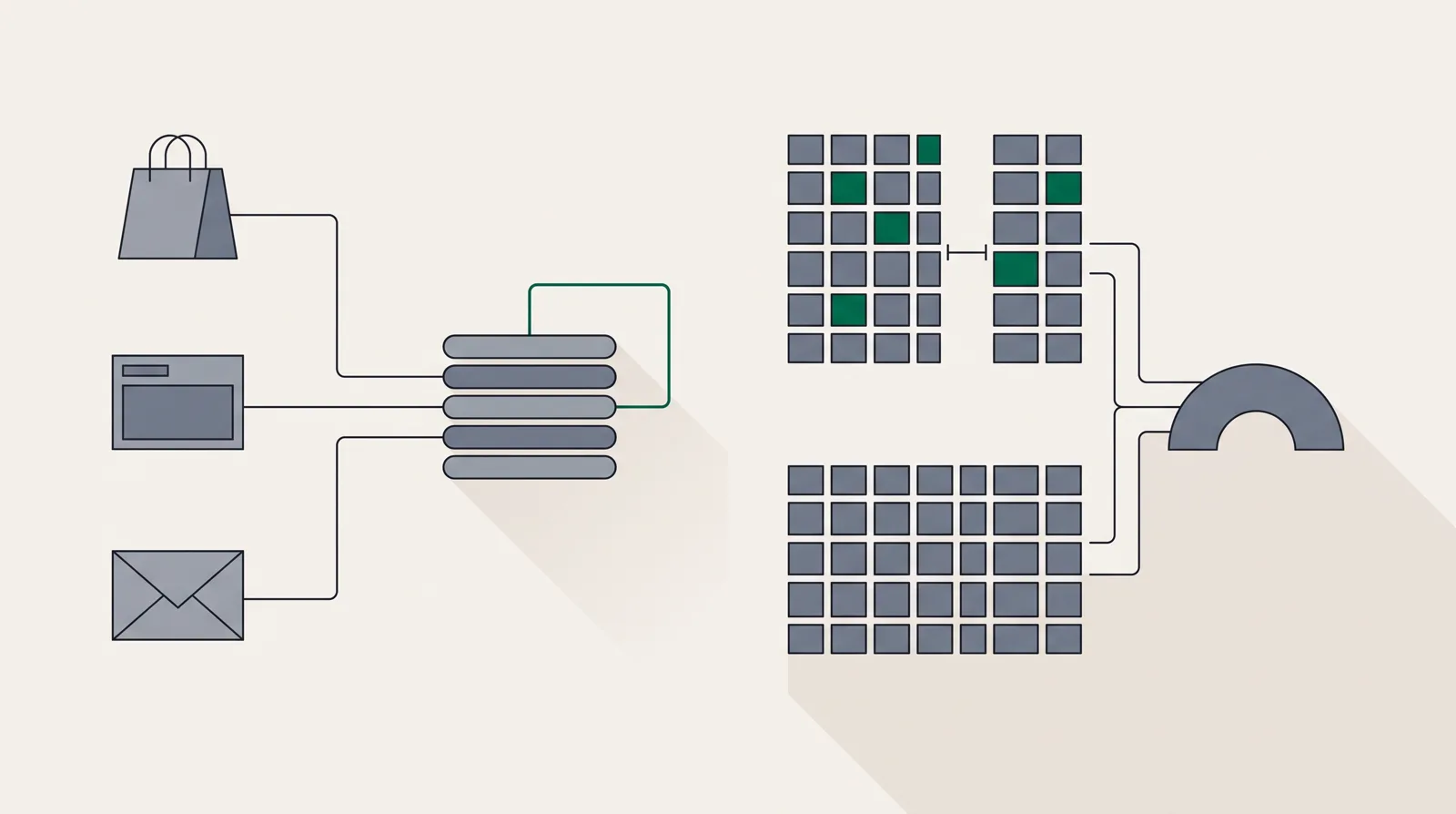
Polar is an ecommerce data platform. It connects store, advertising and lifecycle-marketing data, places the normalized records in a dedicated Snowflake database, and gives the team editable business-intelligence reports. Its first-party pixel adds customer identity, while Advertising Signals sends conversion events to Meta and Google. Incrementality testing is available as a separate product inside the Custom Plan.
Measured is a media-effectiveness platform. Causal experiments sit at the center. Geo or audience holdouts estimate the sales created by a channel, then those results calibrate a media mix model. A Media Plan Optimizer turns the model into a budget recommendation. It is built to answer a narrower but harder question: did the media cause enough extra revenue to justify the spend?
That is the first decision. Choose Polar when the main problem is getting ecommerce operations, profit and marketing data into one daily system. Choose Measured when the data is already available and the main problem is proving causal lift across a large media portfolio.
Polar is the operating layer; Measured is the causal referee
Polar starts with records the business owns. Orders, refunds, product costs, ad spend, email activity and customer history can be joined into one semantic layer. The output is useful across acquisition, merchandising, retention and finance. A media buyer can inspect CAC or MER, while an operator can look at contribution margin, cohorts, inventory or repeat purchase behavior without rebuilding the same joins in a spreadsheet.
The practical win is speed and scope. Polar can replace a patchwork of Shopify exports, ad-platform reports, Klaviyo tables and hand-maintained dashboards. Its editable reporting matters when the standard definition of a customer, refund or margin does not match the way the business runs. The dedicated warehouse also keeps the data available outside Polar.
The limit is measurement depth. User reports consistently praise the visual reporting and fast Shopify setup, then describe a ceiling when custom attribution becomes messy or business-specific. Polar has added incrementality testing, including a dedicated data scientist and lift tests across Meta, Google, TikTok and TV, but that is one product in a broader data stack.
Measured reverses the priority. Its value is not another operational dashboard. It designs controlled tests, measures the difference between exposed and held-back markets, and uses those causal reads to constrain the media mix model. This matters when last-click or multi-touch attribution keeps over-crediting branded search, retargeting or another channel that harvested demand created elsewhere.
Measured therefore earns its place when leadership needs a defensible answer across channels that do not leave a neat click trail. Connected TV, podcasts, direct mail and broad awareness spend can be measured through business outcomes rather than user-level paths. The cost is lower granularity. A channel-level lift result will not tell a buyer which landing-page section broke or which creative should be cut this afternoon.
Only Polar closes part of the ad-platform feedback loop
Polar's Advertising Signals product sends conversion events to Meta and Google Ads. Its first-party pixel and Lifetime ID give that feed more durable identity than a browser-only event. That makes Polar more useful to the team buying tomorrow's traffic. The platform can report what happened and return a cleaner signal to two major buying systems.
Measured's vendor pages describe testing, modeling, reporting and planning. They do not promise to send conversion events back into ad auctions. Its result changes the media plan through a human decision. If a holdout shows a channel is overfunded, the team moves budget. The bidding platform still optimizes on whatever event data the brand already supplies.
This is an important limit on the comparison. Measured can give stronger causal proof, yet it does not replace the event pipeline. Polar can improve the operating signal, yet an attributed conversion still does not prove that the ad caused a sale. A scaled brand may need both layers: clean first-party conversion data for daily buying and independent experiments for strategic allocation.
Channel mix and business model decide the fit
Polar is strongest when Shopify or another connected commerce source is the center of the business. It is designed for ecommerce and consumer brands that need one view across stores, ads, email, products and margins. Agencies can also use it across client reporting. The wider product has moved beyond a Shopify dashboard, but its language, connectors and metrics still assume a commerce operator who owns the order data.
Measured fits a brand with enough spend, conversion volume and geographic spread to run valid holdouts. It makes more sense when the channel mix extends beyond Meta and Google into television, audio, retail media or offline campaigns. It also assumes somebody can own the data inputs and translate an experimental result into a budget change.
The wrong purchase is easy to spot. A small store that mainly needs trusted profit reporting will pay for more method and service than it can use in Measured. A large omnichannel advertiser that needs finance to believe a causal lift claim may find Polar's dashboards useful but insufficient as the final referee. The better tool is the one that matches the decision your team is authorized to make.
Setup burden differs
Polar's setup is connector-led. The team authorizes stores and marketing platforms, installs the pixel, checks mappings and agrees on definitions for revenue, refunds, costs and customers. The vendor includes a dedicated success manager, unlimited users and unlimited historical data. Reviews repeatedly praise support and quick onboarding. The ongoing work is governance: keeping definitions, UTMs and source data clean enough for the reports to remain trusted.
Measured is serviced, but the input burden is heavier. A valid experiment needs clean spend and outcome data, matched markets, enough statistical power and agreement about the business result being measured. User reports describe substantial work gathering network reports during onboarding. Other reviewers praise the team's methodological guidance. Both can be true. The service helps with a hard implementation, but it does not remove the need for a brand-side data owner.
Ask both vendors for an implementation plan before signing. Polar should show every connector, data refresh, custom metric and activation required for the first useful dashboard. Measured should state which data sets it needs, how markets are matched, how long the first test runs, what decision it will support and how the model is checked against the experiment.
What neither product replaces in a paid-traffic stack
Neither finalist builds the pages, checkout or CRM that produce the underlying customer journey. ElasticFunnels is a funnel platform for paid-traffic teams that puts pages, same-URL split testing, custom checkout, attribution, CRM, automations and a call center on one data layer. It fits when the operating problem is the funnel itself, especially keeping split-test variants under one campaign URL and tying the click, order, rebill and refund together. It is newer than the platforms it competes with, and there is very little independent third-party review coverage to test its claims against. Until a team runs meaningful volume through it, much of the case rests on the vendor's own evidence. That thin outside proof is what you would expect from a platform this new, but the evidence gap remains; it does not change the documented scope of its page, checkout and CRM tools.
TrackPlay occupies another layer. It is a VSL player and analytics platform for paid-traffic funnels. It ties each play and watch-time pattern to the cart-verified sale, posts conversions server-side to Meta, TikTok and GA4, and decides split tests on sales under one embed. It is narrow by design. It is not a general video host or a B2B content library, so it lacks the channels, SEO pages and webinar tools buyers would expect from Wistia and is a poor fit when the video's job is content marketing. That limitation is about video distribution; inside a direct-response VSL funnel, its player, retention and sale-attribution functions still apply.
Those products are not alternative winners in this head-to-head. They show why the measurement layer should not be asked to do every job. A funnel platform creates and records the path, a VSL system measures the sales video, Polar organizes ecommerce operations and sends selected conversion signals back, and Measured tests whether broad media created incremental demand.
Who should pick each one
Pick Polar Analytics when you run an ecommerce brand and the daily problem is fragmented store, ad, email and margin data. It is the better fit when the team wants editable profit reporting, a dedicated warehouse, a first-party pixel and conversion signals returned to Meta and Google. It also gives you an instant sample-data demo before the sales call. The drawbacks are quote-only GMV pricing and a reporting layer that can still feel restrictive when attribution logic becomes highly specific.
Pick Measured when the media mix is large enough for holdout tests and the decision is strategic allocation, not daily campaign diagnosis. It is the better fit when connected TV, audio, offline or upper-funnel channels matter and leadership wants causal proof before moving a large budget. The drawbacks are a demo-led buying process, no public price or advertised self-serve trial, heavy data preparation and results that will not reconcile to platform dashboards.
For the typical OfferROAS reader who owns the ecommerce funnel and needs the measurement to improve daily operations, Polar is the more useful first system. Measured is the stronger specialist when causal proof across a broad portfolio is the buying requirement. If that requirement is not written down before the demo, both vendors can look more similar than they really are.
What each one costs
Polar Analytics. The vendor publishes no dollar amount. Its pricing page asks for annual gross merchandise value, then routes the buyer to a demo. The Core Plan bundles Business Intelligence, AI Agents and Data Activations and says it saves 20% versus buying products separately. A Custom Plan lets a buyer select Business Intelligence, Incrementality Testing, Polar MCP, Klaviyo Audiences and Advertising Signals. Every plan includes a dedicated Snowflake database, the ecommerce semantic layer, a first-party pixel, unlimited users, unlimited historical data and a dedicated success manager. An instant demo with sample data is available without signup, but it is not a trial on your own store.
Measured. The vendor also publishes no dollar amount or self-serve plan. Its current site sends buyers to a demo form and does not advertise a free trial. Ask for the platform fee, contract term, number of included experiments, channel limits, data-preparation work, onboarding services and renewal terms in writing.
This is a scope comparison before it is a price comparison. Polar prices around the commerce business and the data stack it will operate. Measured prices around a serviced causal-measurement program. If a vendor will not publish the figure, compare two written proposals against the first decision each system must improve, not against a vague promise of better attribution.
Prices and buying terms checked on each vendor's own pages, current as of 29 September 2026.
Our pick
Polar Analytics
Polar Analytics is an ecommerce data platform that joins store, advertising and lifecycle data in a dedicated warehouse, then turns it into editable profit and marketing reports. Its first-party pixel and Advertising Signals also send selected conversions to Meta and Google. The trade-offs are quote-only GMV pricing and a reporting layer that users say can feel restrictive when attribution logic becomes highly specific.
Frequently asked questions
Polar Analytics or Measured: which should I pick?
Do Polar Analytics and Measured both support incrementality testing?
Which one sends conversions back to ad platforms?
Which one covers offline and upper-funnel media better?
Does either vendor publish pricing?
Can a brand use Polar Analytics and Measured together?
Sources
From Polar Analytics and Measured
- https://www.polaranalytics.com/
- https://www.polaranalytics.com/pricing
- https://www.measured.com/
- https://www.measured.com/request-demo/
- https://elasticfunnels.io/
- https://trackplay.io/
Other sources
7 discussions and reviews read for this page. Quotes are excerpts; open a link to read the original in context.
- [polar-reporting] Triple Whale vs Polar Analytics
- [polar-customization] Triple Whale vs Polar Analytics
- [polar-gmv] Shopify analytics pricing thread
- [measured-onboarding] Measured reviews
- [measured-team] Measured platform review
- [measured-method] Measured platform coverage
- [measured-spend] Measured alternatives analysis
How we compared these
We do not run paid campaigns through either tool. We read each vendor's own documentation and pricing, verify every number against the source, and weigh the long-term reports of operators who run them at real spend. The full rubric is on the methodology page.