Head-to-head
CPV Lab Pro vs Measured
On paper both promise to tell you what your ad spend is really doing. In practice CPV Lab Pro and Measured are opposite tools at opposite budgets. One is a tracker you install on your own server that stamps every click. The other is an enterprise platform that never fires a pixel and proves each channel's lift with holdout experiments. Here is which one your traffic actually needs.
By Marcus Flynn, tracking and attribution editor. Updated 28 September 2026.
Pick CPV Lab Pro if you buy paid traffic to offers and landers you route yourself, want deterministic click-level tracking with conversion feedback to Meta, Google and TikTok on a server you own from $57 a month, and can run the box; pick Measured if you are a mid-market or enterprise brand spending six figures a month across many channels and want causal incrementality tests calibrating a media mix model, not platform ROAS, to set your budget.
Quick answer
CPV Lab Pro is our top pick for most people. For this site's reader buying paid traffic to offers and landers they route themselves, CPV Lab Pro is the pick. It is deterministic click-level tracking on a server you own, flat on events from $57 a month, and it feeds conversions back to Meta, TikTok, Google and Microsoft. The cost is that you run the box, and it will not prove the incremental lift of upper-funnel or offline media. That is Measured's job, at Measured's price.
- CPV Lab Pro. Best for Paid-traffic affiliates and media buyers who want a tracker they own and host themselves. From $57/mo.
- Measured. Best for Mid-market and enterprise brands spending six figures a month across many channels that need causal measurement, not platform ROAS.
Side by side
| Tool | Core job | Method | Feeds back? | Built for | From |
|---|---|---|---|---|---|
| CPV Lab Pro | Self‑hosted click tracking | Deterministic | CAPI to ad platforms | Paid‑traffic buyers | $57/mo |
| Measured | Causal measurement | Geo tests + MMM | None | Six-figure spenders | Not listed |
CPV Lab Pro: pros and cons
What works
- You own it. CPV Lab is self-hosted, so your click data, redirects and tracking domains live on hardware you control, not inside a cloud plan. Every tier is unlimited events and unlimited campaigns, so a winning campaign that suddenly does volume never trips an overage fee or a plan-limit wall.
- It is a real route-through tracker, not a light attribution layer. Direct-link and landing-page campaigns, multiple-path and listicle funnels, offer rotation and landing-page split testing are built in, with S2S postbacks into 300-plus preconfigured traffic sources and affiliate networks, and cookieless tracking that keeps firing on iOS and Safari. This is the media-buyer job the cloud trackers charge more for.
- Conversion API forwarding starts on the Pro plan: server-side conversions back to Meta, TikTok, Google Ads and Microsoft, with enriched signals (email, phone, custom parameters) on Expert. Cleaner signal to the ad platforms means their algorithms optimize against real conversions instead of a browser pixel that iOS keeps breaking.
- Support is the single most repeated piece of praise. G2 sits at 4.9 out of 5 across 11 reviews and Capterra at 4.9 across 17, with a 4.9 for customer service, and reviewers name specific agents who help with install and campaign setup. It undercuts the cloud incumbents on price, and a one-time lifetime licence removes the monthly fee entirely if you would rather buy than rent.
What to watch
- It is self-hosted, so you own the server as well as the tracker. A Linux VPS, PHP, MySQL, the ionCube Loader, SSL, tracking domains and cron jobs are yours to stand up and keep patched. That weighs most on a non-technical buyer or a solo operator with no server experience; a media buyer who already runs a VPS will find the install, which the vendor's onboarding call walks through, a small tax for owning the data.
- The work does not end at install. Before your first campaign tracks you still configure traffic sources, postbacks or CAPI, and custom domains, and one user reported the Google Ads API conversion import not working for them. Plan an afternoon and lean on support rather than expecting it to track the moment it is live.
- Independent proof is thin in absolute numbers. The 4.9 scores on G2 and Capterra are real but rest on 11 and 17 reviews, and a lot of the praise on the vendor's own site is testimonials it collected. Weigh it against your own 14-day trial and the 30-day money-back window, not the star count.
- The lifetime licence is capped to version 13. Pay once and you keep the version you bought and its updates within v13, but a future major version is a separate purchase and support on that one-time deal ends four major versions on. If you want the newest features indefinitely, the monthly or yearly plan, not the pay-once price, is the honest option.
Measured: pros and cons
What works
- Triangulated measurement on one platform: geo incrementality experiments calibrate the media mix model, so a budget decision is cross-checked against a real causal read rather than trusted from a single modeled number.
- Measures questions a click tracker or pixel cannot answer: causal lift by channel including upper-funnel and offline media, saturation curves that show where added spend stops paying off, and a Media Plan Optimizer that recommends where and how much to spend.
- Serviced rather than self-serve: guided onboarding, weekly model refreshes and peer benchmarks mean a lean marketing team is not left to run causal experiments alone.
- Well regarded by the enterprise brands that run it, with recognisable customers and strong review scores.
What to watch
- No public price and no free trial. The only way in is a booked demo on an annual contract that scales with media spend and channel count, so you cannot validate it on your own data before you sign.
- The practical floor is high: third-party analysis flags a high minimum spend barrier, with a working threshold around six figures of monthly media. Below that the ROI rarely covers the cost.
- Onboarding and data work are heavy and front-loaded: connecting spend and conversion data across every network is manual and slow, which weighs most on a team without dedicated data ops.
- Its numbers are modeled and experimental, so they will not match Meta, GA4 or Shopify, and it sends nothing back to the ad platforms.
The real differences
What each one actually is
These two land on the same shortlist for one reason: both promise numbers cleaner than the ad platforms report. They go about it in opposite ways, and that is the whole decision.
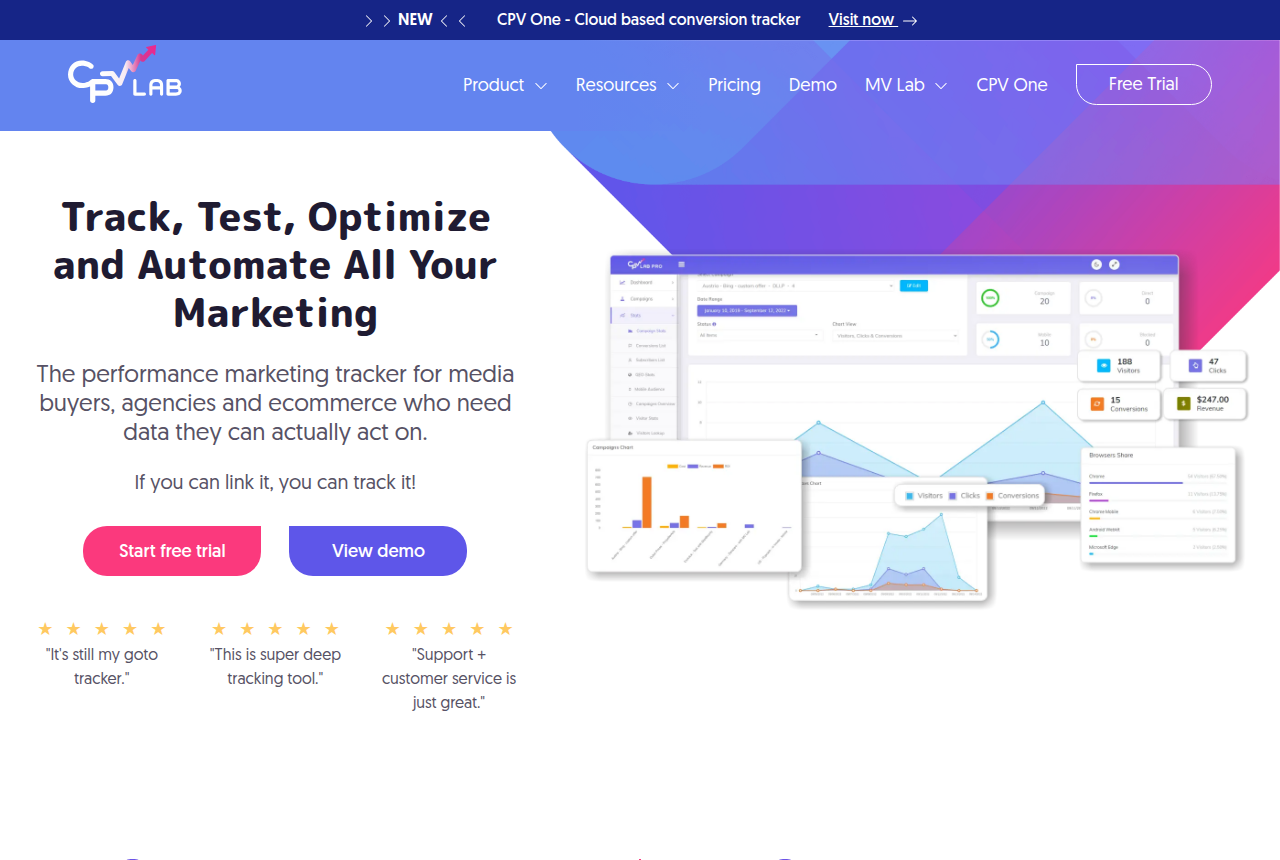
CPV Lab Pro is a self-hosted route-through click tracker. You install it on your own Linux server, point your campaign links through it, and it stamps every click, records the conversion, rotates offers and landers, split-tests, and reads results back from your networks through server-to-server postbacks. Around that sits the kit a paid-media buyer lives in: direct-link and landing-page campaigns, multiple-path and listicle funnels, bot filtering on every tier, and Conversion API forwarding to Meta, TikTok, Google and Microsoft. It is the same category as Binom and Voluum, delivered as a licence you host rather than a cloud account someone else runs. The full CPV Lab Pro review has the detail.
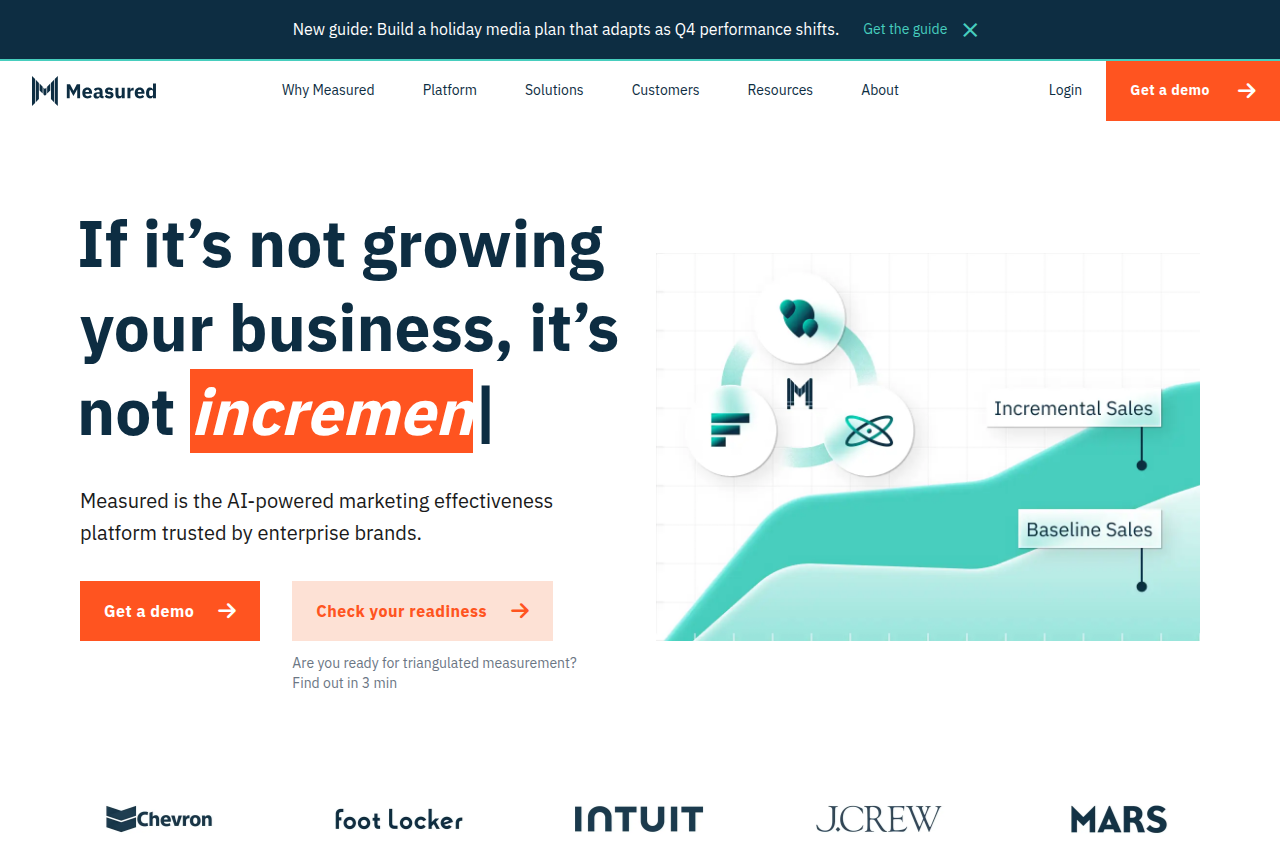
Measured is an enterprise media-effectiveness platform, and it reaches a related goal by the opposite route. It does not sit in your click path and it does not fire a pixel. It asks which channels are actually causing sales across Meta, Google, TikTok, connected TV, affiliates, email and offline, and which are taking credit for sales that would have happened anyway. It answers that with two methods on one system: geo-matched incrementality experiments with holdouts that measure a channel's true lift, and a media mix model calibrated by those experiments so the model is anchored to causal evidence rather than correlation alone. On top sit a Media Plan Optimizer, cross-channel reporting and peer benchmarks. The Measured review covers who it fits.
Deterministic click tracking versus causal experiments
This is the split under everything else. CPV Lab Pro is deterministic. It stamps a click, follows it to a conversion, and reports at the level of the specific campaign, source, placement and lander, so it can tell you which ad produced a sale and what each one truly returned against real spend. That click-level read is why a media buyer pays for it: the number follows the click, and it reconciles with your network. What it does not do is prove causation. A click tracker credits the touch it can see; it cannot tell you whether the sale would have happened without that channel.
Measured never follows a click. It runs a real experiment: hold a channel out in matched geographies, watch what happens to sales, and read the difference as that channel's true lift. Those lift results then calibrate a media mix model that explains total revenue as a function of spend over time. That is a different kind of proof. It can value connected TV, podcasts, direct mail and upper-funnel prospecting, the channels a click tracker structurally cannot see, because turning a channel off and measuring the drop does not depend on a click at all. The cost is granularity. A geo test tells you a channel drove incremental sales; it does not tell you which specific ad closed a named buyer. For that, CPV Lab Pro gives the cleaner answer.
Neither method is better in the abstract. Click-level tracking is right when you route paid traffic yourself and need to price each source, offer and creative. Causal experiments plus a calibrated model are right when your core question is how to split the next budget dollar across many channels, including offline and upper-funnel, and you want that answer proven by a holdout rather than inferred from a click.
Your own server versus a serviced platform
Before either tool's method matters, there is a plainer split: who runs it. CPV Lab Pro is software you host. Its docs require a Linux VPS with PHP, MySQL or MariaDB, the ionCube Loader and SSL, plus tracking domains and the upkeep that comes with them. The vendor runs an onboarding call to get your first campaign tracking, but from there the box is yours. The payoff is control and a fixed bill: your click and conversion data lives on your own server, every tier is unlimited on events, and a winning campaign that suddenly does volume never trips an overage fee. If running a server is the part you want to avoid, CPV Lab Pro has a cloud sibling, CPV One, that is the same tracking managed for you. The same self-hosted trade against an incrementality platform plays out in Binom vs Measured.
Measured is the opposite in every dimension. It is fully serviced, there is nothing to host, and you never touch a server. Guided onboarding, weekly model refreshes, help winning internal buy-in and peer benchmarks are part of what you pay for, because running causal experiments alone is beyond most lean marketing teams. That hand-holding is real value at enterprise scale, and it is priced accordingly. The two sit at opposite ends of the same axis: CPV Lab Pro asks you to run everything for a flat fee, and Measured runs everything for you on an annual contract you cannot see the price of until you book a demo.
The feedback loop: what each can send back
Here the tools stop mirroring each other. CPV Lab Pro forwards conversions server-side to Meta, TikTok, Google Ads and Microsoft through their Conversion APIs, starting on its Pro plan, with enriched signals like email and phone on Expert, so the ad platforms optimise against real conversions instead of a browser pixel iOS keeps breaking. One user did report the Google Ads API conversion import failing for them, so budget time to configure it and lean on support rather than expecting it to work untouched. That feedback loop is central to how a paid-media buyer runs, and CPV Lab Pro is built for it.
Measured feeds nothing back at all. It is a measurement and planning layer, not a conversion-API pipe, and it sends no conversions to the ad platforms. Its counterweight is reach: because it proves lift by experiment rather than by click, it sees the parts of the funnel neither a pixel nor a click tracker can reach, and its Media Plan Optimizer turns those reads into a spend recommendation. So CPV Lab Pro gives you click-level depth and a live feedback loop on traffic you route yourself; Measured gives you a causal, cross-channel view of where the next budget dollar should go, with nothing wired back to the platforms. If closing that loop matters to you, that alone separates them.
Why your numbers will not match Meta or Shopify
Both tools disagree with your ad platforms, and they disagree in opposite ways. CPV Lab Pro is deterministic, so its counts should sit close to your ad accounts and your networks once tracking is clean, with the differences down to how it stamps and de-duplicates clicks. Measured runs the other way: an experiment and a mix model produce estimates and confidence intervals, not deterministic user counts, so they will not reconcile with Meta, GA4 or Shopify, and they will usually strip credit off channels that self-report generously. That independent read is the whole point of buying Measured. Treat whichever you choose as a decision layer, reconciled against backend revenue, and keep your attribution windows consistent when you compare.
Who each one is for
CPV Lab Pro is for the media buyer or affiliate pushing paid traffic to offers and landers they route, who wants deterministic click tracking, conversion feedback to the ad platforms, and data on a box they own, at a flat price or a one-time licence. Below meaningful volume it is more machinery than the job needs, and if you will not run a server the cloud sibling, not the self-hosted plan, is the honest pick. See the alternatives to CPV Lab Pro if the server is the sticking point, or CPV Lab Pro vs Fospha for the same tracker against a modeled measurement platform.
Measured is the fit when you spend at least six figures a month across several channels, run media a click tracker cannot see such as connected TV or upper-funnel prospecting, and have finance challenging marketing's numbers, because a test-calibrated model is exactly what settles that argument. It is the wrong tool for a buyer routing paid clicks to offers they run, and its floor and heavy onboarding rule it out below serious spend. One caveat covers both. Below roughly $50,000 to $100,000 a month of spend, clean UTMs, server-side events and blended metrics like MER and new-customer CAC do most of the job for far less, and neither tool fixes a weak offer, a broken pixel setup or a low conversion rate. They make the numbers clearer. They do not make the funnel better. For the full field, see the best ad tracking and attribution software.
What each one costs
CPV Lab Pro is flat on events and does not move with your traffic. Three tiers, each unlimited on events with no overage: Starter at $57 a month, Pro at $97 (where the Conversion API forwarding to Meta, TikTok, Google and Microsoft begins), and Expert at $187 (adding enriched CAPI signals). Billed yearly the same tiers drop to $48, $81 and $156 a month. You can also buy any plan once as a lifetime licence, a single payment of $1,157 to $3,757, though that price is capped to version 13. A 14-day trial runs with no card, and there is a 30-day money-back window. On top of any plan you carry the Linux server you host it on.
Measured does not publish a price and does not offer a free trial. G2 records that the company has not provided pricing information, so you book a demo and get a quote. Contracts are annual and scale with your media spend and the number of channels you measure, and third-party analysis flags a high minimum spend barrier, with a working floor around six figures of monthly media. Those spend figures are third-party estimates, not the vendor's, so treat them as directional.
These two prices do not compare on a line. CPV Lab Pro is a fixed, published fee on a box you own, and you can start this week. Measured is a committed annual platform for a brand already spending enough that mis-allocated budget is expensive. The question is which describes your business, not which number is lower. Below serious spend, fix the free tracking basics first.
Prices read from each vendor's own pricing page, current as of 28 September 2026.
Our pick
CPV Lab Pro
For this site's reader buying paid traffic to offers and landers they route themselves, CPV Lab Pro is the pick. It is deterministic click-level tracking on a server you own, flat on events from $57 a month, and it feeds conversions back to Meta, TikTok, Google and Microsoft. The cost is that you run the box, and it will not prove the incremental lift of upper-funnel or offline media. That is Measured's job, at Measured's price.
Frequently asked questions
CPV Lab Pro or Measured: which should I pick?
Do CPV Lab Pro and Measured even compete?
Do I need to run a server for either one?
Which one sends conversions back to Meta and Google?
Is CPV Lab Pro or Measured cheaper?
Sources
From CPV Lab Pro and Measured
Other sources
5 discussions and reviews read for this page. Quotes are excerpts; open a link to read the original in context.
- [measured-adex] Measured's Revamped Platform Blends Automation, Incrementality And MMM
- [measured-pricing] Measured Media Mix Modeling & Incrementality Pricing
- [measured-spend] 9 Best Measured Alternatives & Competitors for Incrementality Testing in 2026
- [cpv-reddit-affm] Affiliate marketer on CPV Lab
- [cpv-reddit-gads] Google Ads user on CPV Lab conversion import
How we compared these
We do not run paid campaigns through either tool. We read each vendor's own documentation and pricing, verify every number against the source, and weigh the long-term reports of operators who run them at real spend. The full rubric is on the methodology page.